China's Type 055 large Guided-Missile Destroyer Anqing (Hull 110) has successfully completed its first live-fire training exercises at a designated East China Sea area, demonstrating its operational readiness and combat capacities.
The destroyer was recently commissioned into the navy of the Chinese People's Liberation Army (PLA) Eastern Theater Command and carried out the training at sea with several other types of vessels.
During the initial round of live-fire training, the projectiles showed some deviation. Wang Fulin, the operator of the main gun on the bow and a veteran who previously served aboard China's Type 052C and Type 052D guided-missile destroyers, remained calm under pressure before corrections were made to achieve accurate hitting of all targets.
"At the beginning, the first two projectiles showed some deviation. But we had already had a plan in advance for a situation like this. So we made corrections immediately, and all subsequent shots hit the target precisely, meeting our training expectations," he said.
With the experience on three types of destroyers, the Type 052C, Type 052D and Type 055, Wang has personally witnessed the rapid leapfrog development of China's guided-missile warships, characterized by larger gun calibers and enhanced firepower.
He said that while the advancement in equipment brings greater firepower advantage, it also imposes stricter tests on the psychological quality and operational skills of the gun operators.
"After comparing these three types of destroyers, my impression is that the equipment on board is becoming increasingly advanced. Operating such advanced equipment gives us greater confidence in winning battles and a firmer determination to defeat any powerful enemies," Wang said.
Equipped with advanced early warning and detection systems, the officers and soldiers aboard Destroyer Anqing are also actively conducting early warning and detection training in complex electromagnetic environments, using real maritime and aerial targets.
"We conduct early warning and detection training based on the situation of existing maritime and air targets to detect objects at an early and distant stage, in efforts to enhance the troops' skills and capabilities on active duty, and achieve the integration of personnel and equipment as soon as possible," said Li Chongxiao, a crew member of Destroyer Anqing.
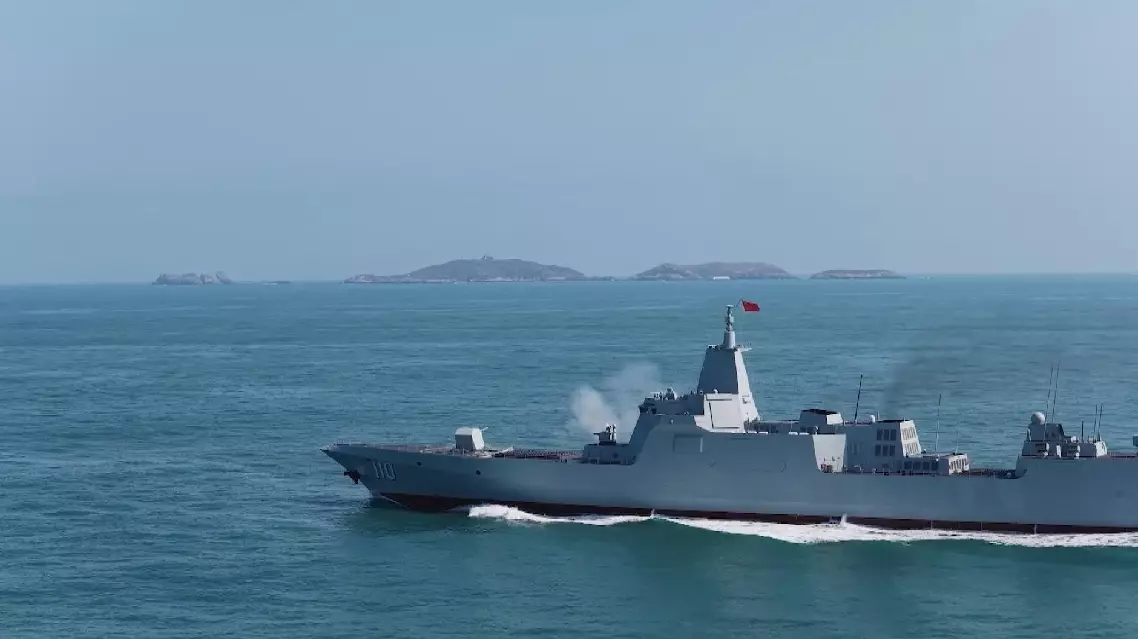
China's Type 055 Destroyer Anqing conducts first live-fire training at sea

Chinese Foreign Minister Wang Yi said on Tuesday that mediation efforts of the Pakistani side regarding the Middle East tensions are in the common interests of all parties.
Wang, also a member of the Political Bureau of the Communist Party of China Central Committee, made the remarks in his talks with Pakistani Deputy Prime Minister and Foreign Minister Mohammad Ishaq Dar in Beijing.
During their talks, the two sides exchanged views on current international issues and regional conflicts.
Wang welcomed the visit of the Pakistani side to Beijing for discussion on easing tensions in the Middle East, just after its holding of a quadrilateral foreign ministers' meeting in Islamabad.
He said China supports and looks forward to Pakistan playing a unique and important role in easing the situation and resuming peace talks. This process is no easy task, and Pakistan's mediation efforts are in line with the common interests of all parties, Wang added.
He noted China is willing to make joint efforts with Pakistan to end the hostilities as soon as possible, create opportunities for peace and open the window for peace talks.
On bilateral ties, Wang said this year marks the 75th anniversary of the establishment of diplomatic relations between China and Pakistan, calling on both sides to implement the important consensus reached by the leaders of the two countries and constantly advance the building of a China-Pakistan community with a shared future.
For his part, Dar said the Pakistan-China friendship is precious and deeply rooted in people's hearts, adding that Pakistan is willing to work with China to promote the continuous development of the all-weather strategic cooperative partnership between the two countries.
Dar thanked China for supporting Pakistan's mediation of the situation in Iran, adding that the current conflict has disrupted international energy supplies and caused heavy damage to developing countries.
Noting that solutions can only be found through negotiation, Dar said Pakistan is willing to strengthen communication and coordination with China to push all parties to start peace talks as soon as possible and restore regional peace.
The two sides also put forward a five-point initiative for restoring peace and stability in the Gulf and the Middle East region:
I. Immediate cessation of hostilities: China and Pakistan call for immediate cessation of hostilities and utmost efforts to prevent the conflict from spreading. Humanitarian assistance must be allowed to all war-affected areas.
II. Start of peace talks as soon as possible. Sovereignty, territorial integrity, national independence and security of Iran and the Gulf states should be safeguarded. Dialogue and diplomacy is the only viable option to resolve conflicts. China and Pakistan support the relevant parties in initiating talks, with all parties committing to peaceful resolution of disputes, and refraining from the use or the threat of use of force during peace talks.
III. Security of nonmilitary targets. The principle of protecting civilians in military conflict should be observed. China and Pakistan call on parties to the conflict to immediately stop attacks on civilians and nonmilitary targets, and fully adhere to International Humanitarian Law, and stop attacking important infrastructure, including energy, desalination and power facilities, and peaceful nuclear infrastructure, such as nuclear power plants.
IV. Security of shipping lanes. The Strait of Hormuz, together with its adjacent waters, is an important global shipping route for goods and energy. China and Pakistan call on the parties to protect the security of ships and crew members stranded in the Strait of Hormuz, allow the early and safe passage of civilian and commercial ships, and restore normal passage through the Strait as soon as possible.
V. Primacy of the United Nations Charter. China and Pakistan call for efforts to practice true multilateralism, to jointly strengthen the primacy of the United Nations, and to support the conclusion of an agreement for establishing a comprehensive peace framework and realizing lasting peace based on the purposes and principles of the UN Charter and international law.
Pakistan's mediation efforts in common interests of all parties: Chinese FM