SAN FRANCISCO--(BUSINESS WIRE)--Apr 2, 2026--
Epia Neuro, a brain computer interface company developing intent-driven systems to restore independence for people living with neurological conditions, today announced its official launch. The company is advancing a proprietary neural interface platform designed to translate brain signals into actionable digital commands, enabling rehabilitation and assistive therapies for stroke survivors and individuals with cognitive decline.
This press release features multimedia. View the full release here: https://www.businesswire.com/news/home/20260402282679/en/
Epia Neuro’s lead product is designed as a dual-phase stroke therapy that supports both post-stroke recovery and long-term assistive living after rehabilitation. The platform combines a minimally invasive, long-lifetime “read/write” brain-computer interface (BCI) with assistive devices and AI-driven support to help stroke survivors translate neural intent into functional movement and daily independence.
Epia Neuro is advancing towards first-in-human system demos this year, at the Department of Neurosurgery at Lenox Hill Hospital in New York.
“Epia Neuro was founded to restore meaningful function, provide real independence and ultimately provide the support individuals need to be fully present in their lives,” said Michel Maharbiz, Ph.D., Chief Executive Officer, Epia Neuro. “Over the past five years, our team has been building our first product: a system that interprets neural intent in real time and translates it into rehabilitation therapies and practical, everyday assistance. We’re starting with stroke and plan to rapidly expand into additional neurological conditions.”
“Restoring function after neurological injury requires not just decoding signals, but translating them into meaningful, real-world actions for individuals post stroke,” said David J. Lin, M.D., a critical care neurologist, neurorehabilitation specialist, and Director of Massachusetts General Hospital's Neurorecovery Clinic. “What is compelling about Epia Neuro’s approach is its focus on real-time interpretation of neural intent and its potential to deliver practical, day-to-day independence, starting with a focus on people with stroke where the unmet need is enormous.”
At the core of Epia Neuro’s technology is a proprietary implantable interface engineered for surgical scalability and long-term durability. The device can be implanted within the skull in under an hour without piercing the dura, enabling a procedure and a clinical workflow designed from scratch for broad neurosurgical adoption. The implanted system is completely discreet and externally invisible, charged through a non-invasive headset, and designed for long lifetime use with the ability to be replaced or upgraded.
For stroke survivors, Epia Neuro’s device is training its neural interface to interpret user intent. Neural signals are fused with contextual data from external sensors to predict and drive assistive actions, including control of an upper-limb grip-assist motor prosthetic designed to be accessible, simple, and replaceable.
Unlike conventional read-only neural interfaces, the Epia Neuro platform supports both sensing and stimulation, both at the cortex and deep in the brain, enabling compatibility with cortical stimulation and deep brain stimulation approaches where clinically appropriate.
Stroke is a leading cause of long-term disability in the United States, with approximately 690,000 new stroke survivors each year. Of these, an estimated 60,000 stroke survivors annually could be eligible for Epia’s products, representing a U.S. market opportunity potentially in excess of USD 5 billion, dependent on pricing assumptions.
Epia Neuro is initially focused on stroke-related motor impairment, where clinical validation can be achieved efficiently while addressing a significant existing need. Beyond stroke, the company plans to expand their footprint to address cognitive decline and other neurological disorders, focusing on long-term solutions for the growing aging population.
Epia Neuro is led by a multidisciplinary executive team and world-class advisors with expertise spanning neuroscience, engineering, finance, and company building:
The company is supported by a distinguished group of advisors and key opinion leaders from leading academic and clinical institutions, including Mark Richardson, M.D., Ph.D. (Massachusetts General Hospital); Netanel Ben-Shalom, M.D. (Lenox Hill Hospital); Joshua Aronson, M.D. (Beth Israel Deaconess Medical Center / Harvard); Bernardo Sabatini, M.D., Ph.D. (Harvard Medical School / HHMI); Jan M. Rabaey, Ph.D. (University of California, Berkeley); David J. Lin, M.D. (Massachusetts General Hospital / Harvard Medical School); and Mark Slutsky, M.D. (Northwestern University and President of the Brain Computer Interface Society).
About Epia Neuro
Epia Neuro is a neural technology company developing intent‑driven systems designed to restore function and independence for people living with neurological conditions. The company advances work originally developed by iota Biosciences, which was founded in 2017 to pioneer cutting‑edge bioelectronic technologies and is now powered by Astellas. Epia Neuro’s platform integrates implantable neural interfaces, adaptive algorithms, and assistive devices to translate neural intent into real‑world action. The company’s initial focus is stroke-related motor impairment, with expansion in cognitive decline and other neurological disorders, focusing on long-term solutions for the growing aging population. For more information, visit www.epianeuro.com.

Epia Neuro Launches to Develop Intent-Driven Neural Technology to Restore Function After Stroke and Address Cognitive Decline

Epia Neuro Launches to Develop Intent-Driven Neural Technology to Restore Function After Stroke and Address Cognitive Decline
LONDON (AP) — U.S. President Donald Trump and his Defense Secretary Pete Hegseth have been damning of the U.K.'s naval capabilities. Their jibes may have stung in a country with a long and proud maritime history, but they do carry some substance.
The U.K. has been at the forefront of Trump’s ire since the onset of the Iran war on Feb. 28, when British Prime Minister Keir Starmer refused to grant the U.S. military access to British bases.
Though that decision has been partly reversed with the decision to permit the U.S. to use the bases, including that of Diego Garcia in the Indian Ocean, for so-called defensive purposes, Trump is adamant he was let down. He has repeatedly lashed out at Starmer and branded the Royal Navy’s two aircraft carriers as “toys.”
“You don’t even have a navy,” he told Britain's Daily Telegraph in comments published Wednesday. "You’re too old and had aircraft carriers that didn’t work.”
Hegseth, meanwhile, said sarcastically that the “big, bad Royal Navy” should get involved in making the Strait of Hormuz safe for commercial shipping.
For numerous reasons, the Royal Navy is not as big and bad as it used it to be when Britannia ruled the waves. But it's not as feeble as Trump and Hegseth imply and is largely similar with the French navy, which it is often compared with.
“On the negative side, there is a grain of truth, with the Royal Navy being smaller than it has been in hundreds of years,” said professor Kevin Rowlands, editor of the Royal United Services Institute Journal. “On the positive side, the Royal Navy would say that it’s entering its first period of growth since World War II, with more ships set to be built than in decades.”
It’s not that long ago that Britain could muster a task force of 127 ships, including two aircraft carriers, to sail to the south Atlantic after Argentina’s invasion of the Falkland Islands. That 1982 campaign, which then-U.S. President Ronald Reagan was lukewarm about, marked the final hurrah of Britain’s naval pedigree.
Nothing on that scale, or even remotely, could be accomplished now. Since World War II, Britain’s combat-ready fleet has declined substantially, much of it linked to changing military and technological advances and the end of empire. But not all.
The number of vessels in the Royal Navy fleet, including aircraft carriers, destroyers frigates and submarines has fallen from 166 in 1975 to 66 in 2025, according to The Associated Press' analysis of figures from the Ministry of Defense and the House of Commons Library.
Though the Royal Navy has two aircraft carriers at its command, there was a seven-year period in the 2010s when it had none. And the number of destroyers has halved to six while the frigate fleet has been slashed from 60 to just 11.
The Royal Navy faced criticism for the time it took to send the HMS Dragon destroyer to the Middle East after the war with Iran broke out. Though naval officials worked night and day to get it shipshape for a different mission than the one it was readying for, to many it symbolized the extent to which Britain’s military has been gutted since the fall of the Berlin Wall in 1989.
For much of the Cold War, Britain was spending between 4% and 8% of its annual national income on its military. After the Cold War, that proportion steadily dropped to a low of 1.9% of GDP in 2018, fuel to Trump's fire.
Like other countries, Britain, largely under the Labour governments of Tony Blair and Gordon Brown, sought to use the so-called “peace dividend” following the collapse of the Soviet Union to divert money earmarked for defense to other priorities, such as health and education.
And the austerity measures imposed by the Conservative-led government in the wake of the global financial crisis of 2008-9 prevented any pickup in defense spending despite the clear signs of a resurgent Russia, especially after its annexation of Crimea and parts of eastern Ukraine.
In the wake of Russia's full-blown invasion of Ukraine in 2022, and with another Middle East war underway, there's a growing understanding across the political divide that the cuts have gone too far.
Following the Ukraine invasion, the Conservatives started to turn the military spending tide around. Since the Labour Party returned to power in 2024, Starmer is seeking to ramp up British defense spending, partly at the cost of cutting the country's long-vaunted aid spending.
Starmer has promised to raise U.K. defense spending to 2.5% of gross domestic product by 2027, and the updated goal is now for it to rise to 3.5% of GDP by 2035, as part of a NATO agreement pushed by Trump. That, in plain terms, will mean tens of billions pounds more being spent — a lot more kit for the armed forces.
The pressure is on for the government to speed that schedule up. But with the public finances further imperilled by the economic consequences of the Iran war, it's not clear where any additional money will come.
The jibes will likely keep coming even though the critiques are unfair and far from the truth, said RUSI's Rowlands, who was a captain in the Royal Navy.
“We are dealing with an administration that doesn’t do nuance," he said.
This story has been corrected to show there were 166 vessels in 1975, not 466.

An artillery piece from the 1982 Falklands War between Argentina and Britain lies on Mount Longdon on the Falkland Islands, also known as Islas Malvinas, Monday, March 16, 2026. (AP Photo/Ricardo Mazalan)

FILE - The Royal Navy aircraft carrier HMS Prince of Wales is pictured before its port call in Tokyo, Thursday, Aug. 28, 2025. (AP Photo/Eugene Hoshiko, File)

FILE - Britain's Prime Minister Keir Starmer speaks to Royal Marines onboard the HMS ST Albans in Oslo, during his visit to Norway on Friday, May 9, 2025.(AP Photo/Alastair Grant, Pool, File)

FILE - Indonesian soldiers stand guard as Royal Navy offshore patrol vessel HMS Spey is docked at Tanjung Priok Port during a port visit in Jakarta, Indonesia, Wednesday, Jan. 15, 2025. (AP Photo/Tatan Syuflana, File)
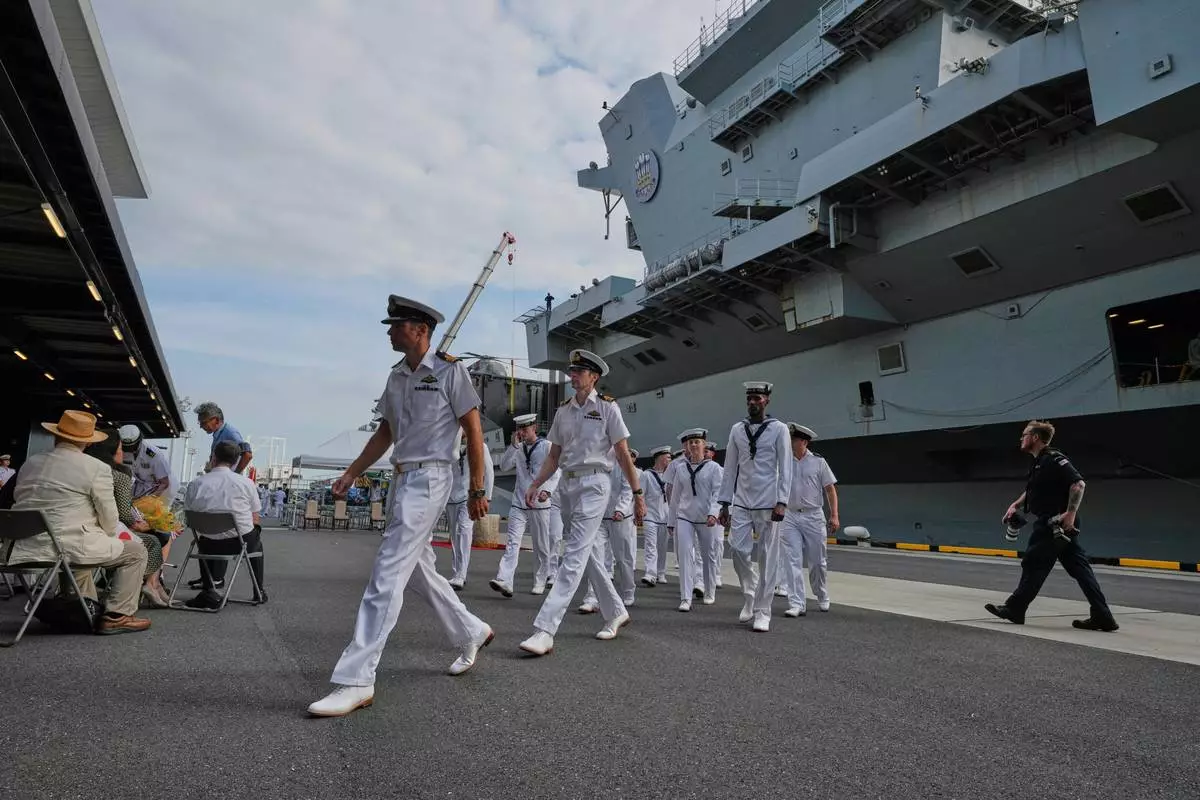
FILE - Crews walk near the Royal Navy aircraft carrier HMS Prince of Wales before its port call in Tokyo Thursday, Aug. 28, 2025. (AP Photo/Eugene Hoshiko, File)