NEW YORK (AP) — After Pam Bondi became U.S. attorney general last year, conservative influencers, online sleuths and others who wanted the government to disclose all it knew about Jeffrey Epstein thought they might have a champion in the Department of Justice.
So did Jess Michaels, one of the legions of women who have said they were sexually assaulted by the late financier and convicted sex offender with a roster of powerful friends in business, politics and beyond.
“I thought, ‘Well, maybe a woman stepping into this role will finally, finally get the truth,’” Michaels recalled Thursday, after President Donald Trump announced Bondi was out of the nation's top law enforcement job.
“She had this opportunity to be a hero and to really do right by survivors of sexual violence and trafficking,” Michaels said, "and she chose not to.”
The furor over the “Epstein files,” as the trove of investigative records came to be known, wasn't the only controversy of Bondi's tenure. But the arc — first raising expectations for a big reveal, then declaring there was nothing to see, and ultimately a forced, flawed document dump — was a stubbornly problematic storyline that ran through her time as attorney general.
Bondi rejected criticism of her handling of the matter, and Trump on Thursday praised her as “a Great American Patriot and a loyal friend.”
Michaels and other Epstein victims watched it all with shaken trust that Bondi's departure alone won't likely rebuild.
“This is not about a single person,” accuser Annie Farmer said Thursday. “It is about a government and judicial system that has repeatedly failed Epstein survivors.”
Here's a glance at Bondi's part in the Epstein saga:
Freshly confirmed as attorney general for a president who had suggested on the campaign trail that he'd open more government documents on Epstein, Bondi whetted appetites by declaring on Fox News that “you’re going to see some Epstein information released.” And when a host asked about "releasing “the list of Jeffrey Epstein’s clients” — a long-rumored, never-seen sex trafficking roster — she replied that it was “sitting on my desk right now.”
A day later, conservative commentators and content creators were brought to the White House to get DOJ binders emblazoned with “The Epstein Files: Phase 1” and “Declassified.”
The attempt to showcase transparency soon backfired, once it emerged that the contents largely were already public. Bondi demanded that the FBI give her “the full and complete Epstein files,” and she later said that she'd unearthed a "truckload” of previously withheld material and that “everything is going to come out to the public.”
After months of anticipation, the Justice Department said it wouldn't release any more Epstein material. A court had sealed much of it to protect victims, and “only a fraction” would have come out if Epstein had gone to trial, the agency said in an unsigned memo. It added that authorities hadn't found evidence that merited new charges or investigations and that “perpetuating unfounded theories about Epstein” wouldn't help victims get justice.
And, it said, there was no “client list.” As for Bondi's prior comment that it was on her desk, officials said she had meant the overall case file.
Conservative influencers, among others, blasted the turnabout and questioned Bondi’s capability. But Trump stood by her, scolding a journalist for attempting to ask her a question about Epstein at a White House Cabinet meeting.
Trump had himself raised questions for some years after Epstein's 2019 death in jail as the financier faced federal sex trafficking charges. After the Justice Department memo, however, the president suggested there was nothing more to say about Epstein and the country, including his own supporters, should simply move on.
Amid a drumbeat of disclosures that begin to exact consequences for some powerful people — particularly Andrew Mountbatten-Windsor, Britain's former Prince Andrew — Congress passed legislation to force the Justice Department to disclose its investigative files on Epstein. Trump signed it into law, casting the quest for Epstein information as a Democratic-led distraction from the Republican agenda.
Meanwhile, at his urging, Bondi announced that the U.S. attorney in Manhattan would investigate Epstein’s ties to some of the Republican president’s political foes, including Democratic former President Bill Clinton. None has been accused of misconduct by Epstein’s accusers; nor has Trump, another former Epstein friend. Both Clinton and Trump have said they knew nothing about Epstein's misconduct and cut ties with him many years ago.
At the statutory deadline for making the Epstein files public, the Justice Department released only some of them. While the records included some material the public hadn't previously seen, including some candid photos of Clinton, the documents didn't break major ground and included little about Trump.
The department said it was continuing to review other Epstein records to make sure that victims were protected.
But Democrats cried cover-up, bill sponsor Rep. Thomas Massie, R-Ky., accused the Justice Department of breaking the law by missing the deadline and redacting too much, and some Epstein accusers also questioned the extensive redactions.
The Justice Department began releasing a huge cache of additional Epstein documents, videos and photos, though others remained under wraps.
The records pulled back a curtain on favor-trading and frank communications in a chummy elite that looked past Epstein's 2008 guilty plea to solicitating prostitution from an underage girl in Florida. Some high-flying Epstein friends resigned or lost jobs in corporate America, academia, big law firms, the British, Slovakian and Norwegian governments and beyond.
But the documents disclosed highly personal information about some victims while redacting the names of Epstein correspondents in, for example, emails that appeared to refer to the sexual abuse of underage girls.
Gloria Allred, an attorney for numerous Epstein victims, said Thursday that Bondi betrayed them by failing to protect personal information in the files.
“She has destroyed the trust in the DOJ that victims had a right to expect, and her termination may be the only type of justice that survivors will receive from the DOJ,” Allred said by email.
At a congressional hearing, a combative Bondi tried to quell the Epstein files controversy. She defended how the Justice Department dealt with it, lobbed personal insults at Democrats and lauded Trump over, among other things, the performance of the stock market.
Bondi said she was deeply sorry for what Epstein victims suffered. But she declined a request from Rep. Pramila Jayapal, D-Wash., to face and apologize to them for the Justice Department's actions, and Bondi dismissed Massie’s critiques of the release of victims’ personal information.
The House Committee on Oversight and Government Reform subpoenaed Bondi to answer questions on April 14 about the Justice Department’s handling of the Epstein investigation and file release. With five Republicans joining Democrats to support the subpoena, it reflected widespread discontent, including in the GOP base, over Bondi’s management of the matter.
For now, Deputy Attorney General Todd Blanche will be the acting attorney general.
Michaels, who traveled to the Capitol last year to press for the files’ release, wanted Bondi gone. But will Blanche do better?
"We can only hope. But given that they worked together, I don’t have great expectations,” she said.
The Associated Press generally does not identify people who say they have been sexually assaulted unless they come forward publicly, as Michaels has done.
Robert Glassman, an attorney for a woman who testified as “Jane” in the 2021 criminal trial of Epstein confidante Ghislaine Maxwell, noted that agency leaders come and go.
“For victims of sexual abuse, what matters is whether the institutions meant to protect them actually do their job,” he said.
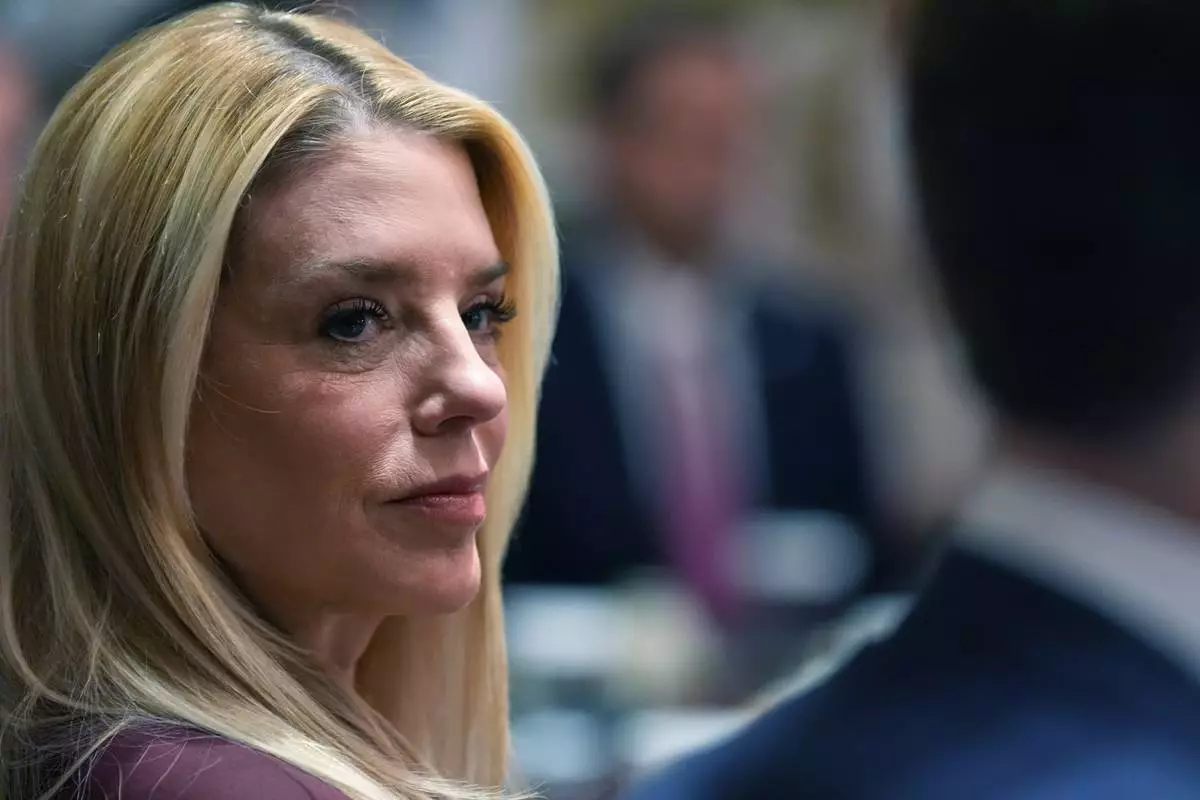
Attorney General Pam Bondi listens during a Cabinet meeting at the White House, Thursday, March 26, 2026, in Washington. (AP Photo/Alex Brandon)