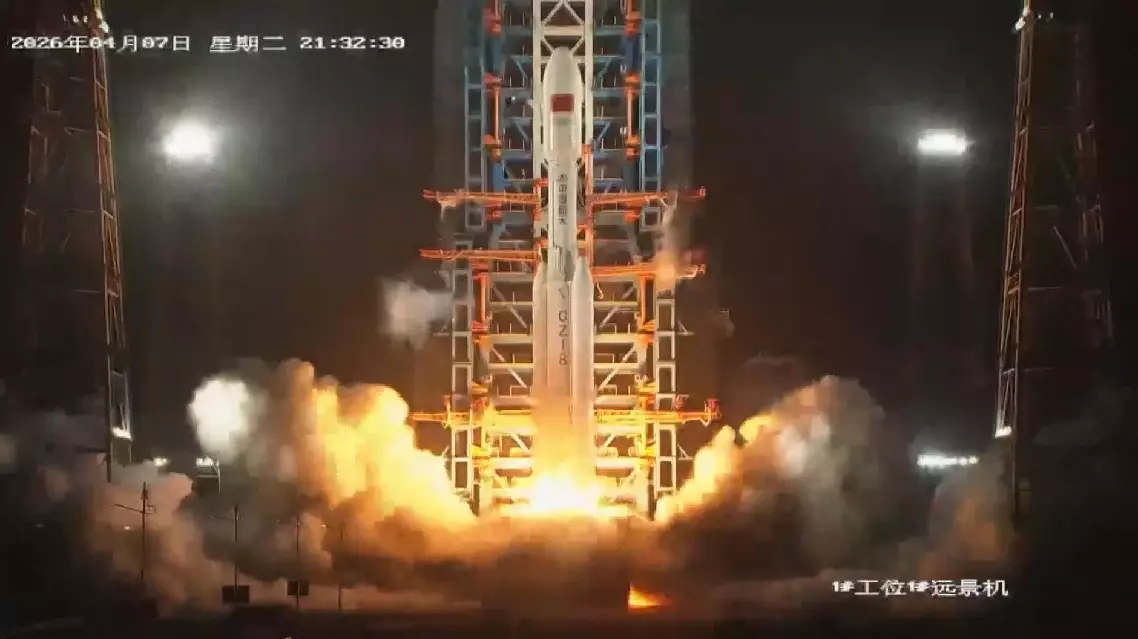
China launched a Long March-8 carrier rocket on Tuesday in the southern island province of Hainan, sending 18 internet satellites into space.
The rocket blasted off at 21:32 (Beijing Time) from the Hainan commercial spacecraft launch site. It successfully placed the payloads, the 7th batch of networking satellites for the Qianfan Constellation, into preset orbit.
Qianfan is China's first giant low-orbit commercial satellite constellation to enter the formal networking phase. It will build a satellite internet system that provides high-speed, real-time, secure, and reliable integrated solutions and services connecting space, air, ground and sea, independently constructed and operated by China.
The project launched its first batch of satellites in August 2024 and aims to have a full operational network of more than 15,000 low-Earth orbit satellites in place by 2030.
The Long March-8 rocket that carried out Tuesday's mission is a member of the Long March 8 family. Together with the Long March-8A carrier rocket, the two models feature the payload capacity of 5 tonnes and 7 tonnes to sun-synchronous orbit, respectively, which underscores China's upgraded launch capabilities for deploying satellites into medium and low Earth orbits.
This year, the Long March 8 rockets will enter a high-density launch schedule, continuing to support the development of China's low-Earth orbit satellite internet constellation and the high-quality development of the country's commercial space sector.
In addition, the meteorological system at the Hainan commercial spacecraft launch site took on the weather support role independently for the first time in this launch mission. The successful validation of its performance has further enhanced the site's overall service and support capabilities.
China launches new batch of 18 internet satellites for Qianfan Constellation
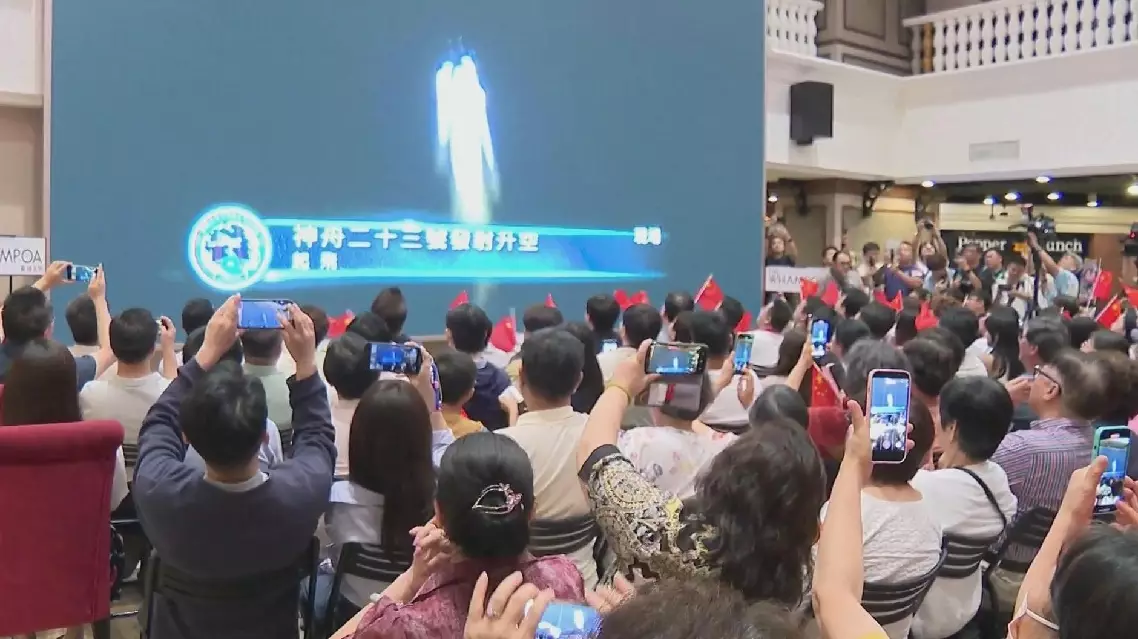
Hong Kong's first astronaut lifted off into space on Sunday, sparking a wave of enthusiasm for space exploration in the special administrative region, while inspiring a new generation to look to the stars.
The Shenzhou-23 crewed spaceship, atop a Long March-2F carrier rocket, blasted off from the Jiuquan Satellite Launch Center in northwest China at 23:08 (Beijing Time) on Sunday. The crew members include Lai Ka-ying, the first astronaut and payload specialist from Hong Kong to join a national space mission, whose achievements have motivated many Hong Kong residents.
"I feel so happy and thrilled. This is the first time a Hong Kong astronaut has gone to space, and to see a true Hong Konger, who is also a mother of three, just really touches my heart," said Chow, a local resident.
The successful spaceflight of Lai has especially captivated the younger generation to dream bigger about the future.
"I want to be an astronaut, because I want to discover more things about space," said a young student surnamed Chow.
"I have seen things related to spaceflights of astronauts. I hope when I grow up, I could receive training and go to space myself," said another student surnamed Koo.
To meet public expectations, the Hong Kong Space Museum has updated its space-themed exhibition with the latest development of the Shenzhou-23 mission, extending the display until July 6. Parents are seizing the moment to enrich their children's knowledge.
"At his age, I want him to be exposed to a wide range of information. With all the recent astronaut news, I brought him here specially to see for himself. We will also check out a film about space knowledge at the planetarium. I hope he can get more out of this from an early age," said Cheung, a father.
"We just watched the Shenzhou-23 launch at home with my son last night, and decided to take him to the Space Museum," a mother surnamed Chun shared.
"I saw on TV that so many people were cheering for the launch. When the rocket was launched, fire burst out from its body. I was really happy they succeeded," said Chun's son.
Hong Kong's first astronaut ignites citywide enthusiasm over space exploration