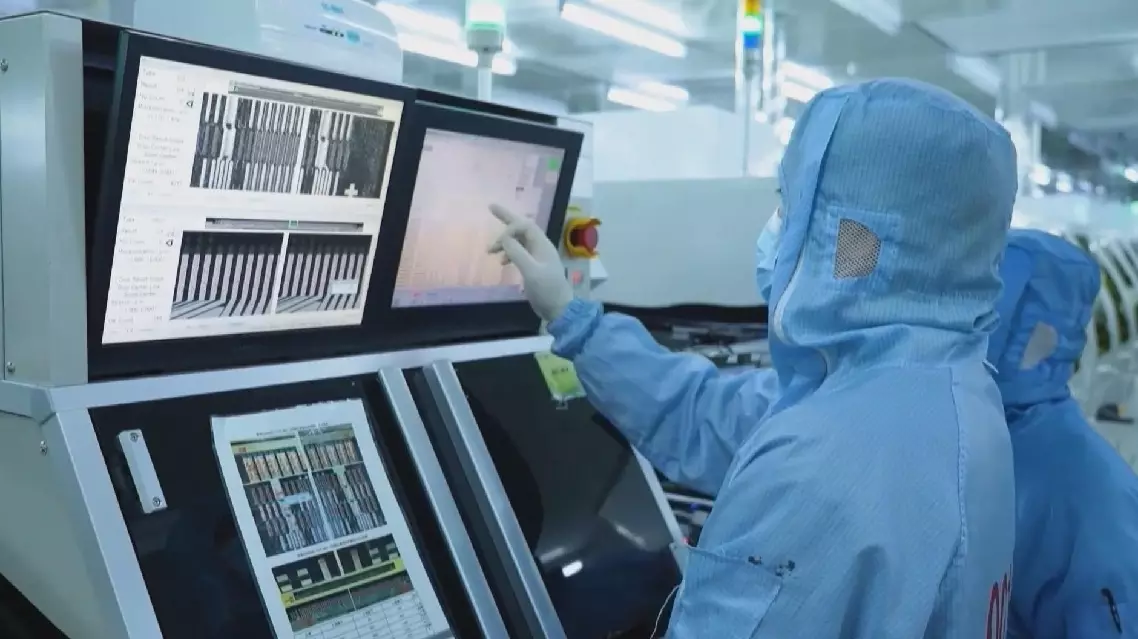
China's electronic information manufacturing industry recorded robust performance in production, export and investment in the first two months of this year, official data showed on Wednesday.
According to the Ministry of Industry and Information Technology, the value-added output of electronic information manufacturers above the designated size grew more than 14 percent year on year in the January to February period, outperforming the overall industrial growth rate by 7.9 percentage points and that of high-tech manufacturing by 1.1 percentage points.
In the same period, major players in the industry generated 2.63 trillion yuan (about 385.3 billion U.S. dollars) in total business revenue, up 14.3 percent year on year. Exports rose by 1.2 percent, driven by strong overseas demand for integrated circuits. Investment returned to a growth zone after logging a decrease in 2025.
Industrial enterprises above the designated size refer to those with an annual revenue from their principal business of 20 million yuan or more.
China's electronics information manufacturing logs strong growth in Jan-Feb
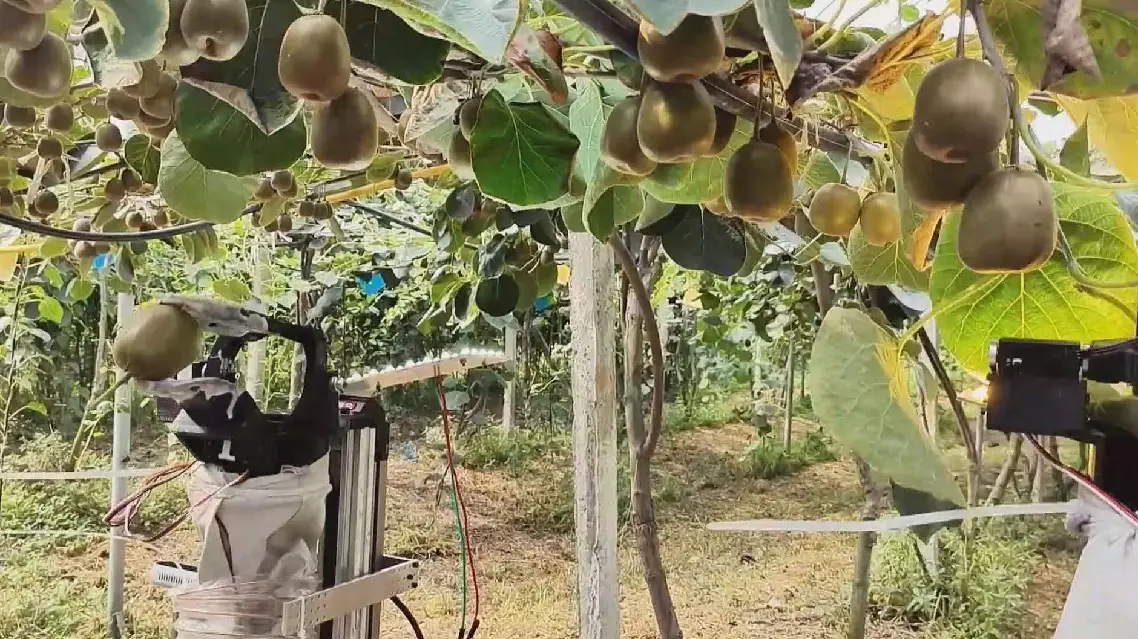
In southwest China's Sichuan Province, agricultural robots are rapidly moving out of laboratories and into the fields, driving more efficient and intelligent farming through technology.
This year, China's "No. 1 central document", the annual plan on agriculture, farmers, and rural area-related issues, for the first time highlighted drones, Internet of Things (IoT), and robotics applications within the broader push to develop new quality productive forces in agriculture, marking enhanced governmental efforts for smart agriculture development.
At an agricultural tech startup hub in Sichuan, robots of all kinds are already at work.
One example is a weeding robot for orchards and vegetable fields. Equipped with a high-speed weeding mechanism, it can grind up weeds and dispose of them on-site as fertilizer, creating an eco-friendly cycle.
With tracked design and BeiDou navigation sensors, it can navigate slopes and uneven terrain with ease and accuracy.
"The machine relies on its two BeiDou sensors, like its 'eyes', to guide the entire operation process. It can operate with an accuracy of within five centimeters, which is more than enough for weeding tasks," said Wan Yicai, head of Sichuan Qianxiaomo Technology.
Another robot is designed to pick hibiscus flowers, handling delicate blossoms with both speed and care while significantly reducing labor needs.
"With a single robotic arm, it takes about 2.8 seconds to pick one flower, and the machine can cover around 10 mu (about 0.7 hectare) of farmland a day," Wan said.
From weeding and flower picking to harvesting grapes, asparagus, and citrus fruits, more than a dozen types of agricultural robots are on display in the field, able to assist at all key stages of production.
"Agricultural robotics represents a promising new growth area. The core issue agriculture needs to address is its heavy reliance on labor, and how to bring down costs," said Tian Hailong, head of Utrans (Xiamen) Supply Chain Group.
In Sichuan, where mountainous and hilly landscapes dominate, such compact, adaptable machines are especially valuable. The terrain limits the use of large-scale machinery, while rural labor continues to decline as young people move to cities. These robots are offering new solutions to the long-standing question of who will farm the land and how.
"'New farming tools' integrating BeiDou navigation, AI vision, and intelligent control are now being deployed in hilly areas across Sichuan to boost productivity. During the 15th Five-Year Plan period, Sichuan aims to develop and refine 30 types of agricultural machinery that are more suitable, intelligent, and environmentally friendly, helping to address existing gaps in agricultural mechanization," said Zhou Shan, head of the Agricultural Mechanization Division under Sichuan Provincial Department of Agriculture and Rural Affairs.
Beyond robotics, Sichuan Province expects to have more than 15,000 agricultural drones in operation by 2027, along with 5,000 more certified drone operators. Annual drone operation for crop protection is projected to cover over 100 million mu (about 6.7 million hectares). With targeted subsidies, farmers could have easier access to smart tools.
Adaptive agricultural robots bring higher efficiency to farming in Sichuan