Cities across China are gearing up for a brand new season of the popular grassroots football leagues which took the country by storm last year, with these provincial-level competitions igniting fan fever and injecting fresh momentum into the nation's sports economy.
The amateur football leagues, often dubbed the "city super leagues" -- a play on words for China's top professional division -- have captured the imagination of fans and sports enthusiasts up and down the country, with huge stadiums being filled out and related merchandise and products also proving top sellers.
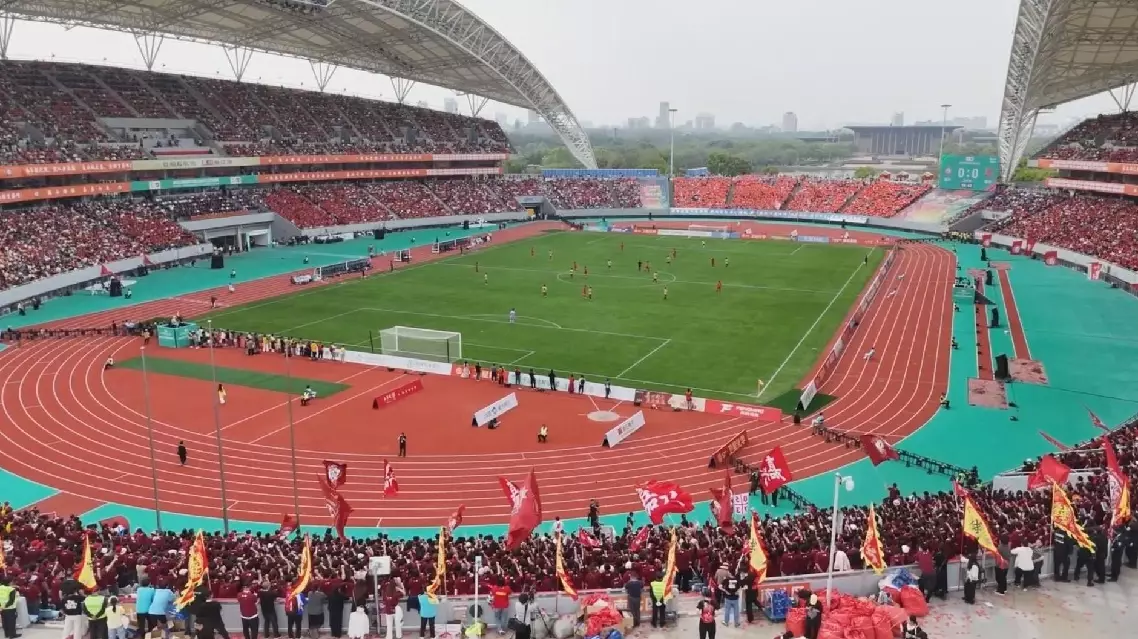
East China's Zhejiang Province on Monday kicked off its own football league, branded as the "Wuyue Cup", which playfully means the 'arch enemy' cup, with the opening match held at a packed-out arena in the city of Jiaxing.
A total of 11 prefecture-level cities in Zhejiang will contest the league, which is composed entirely of local amateur players. There are no active professionals among the 627 participants, underscoring its grassroots nature, official data showed.
The opening fixture was a hard-fought affair, with the home favorites Jiaxing eventually prevailing to record a 1-0 victory over the team from Quzhou City.
Beyond the excitement inside the stadium, the matches are also driving consumption outside, with merchandise stores which were set up around the venue being swarmed with supporters eager to purchase the latest team jerseys.
"We have sold 200 to 300 (jerseys). There was such a long queue just now, and we simply couldn't keep u," said Li Qianglong, the manager of one popular store.
Jiaxing has also organized a football-themed cultural and tourism fair, offering local delicacies and virtual reality-powered interactive experiences to enrich the match-day experience for spectators.
Meanwhile, in the neighboring Jiangsu Province, the second season of the "Su Super League" is set to begin on Saturday, featuring 13 teams representing cities across the province.
In Nanjing's Jiangning Football Base, teams were training under light rain as they made final preparations for the much-anticipated opening weekend.
Last year, the "Su Super League" ran for nearly six months, attracting more than 2.43 million spectators overall, with an average attendance of 28,000 per match.
Official data showed that during match-day periods, major retailers and supermarkets in Jiangsu recorded a staggering 11.64 billion yuan (1.7 billion U.S. dollars) in sales, up 34.7 percent year-on-year, while foot traffic rose by over 31 percent. Across Jiangsu, many stores have been launching an array of football-themed cultural and creative products to further stimulate consumption as they look to build on the runaway success of last year's edition.
The Guangdong City Football Super League in south China is scheduled to get underway in late April, with 21 cities participating across the country's most populous province.
Organizers say the tournament is expected to better promote urban-rural integration by bringing new consumption opportunities to rural areas.
Official figures show China's sports industry surpassed five trillion yuan in total value in 2025. The government is aiming to further tap into this rising fan demand and unlock sports consumption, with the sector projected to exceed 7 trillion yuan by 2030.
China's grassroots football leagues kick off new season, with fan fever set to boost sports economy