Advanced technology is driving major progress in the rescue and rehabilitation of plateau wildlife at a rescue and breeding center in Xining City, northwest China's Qinghai Province.
Since its official establishment in 2010, the Qinghai Wildlife Rescue and Breeding Center has transformed its approach to wildlife rescue, leveraging the resources of Xining Wildlife Park. In its early years, the center rescued only 30 to 50 wild animals annually, with very few successfully released back into the wild. By 2025, the number of animals rescued had surpassed 300, with 78 successfully returned to their natural habitats.
"In the past, our wildlife rescue work was limited to saving animals and keeping them here to enhance visitors' awareness in wildlife protection. But in 2021, we rescued a desert cat named 'Huang Rong' and successfully released her into Qilian Mountains in January 2022. Later, we released another desert cat, 'Huang Taiji,' both fitted with tracking devices. Through satellite tracking, we monitor their activities and habits in the wild, collecting a large amount of scientific data," said He Shunfu, director of the Rescue and Rehabilitation Department at the center.
The center has evolved from providing emergency medical care to establishing a comprehensive chain of medical rescue, rehabilitation training, wild adaptation, release monitoring, and public education. This has led to a complete upgrade in the rescue and release techniques for rare plateau felines.
Early this year, a weak desert cat named "Huang Anan" was found in the snow of a village in Xining's Huangzhong District, suffering from lethargy and yellow purulent nasal discharge. The center's staff quickly conducted a thorough examination of the animal.
"When the cat first arrived, it was in poor health condition, with pus in both nostrils. We provided it with timely treatment, and after about a month of care, its health has greatly improved," said Zhao Hailong, a veterinarian at the center.
The center's breakthroughs extend beyond desert cats. In 2017, it used MRI technology for the first time to diagnose a snow leopard's illness, leading to China's first successful rehabilitation of a paralyzed snow leopard. In 2019, another snow leopard underwent the world's first phacoemulsification cataract surgery with artificial lens implantation. These advanced techniques have since been applied to other plateau felines, including Pallas's cats and lynxes. In 2021, the center successfully treated a blind lynx cub and released it back into the wild, the first such case in China.
Over the past decade, the center has rescued more than 2,500 wild animals across 62 species.
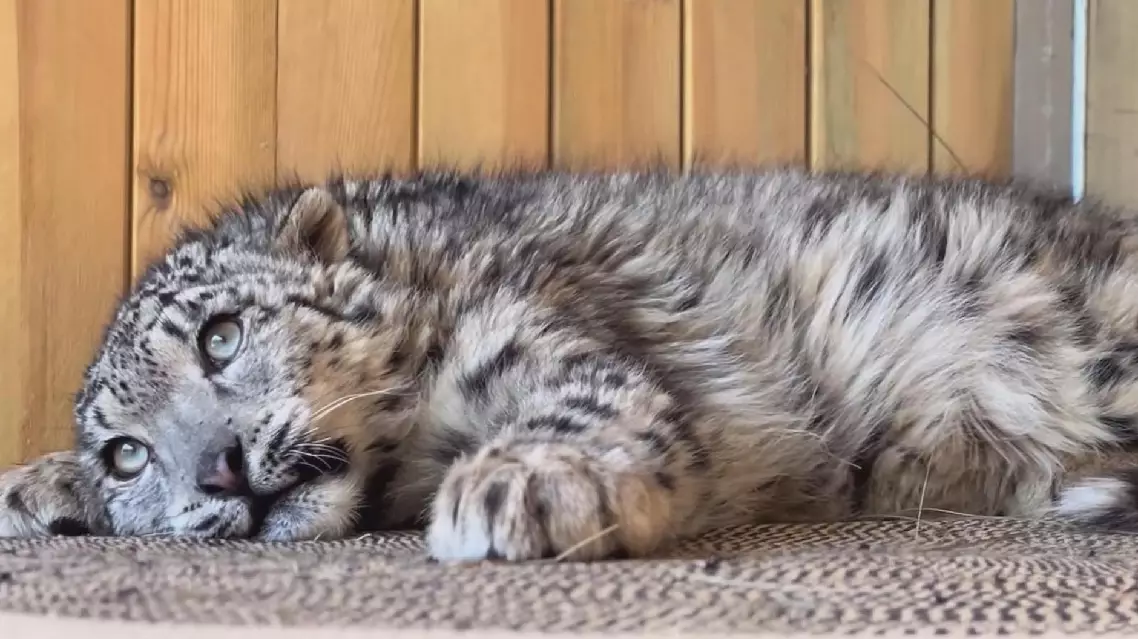
New technology helps Chinese conservationists to rescue wildlife more effectively