Members of the original 1971 U.S. table tennis team returned to the Great Wall five and a half decades after their historic visit to China which broke the ice for China-U.S. relations, proving that while much has changes, some bonds remain unbreakable.
On April 10, 1971, the U.S. table tennis delegation visited China, breaking the ice for China-U.S. relations and is remembered as the Ping-Pong Diplomacy.
On Thursday, three of the members of the pioneering 1971 tour, climbed the ancient landmark, Great Wall, in Beijing once again, retracing steps they first took as young competitors in their early twenties.
"Happy to be here with my friends from the original 1971 Ping-Pong Diplomacy. We're still here, and despite the rain we feel very invigorated and very happy to be here. Just a very warm feeling," said Judy Hoarfrost, one of the members.
"It's very nostalgic to be back here with the three of us who were originally on this wall in 1971," said Connie Sweeris, another member.
For the veteran athletes, the memories came flooding back when they once again stood on the Great Wall decades later.
"When we were in the Great Wall, I didn't even know you could walk on top of it. I knew nothing. And all I knew is that it was one of the seven wonders of the world," said Hoarfrost.
She described a journey that stands in stark contrast to today's experience.
"There were no people there when we were there. And all the way, the drive all the way to the Great Wall was rural. It was just a bumpy rural drive. It was not like now where all the cars and traffic and everything," said Hoarfrost.
While Sweeris recalled marveling at the ancient builders.
"I remember thinking what a feat it was for the people to be able to build that back in that time. Ancient tools and stuff they had. What a feat to be there and how wide it was. I guess they used to ride horses on the Great Wall to protect their area from invaders," she said.
Asked what has changed over the past 55 years, the answers were immediate.
"So many more people. Well, there's a McDonald's here. There was no McDonald's in 1971. And I mean, everything is so modern. Here, we are taking, you know, with cell phones. We had no cell phones then," said Hoarfrost.
"We had a journalist with us from Time magazine that took the original photo of our team on the thing. So while we had cameras, but they were just push cameras. Not very good ones. Colored pictures had just come out," said Sweeris.
Despite the changes, the members said that the meaning of their journey remains as powerful as ever.
"I mean, here we are, 55 years later, and everyone is still interested in Ping-Pong Diplomacy because it brings us together, China and America. It sparked us to have new relations. And here we are today," said Hoarfrost.
The nine players from the 1971 U.S. table tennis team marked the first delegation of Americans to visit China in decades. Their trip helped lay the groundwork for the establishment of official diplomatic relations between China and the United States.
Later that year, then U.S. Secretary of State Henry Kissinger secretly visited Beijing in July, paving the way for a groundbreaking 1972 meeting in Beijing between President Richard Nixon and Chairman Mao Zedong.
On Feb 28, 1972, as Nixon’s visit to China drew to an end, the historic Shanghai Communique was issued, becoming the political foundation for normalizing China-U.S. relations.
The two countries officially established diplomatic relations in 1979.
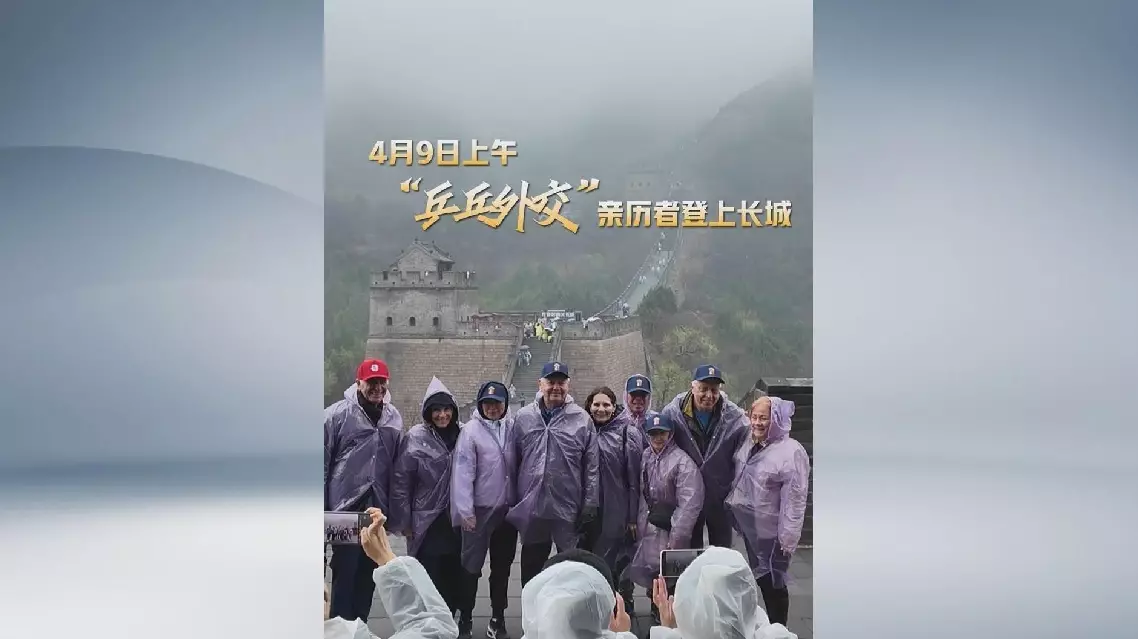
Ping-Pong Diplomacy veterans return to Great Wall after 55 Years