TEHRAN, Iran (AP) — Iranians reacted with a mixture of disappointment and defiance on Sunday after peace talks with the United States failed to reach an agreement following hourslong negotiations.
U.S. officials said the talks collapsed over what they described as Iran’s refusal to commit to abandoning its nuclear program. Iranian officials blamed the U.S. for failing to reach a deal, without specifying the sticking points.
The failure of the high-stakes talks in Pakistan after 21 hours casts doubt over the future of a fragile two-week ceasefire, due to expire on April 22.
While the fragile ceasefire seems to hold, the war is not over and uncertainty remains in the streets of Tehran where some residents were reluctant to speak to the media.
Iranians have been living in digital blackout for over a month after the internet was blocked shortly after the war started on Feb. 28. Since then, the population has been relying on state-controlled media, with a limited number of people having access to overseas satellite TV channels for access to information.
Standing outside a newsstand in the capital, Tehran, Farhad Simia told The Associated Press he had hoped for successful negotiations and an end to the fighting, but stood with Iran despite the failure of the talks.
“I’m against war. I think negotiation is the better path,” Simia, 43, said. He blamed “inappropriate demands” by the U.S. for the failure to reach a deal.
Mehdi Hosseini, also 43, agreed: “Considering the advantage Iran seemed to have on the battlefield, there was a real concern that we might lose all those gains in the negotiations.
“Whether the talks succeed or not is one matter, but the fact that the Iranian negotiating team managed to preserve what it achieved in the war, while refusing to back down and surrender, gives reason for hope.”
The streets of Tehran were lined up with large Iranian flags and giant billboards glorifying the country's leaders and military achievements. One large illustration depicted Iranian men in uniform lifting a fishing net out of the sea with a catch of miniature-sized U.S. military aircraft and warships. “The Strait Remains Closed,” the billboard read.
Hamid Haghi, 55, said “America's overreach” was the reason for the talks' failure. The U.S. wants “to come to the Strait of Hormuz, which is a legacy from our fathers,” he said. “We can oversee (it) ourselves.”
Like many Iranians, 60-year-old Mohammad Bagher believes Iran should continue to stand strong against the U.S. in what he sees as a war of their own making.
“We are a nation of dialogue and negotiation as long as our interests are respected. We have never sought war,” he said. “We will stand firm to the end, we are ready to sacrifice our lives, and will not give them one inch of our land.”
Since the U.S. and Israel launched the war on Feb. 28, it has killed at least 3,000 people in Iran, 2,020 in Lebanon, 23 in Israel and more than a dozen in Gulf Arab states, and caused lasting damage to infrastructure in half a dozen Middle Eastern countries.
Iran’s grip on the Strait of Hormuz has largely cut off the Persian Gulf and its oil and gas exports from the global economy, sending energy prices soaring.
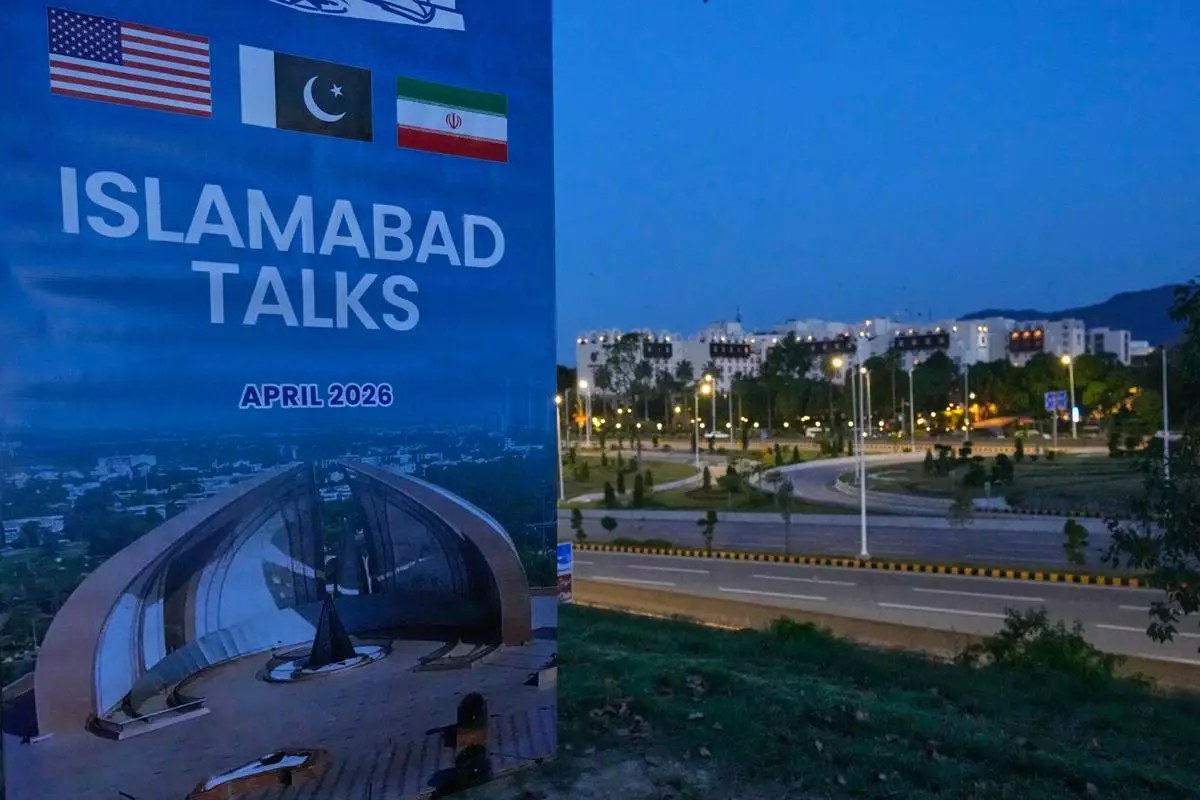
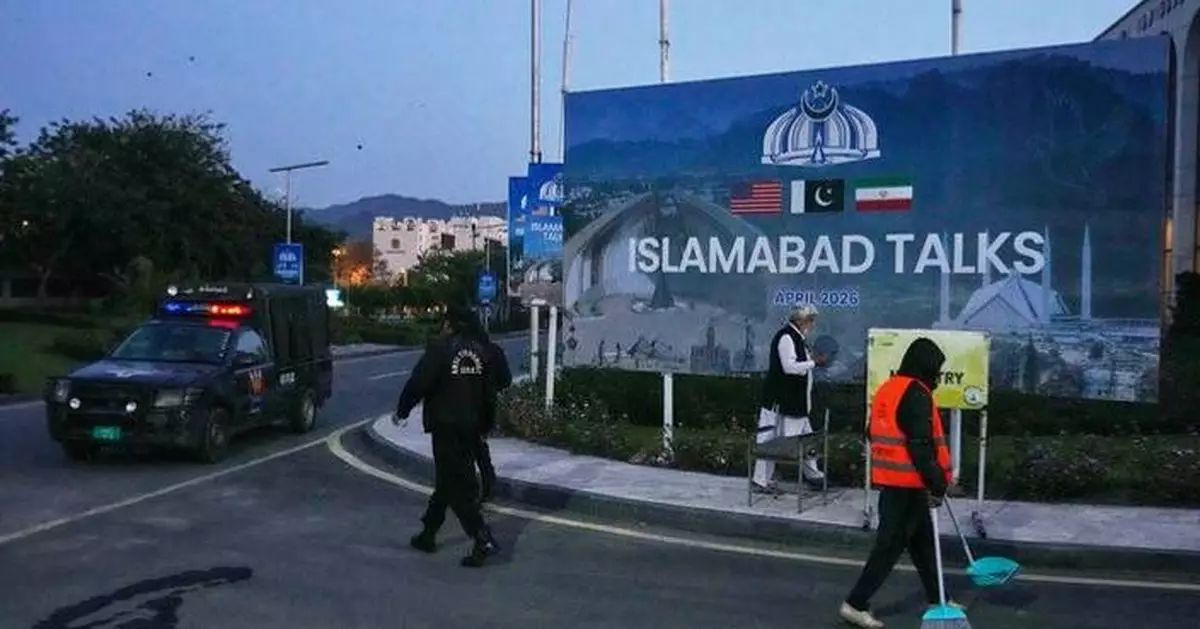
A billboard of the U.S. Iran talks is seen near Serena Hotel, the venue for the U.S. Iran officials meeting, in Islamabad, Pakistan, Sunday, April 12, 2026. (AP Photo/Anjum Naveed)
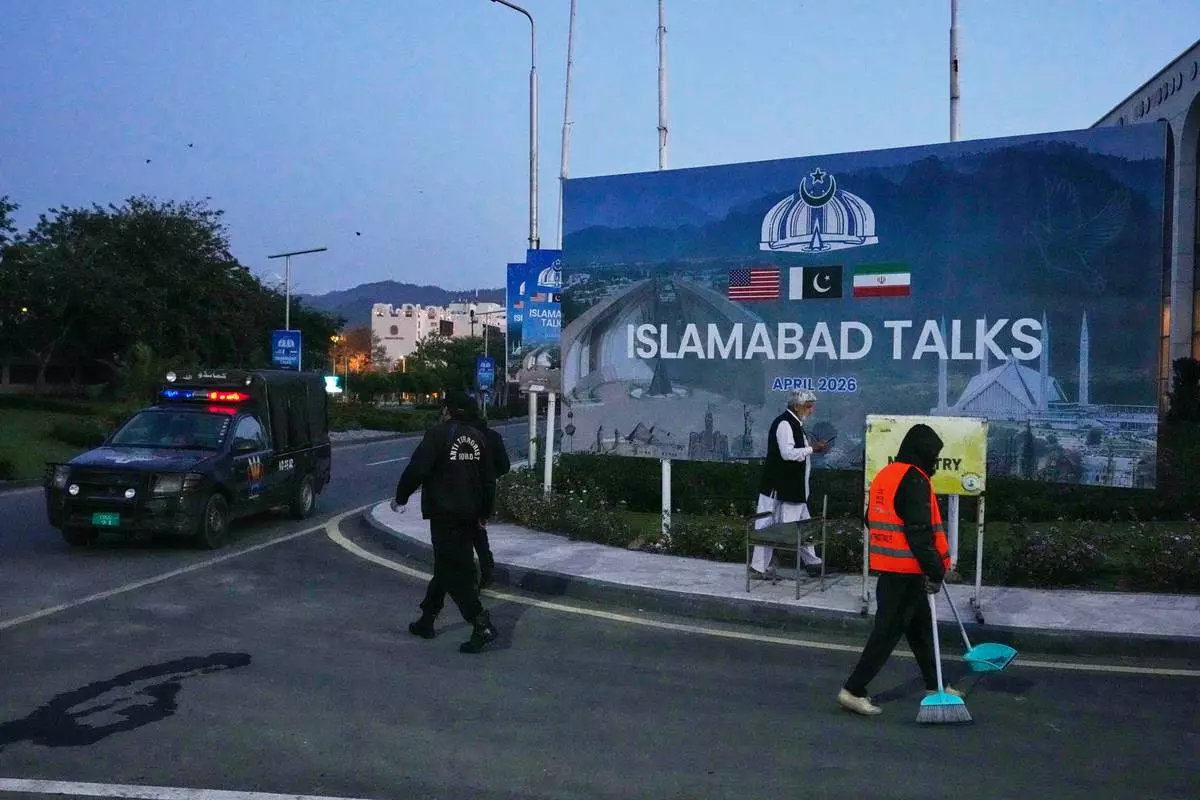
A worker cleans the street as police officers walks towards their vehicle outside a media center close to Serena Hotel, the venue for the U.S. Iran officials meeting, in Islamabad, Pakistan, Sunday, April 12, 2026. (AP Photo/Anjum Naveed)
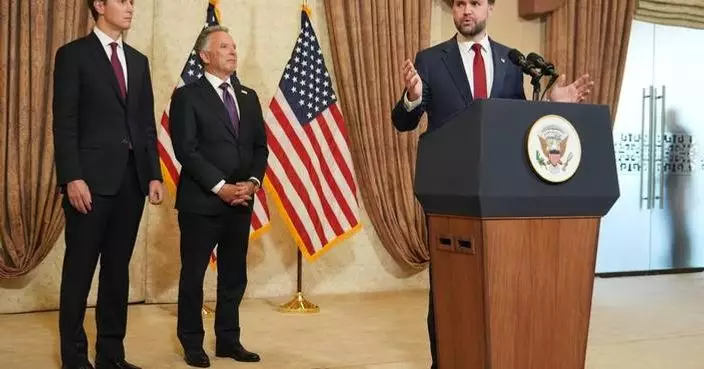
Vice President JD Vance said negotiations between the United States and Iran ended early Sunday without a deal after the Iranians refused to accept U.S. terms to not develop a nuclear weapon.
The high-stakes talks in Pakistan ended after 21 hours, Vance said, with the vice president in constant communication with President Donald Trump and others in the administration.
“But the simple fact is that we need to see an affirmative commitment that they will not seek a nuclear weapon, and they will not seek the tools that would enable them to quickly achieve a nuclear weapon,” Vance told reporters.
The war that has killed thousands of people and shaken global markets entered its seventh week.
The U.S. delegation led by Vance and the Iranian delegation led by parliament Speaker Mohammad Bagher Qalibaf had discussed how to advance a ceasefire already threatened by deep disagreements and Israel’s continued attacks against the Iranian-backed Hezbollah in Lebanon.
Here is the latest:
In response to comments from U.S. officials that the Islamabad talks collapsed over Iran’s refusal to commit to abandoning a path to a nuclear weapon, the official said: ″It is false. Iran’s position is clear. Iran is not seeking to acquire nuclear weapons, but it has the right to nuclear energy for peaceful purposes. This right is undeniable and must be recognized.″
However, Iran is ready to limit its nuclear activities as part of confidence-building measures, the official said, including enrichment levels.
He did not elaborate on why the talks failed and spoke on condition of anonymity because of the sensitivity of the closed-door discussions.
In response to comments from U.S. officials that the talks in Islamabad collapsed over Iran’s refusal to commit to abandoning a path to a nuclear weapon, the official said: ″It is false. Iran’s position is clear. Iran is not seeking to acquire nuclear weapons, but it has the right to nuclear energy for peaceful purposes. This right is undeniable and must be recognized.’’
However, Iran is ready to limit its nuclear activities as part of confidence-building measures, the official said, including enrichment levels.
He did not elaborate on why exactly the talks failed and spoke on condition of anonymity because of the sensitivity of the closed-door discussions.
Across the central Beirut neighborhoods attacked last week in Israel’s deadly bombardment of the city, Orthodox Christians in Lebanon found themselves grasping for solace in their faith and beloved Easter rituals.
Many worshippers said they were still reeling from Wednesday’s Israeli airstrikes, which hit areas of Beirut previously considered safe and killed more than 350 people while wounding over 1,100 others.
“What happened was a crime,” said Ghada Chabo Markossian from Easter services at her Syriac Orthodox church in Msaitbeh, one of several residential neighborhoods devastated in the attack.
“God willing, during this feast, the Lord will set right … these evil things that are happening.”
The priest attributed the low attendance to a chilling fear that has grown more pervasive in the last few days of the Israel-Hezbollah war.
“Many members of the parish are afraid to come, due to the terror they experienced two or three days ago,” the Rev. Daniel Gawriya said.
Leo said Sunday he was “closer than ever” to the people of Lebanon at the end of his noontime prayers, and called on all sides to stop fighting and seek peace.
“The principle of humanity, inscribed in the conscience of every person and recognized in international law, entails the moral obligation to protect the civilian population from the atrocious effects of war,” Leo said.
Though Israel’s strikes over Beirut have calmed in recent days, its attacks on southern Lebanon have intensified alongside a ground invasion it renewed after Hezbollah launched rockets toward Israel in the opening days of the U.S.-Israeli war against Iran.
Leo wished Christians celebrating Orthodox Easter, and said he hoped especially that the international community doesn’t turn its back on the “beloved people of Ukraine.”
He noted that Wednesday marks the third anniversary of the “fratricidal war” in Sudan, and appealed for talks to end what he called an “inhuman tragedy.”
Iran’s First Vice President Reza Aref said Tehran sought U.S. recognition of its control of transit through the Strait of Hormuz in the collapsed Islamabad talks.
Iran having “authority in the Strait of Hormuz” and pursuing compensation for the damage caused by U.S. and Israeli strikes were “the rights of the (Iranian) people," he said.
“This is our firm commitment to a strong Iran,” Aref wrote on social media.
In a series of posts on X, Parliament Speaker Mohammad Bagher Qalibaf said the Iranian delegation provided “forward-looking initiatives” during the 21-hour talks but the Americans could not gain Iran’s trust.
He said now is the time for the U.S. “to decide whether it can gain our trust or not.”
He didn’t elaborate. But Iranian state media reported earlier that major points of disagreement included Iran’s nuclear program and transit through the Strait of Hormuz.
Israeli Prime Minister Benjamin Netanyahu on Saturday criticized Turkish President Recep Tayyip in a post on X in which he wrote: “Israel under my leadership will continue to fight Iran’s terror regime and its proxies, unlike Erdogan who accommodates them and massacred his own Kurdish citizens.”
In response, Omer Celik, spokesperson of the ruling Islamic-oriented Justice and Development Party, or AKP, said Sunday that Israel’s comments aimed to sabotage the peace talks in Pakistan, foment unrest among the Kurdish minority and pit Turkey against Iran.
Numan Kurtulmus, the speaker of Turkey’s parliament, called Netanyahu “the ringleader terrorist of the 21st century’s massacre and terror network.”
“The audacity of someone whose hands are stained with children’s blood — someone pursued by international law — to presume to lecture Turkey on morality is merely an indicator of his efforts to cover up his own crimes against humanity, and it holds no validity whatsoever,” Kurtulmus said.
The strike on Sunday morning hit a home of seven people in the Lebanese town of Maaroub, Lebanon’s state-run National News Agency reported.
The strike came without warning, and Israel did not immediately comment on it.
Israel’s government has said its strikes target operatives or infrastructure belonging to the Hezbollah militant group.
Israeli strikes over Beirut have decreased in recent days, but its attacks on southern Lebanon have intensified alongside a ground invasion.
Iran's state-run TV said the delegation left Pakistan's capital after talks with the U.S. failed to reach a deal.
The East-West pipeline, used to send oil to the Red Sea for transport, was repaired after an attack, the Saudi Energy Ministry said in a statement Sunday. It said it has full capacity of about 7 million barrels a day.
The pumping station was attacked Thursday, affecting about 700,000 barrels of output through the pipeline, which has allowed Saudi Arabia to continue exporting a substantial portion of its oil.
Saudi Aramco operates the pipeline from the Aqaiq oil processing center near the Persian Gulf to the Yanbu port on the Red Sea, avoiding the Iranian chokepoint on the Strait of Hormuz and the Persian Gulf. The ministry said the Manila oil field was also repaired, restoring a capacity of around 300,000 barrels a day.
It said work was still underway at another field, Kurais, to restore a capacity of another 300,000 barrels a day.
Iran’s Foreign Ministry said Sunday that negotiations with the U.S. fell apart over a “gap between our opinions over two or three important issues.”
“Ultimately the talks didn’t result in an agreement,” spokesman Esmaeil Baghaei told Iran’s state TV. He did not detail what those issues were.
On some topics, Baghaei said U.S. and Iranian negotiators “actually reached mutual understanding.” The negotiators discussed the Strait of Hormuz, Baghaei said, but did not mention discussion of nuclear weapons.
Pakistan’s Foreign Minister Ishaq Dar called on Iran and the United States to keep their commitment to maintain a ceasefire, after both countries ended historic face-to-face talks without an agreement.
“It is imperative that the parties continue to uphold their commitment to ceasefire,” Dar said.
He added that Pakistan will continue to play is mediating role and will try to keep facilitating the dialogue between Iran and the U.S. in coming days.
Vice President JD Vance boarded his government plane at 7:08 a.m. local time in Islamabad, planning to depart Pakistan after he said that Iran declined to back down on developing a nuclear weapon.
That’s according to a reporter traveling with Vance.
The war with Iran started at the end of February and the extensive talks ended after 21 hours. The U.S. and Iran agreed to a two-week ceasefire on April 7 for negotiations.
Vice President JD Vance said negotiations between the U.S. and the Iranians have ended without a peace deal after the Iranians refused to accept American terms to not develop a nuclear weapon.
The high-states talks ended after 21 hours, Vance said, with the vice president in constant communication with President Donald Trump and others in the administration.
“But the simple fact is that we need to see an affirmative commitment that they will not seek a nuclear weapon, and they will not seek the tools that would enable them to quickly achieve a nuclear weapon,” Vance told reporters. “That is the core goal of the president of the United States. And that’s what we’ve tried to achieve through these negotiations.”
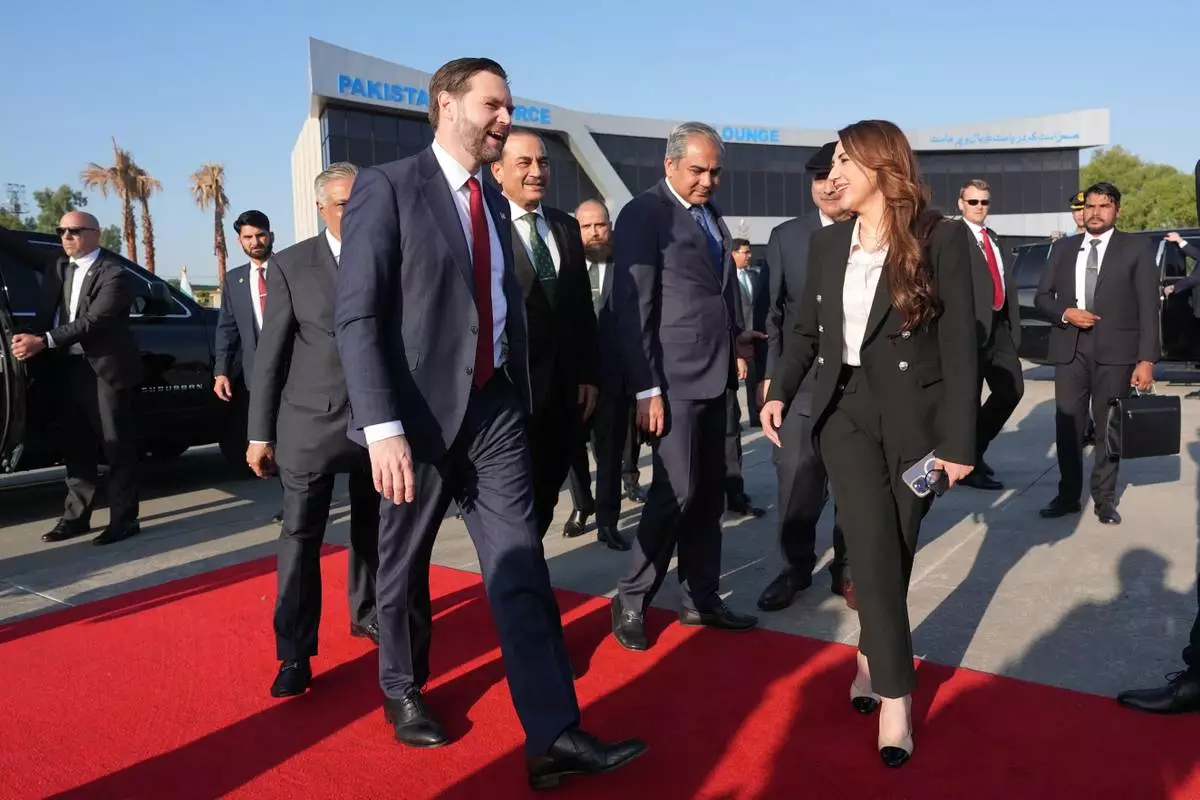
Vice President JD Vance walks with Pakistani Deputy Prime Minister and Foreign Minister Mohammad Ishaq Dar, partially seen on the left, Pakistan's Chief of Defence Forces and Chief of Army Staff Field Marshall Asim Munir, third left, Pakistan's Interior Minister Mohsin Naqvi, and Charge d'Affaires of the U.S. Embassy in Islamabad Natalie A. Baker, right, before boarding Air Force Two after attending talks on Iran in Islamabad, Pakistan, Sunday, April 12, 2026. (AP Photo/Jacquelyn Martin, Pool)
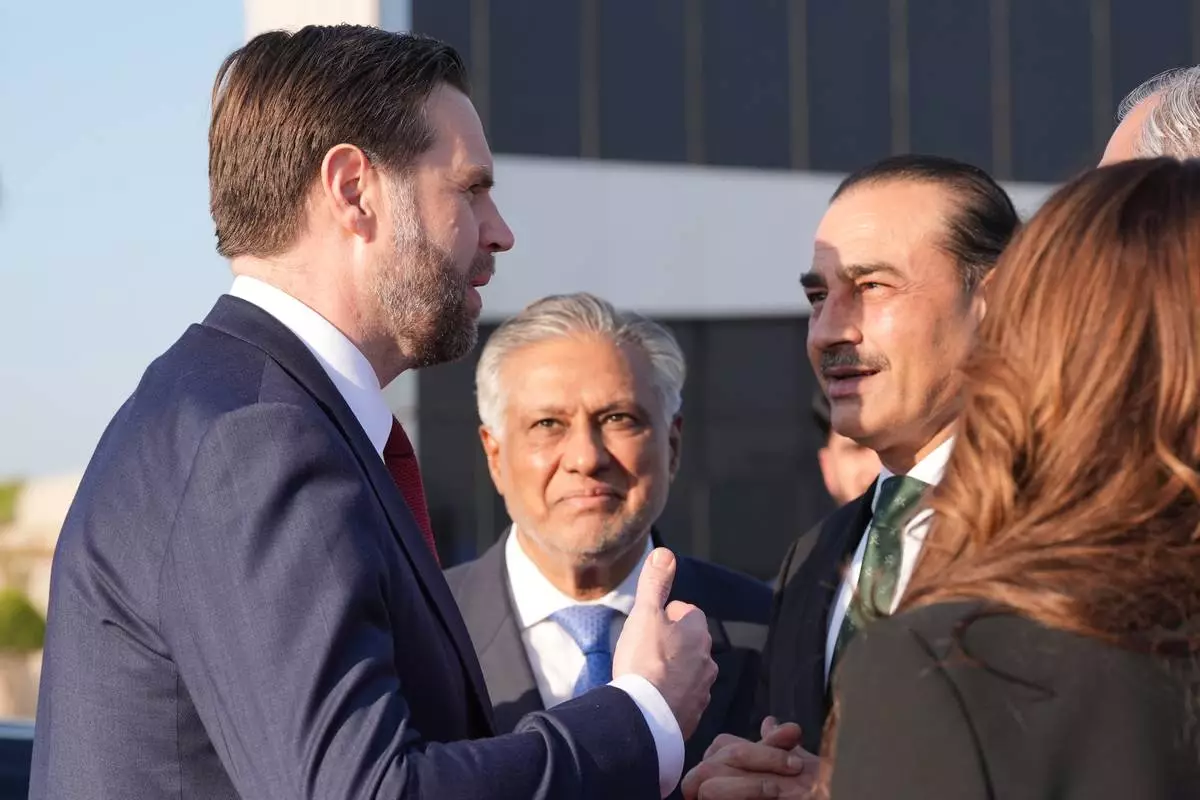
Vice President JD Vance, left, talks to Pakistan's Chief of Defence Forces and Chief of Army Staff Field Marshall Asim Munir, right, and Pakistani Deputy Prime Minister and Foreign Minister Mohammad Ishaq Dar, center, before boarding Air Force Two after attending talks on Iran in Islamabad, Pakistan, Sunday, April 12, 2026. (AP Photo/Jacquelyn Martin, Pool)

Vice President JD Vance gives a thumb up sign as he boards Air Force Two after attending talks on Iran in Islamabad, Pakistan, Sunday, April 12, 2026, . (AP Photo/Jacquelyn Martin, Pool)
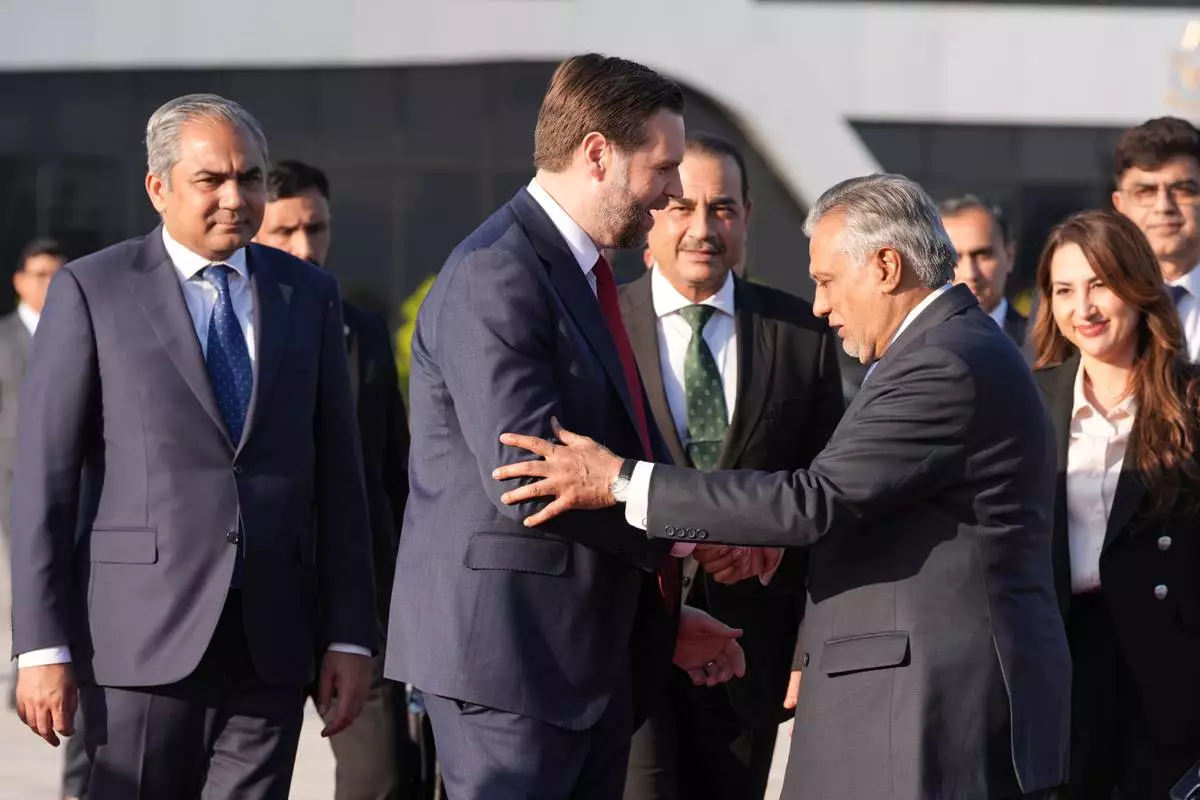
Vice President JD Vance, second left, shakes hands with Pakistani Deputy Prime Minister and Foreign Minister Mohammad Ishaq Dar, as Pakistan's Interior Minister Mohsin Naqvi, left, Pakistan's Chief of Defence Forces Chief of Army Staff Field Marshall Asim Munir, third left, and Charge d'Affaires of the U.S. Embassy in Islamabad Natalie A. Baker, right, look on, as he prepares to board Air Force Two after attending talks on Iran in Islamabad, Pakistan, Sunday, April 12, 2026. (AP Photo/Jacquelyn Martin, Pool)