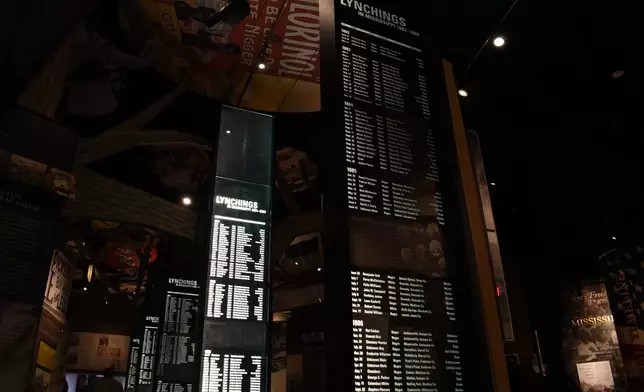
JACKSON, Miss. (AP) — The glass panels of the Lynching Victims Monolith are simple, etched with the names of more than 600 victims of documented racial killings in Mississippi, along with the attackers' motives.
One man, Malcolm Wright, was beaten to death in front of his family in 1949. His offense? “Hogging the road.” Further research revealed that his mule-drawn wagon was, to his killers, moving too slowly.
Click to Gallery
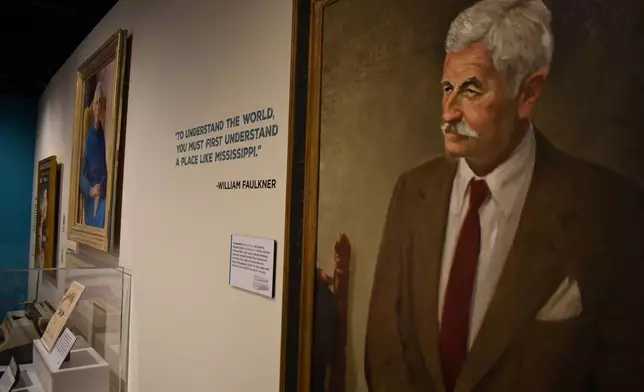
A William Faulkner quote displayed in the Mississippi Made exhibit reads, "To understand the world, you must first understand a place like Mississippi," on Friday, March 27, 2026, in Jackson, Miss. (AP Photo/Sophie Bates)
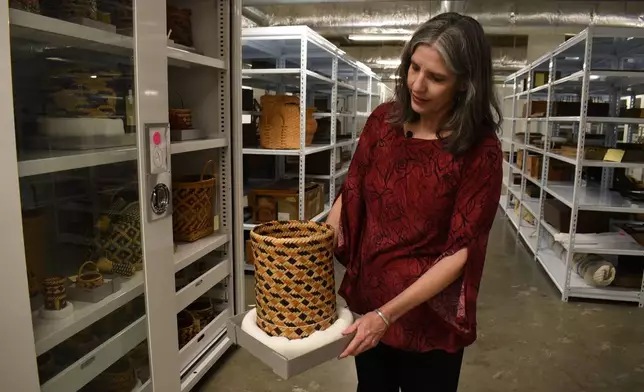
Nan Prince, the director of collections for the Mississippi Department of Archives History, holds a Native America basket in the archives, March 26, 2026, in Jackson, Miss. (AP Photo/Sophie Bates)
Lynching monoliths at the Mississippi Civil Rights Museum display the names of more than 600 victims of documented racial killings, March 26, 2026, in Jackson, Miss. (AP Photo/Sophie Bates)
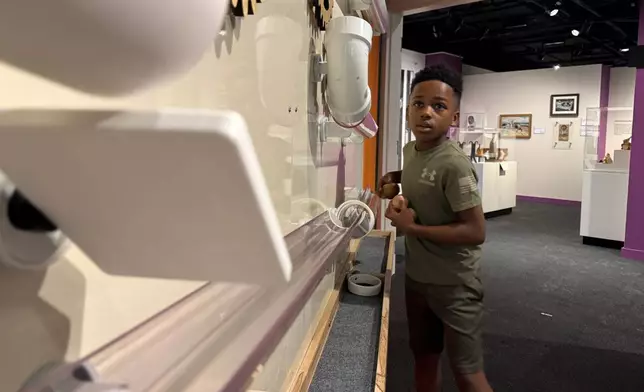
Jackson Strong, 9, plays with an interactive section of the Mississippi Made exhibit on Friday, March 27, 2026, in Jackson, Miss. (AP Photo/Sophie Bates)
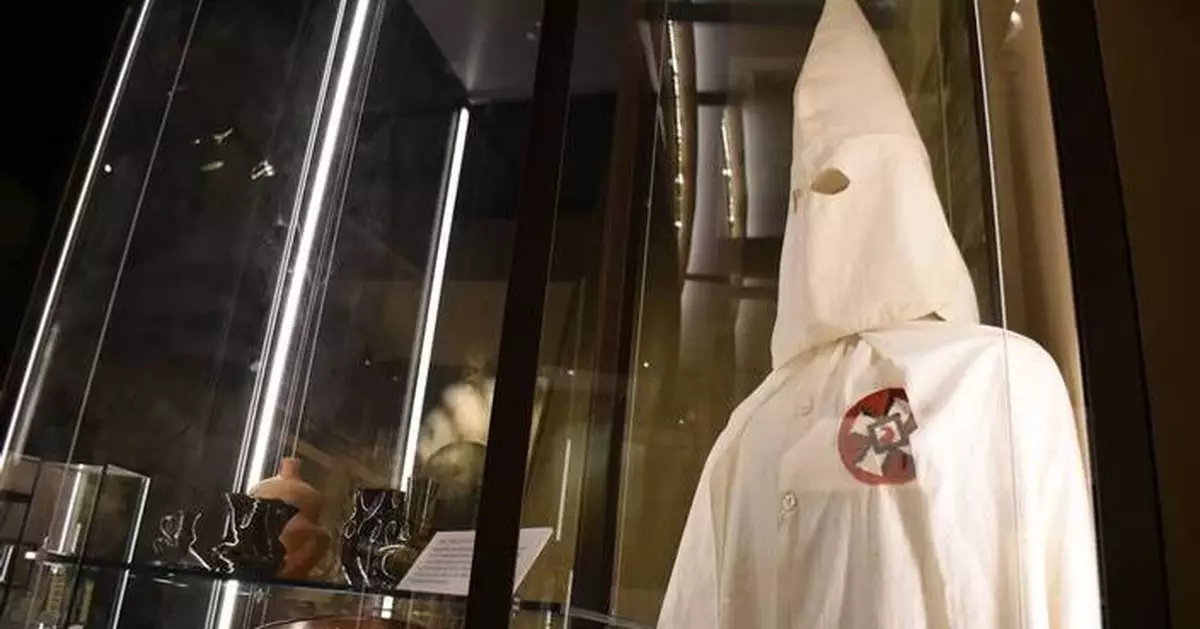
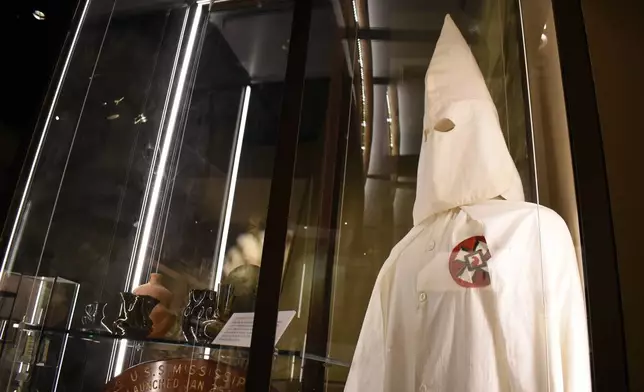
A Ku Klux Klan mask stares out over the Mississippi Museum of History on Friday, March 27, 2026, in Jackson, Miss. (AP Photo/Sophie Bates)
The panels are among thousands of exhibits and artifacts inside the Mississippi Civil Rights Museum and the adjoining Museum of Mississippi History. Called the Two Mississippi Museums, the massive complex in sight of the state Capitol is a central part of the state’s America 250 celebration.
“That’s just the people that we know about," Kiama Johnson, who was visiting from Monroe, Louisiana, said of the victim panels as she sat beyond the display and fought back tears. "Just imagine the ones that we don’t. Imagine the ones that’s never going to be written in history books.”
Mississippi’s warts-and-all approach to reflecting its history as part of the state’s official commemoration of the nation’s 250th anniversary is a stark contrast with what has taken place at the national level since President Donald Trump returned to the White House in January 2025.
Easing the discomfort of a sometimes brutal American history has been a central theme of Trump’s administration. He signed an executive order his first day back in office eliminating diversity, equity and inclusion efforts in the federal government. That, along with a March 2025 executive order, ” Restoring Truth and Sanity to American History,” have led to signs being changed at federal parks, exhibits being altered or in some cases removed, and military bases being renamed.
Part of the Republican administration's preparations to celebrate the 250th anniversary have included putting pressure on federal institutions, including the Smithsonian, to tell a version of history that is less focused on discrimination and episodes of racial violence.
In Mississippi, a temporary exhibit created specifically for the commemoration — Mississippi Made -- fills a space that is routinely changed to entice visitors to return. But it is housed in a space where achievement is intertwined with the state’s dark past involving Native Americans, enslaved people and the Civil Rights era.
Nan Prince, director of collections for the Mississippi Department of Archives & History, said the instructions were simple from scholars, politicians, staff members, and civic and civil rights groups when the museums were being conceived and built.
“Don’t brush over anything, don’t whitewash anything," she said. "Just tell the absolute truth.”
Jackson Mayor John Horhn was a state senator when he began pushing for the Civil Rights Museum in 1999. His efforts finally got a boost when Haley Barbour, a former Republican National Committee chairman, became governor.
Plans for the museum eventually were combined with a parallel effort to move the state history museum from the Capitol grounds, with the complex opening in 2017.
The approach to creating a state history museum was the same — tell the full story, beginning with how Native Americans were removed from the land.
“We said at the beginning we weren’t going to hide anything," Barbour said in an interview, noting that he grew up in an era of segregation. "We weren’t gonna try to justify what was done. That’s what the people wanted — to say, ‘Look, we’re not proud of this, but we’re not going to deny it.’”
Other states have made sure to highlight their diversity in their presentations for the 250th anniversary. The America 250 description for neighboring Alabama includes milestones in the Civil Rights Movement.
Mississippi takes its history head-on. Its “America 250 MS” platform says the state’s history mirrors the American story, with the removal of Native Americans making way for slavery and slavery leading to the Civil War, followed by Reconstruction and the Jim Crow era.
Horhn praised the willingness of Mississippi leaders to use the museums to tell the state's full story.
“We still have issues, we still have a lot of challenges," he said. "But it’s a demonstration that progress has been made.”
The History Museum opens into a gallery that explores Mississippi’s first people, the Native Americans. The entrance is dominated by a 500-year-old canoe, a vivid reminder that Native Americans were here thousands of years before settlers arrived and forced them out, taking the land to begin growing cotton, which was tended by enslaved people.
Across the lobby sits the Civil Rights Museum. The first audio exhibit is abrupt: “We don’t serve your kind,” a menacing voice tells visitors, triggered when they cross the museum threshold.
It is one of several phrases once commonplace in the nation’s segregated past that bombard visitors at the opening to the gallery.
The museum also does not shy away from presenting one of the state's most infamous racial killings, that of Emmett Till. The 14-year-old was kidnapped, tortured and killed in 1955 after being accused of whistling at a white woman in a rural Mississippi grocery store.
Till’s murder was a pivotal moment in the Civil Rights Movement. Thousands came to his funeral in Chicago, and his mother, Mamie Till Mobley, insisted on an open casket so the country could see the gruesome state of her son’s body.
At the end of the narrative, by Oprah Winfrey, visitors can see the .45-caliber pistol used to kill the teenager.
Lindsay Ward, 49, cried in the lobby after touring the Civil Rights Museum. Raised in what she described as a sheltered world in Salt Lake City, she said she had not had any exposure to the topics she encountered during her visit — "this heaviness," as she put it.
Ward, now living in Denver, said she was troubled by how recent some events were.
“We’re not talking about hundreds and hundreds of years ago. We’re talking 60 years. It just made me want to weep," she said. "It doesn’t feel great, but it’s important we understand what happened in the past.”
Connor Lynch, a history teacher and social justice advocate from Chicago, said deciding how history will be told has always been a struggle.
“All we have is human narrative” and that comes with bias, he said. "I do believe that no matter what sort of erasure the country might be doing, we know the stories. We know the truth."
For the America 250 celebration, the museums created ”Mississippi Made," which highlights the state's products and achievements.
There is the common household cleaner Pine-Sol, a Nissan Frontier and a Toyota Corolla, a section citing the state's involvement in the U.S. space program and medical advances such as the first human lung transplant.
There is something else — a display by renowned Mississippi quilter Hystercine Rankin. It is a quilt telling the story of her father being killed in 1939.
Jessica Walzer, the exhibit curator, said she included it because it is one of the few story quilts in the museums’ collection and because it tells part of Mississippi's history.
“I think it’s important to have something kind of striking like that to kind of remind us that Mississippi also has this very difficult history that a lot of people have been through,” she said.
Prince, the state director of collections, said such truth had long been denied. Visitors to antebellum homes, for instance, heard about the families who lived there, but “they would never once tell you about the people that lived behind the house or the people that built the house or the people that worked the fields,” she said.
“For so long," she said, "we just tried to gloss over that because it was uncomfortable.”
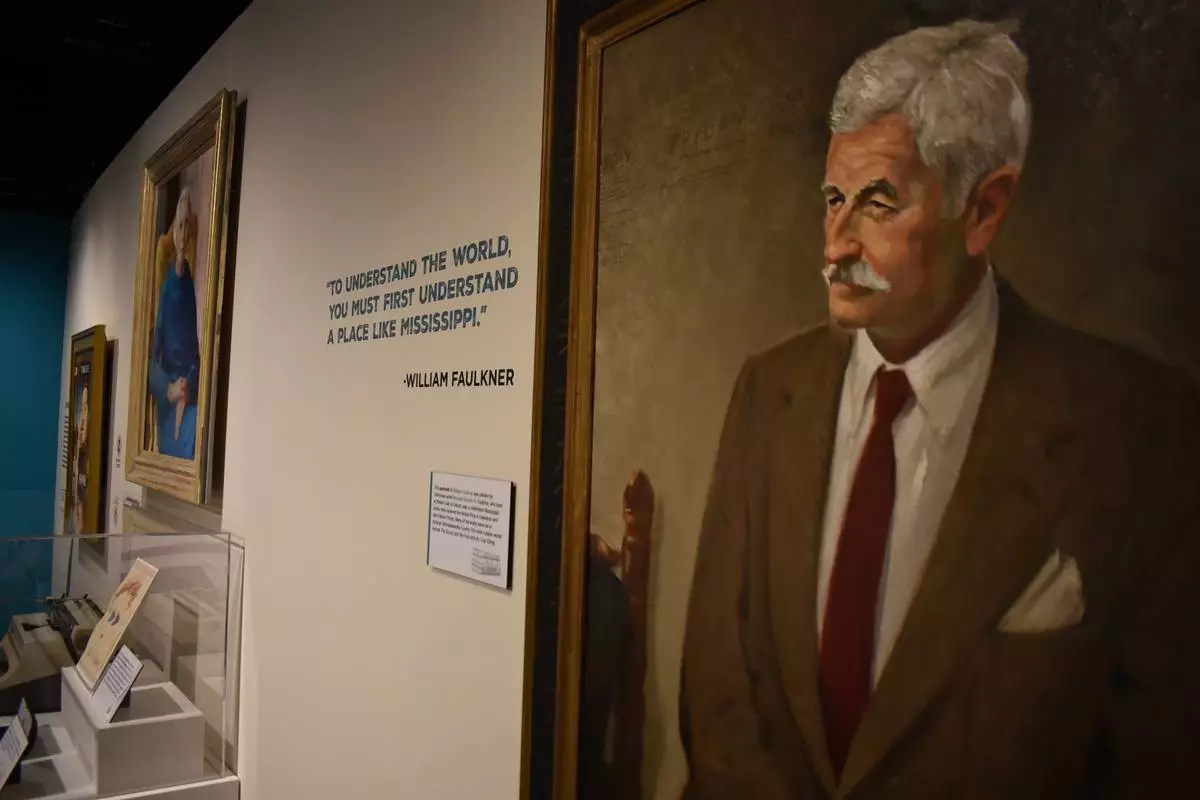
A William Faulkner quote displayed in the Mississippi Made exhibit reads, "To understand the world, you must first understand a place like Mississippi," on Friday, March 27, 2026, in Jackson, Miss. (AP Photo/Sophie Bates)
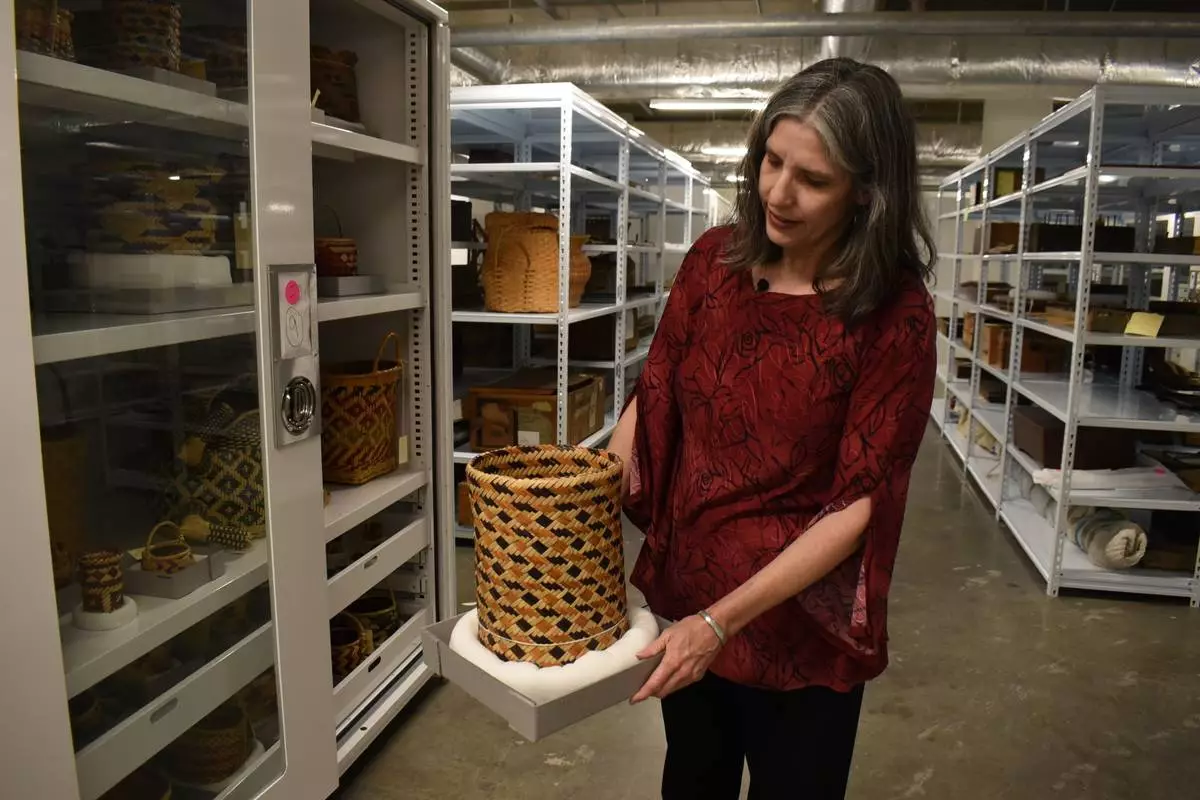
Nan Prince, the director of collections for the Mississippi Department of Archives History, holds a Native America basket in the archives, March 26, 2026, in Jackson, Miss. (AP Photo/Sophie Bates)
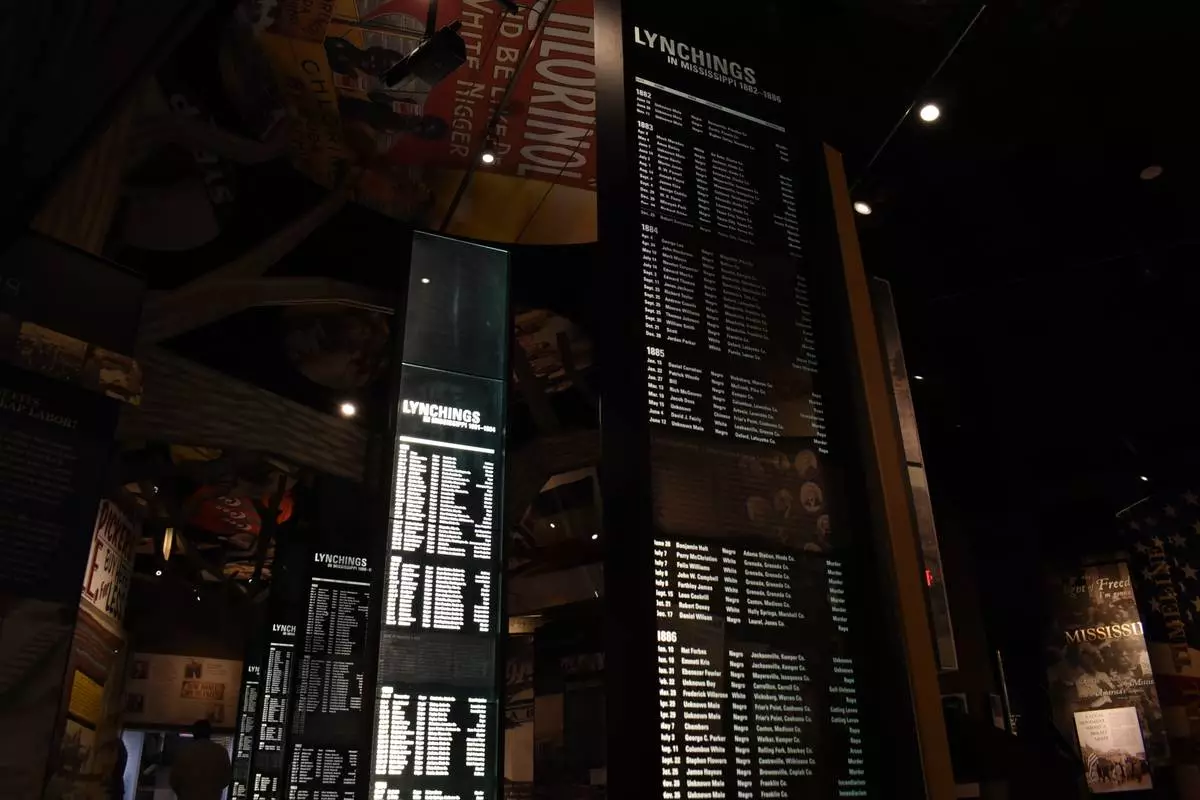
Lynching monoliths at the Mississippi Civil Rights Museum display the names of more than 600 victims of documented racial killings, March 26, 2026, in Jackson, Miss. (AP Photo/Sophie Bates)
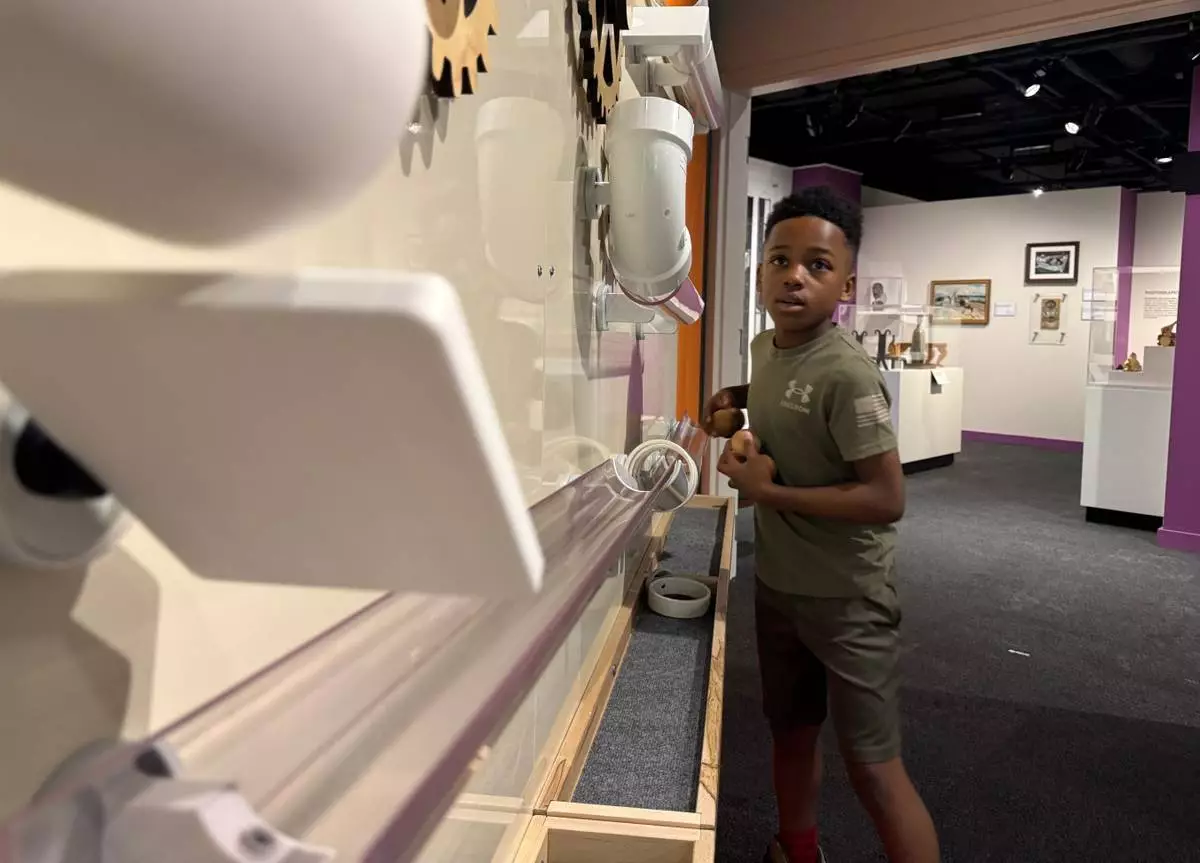
Jackson Strong, 9, plays with an interactive section of the Mississippi Made exhibit on Friday, March 27, 2026, in Jackson, Miss. (AP Photo/Sophie Bates)
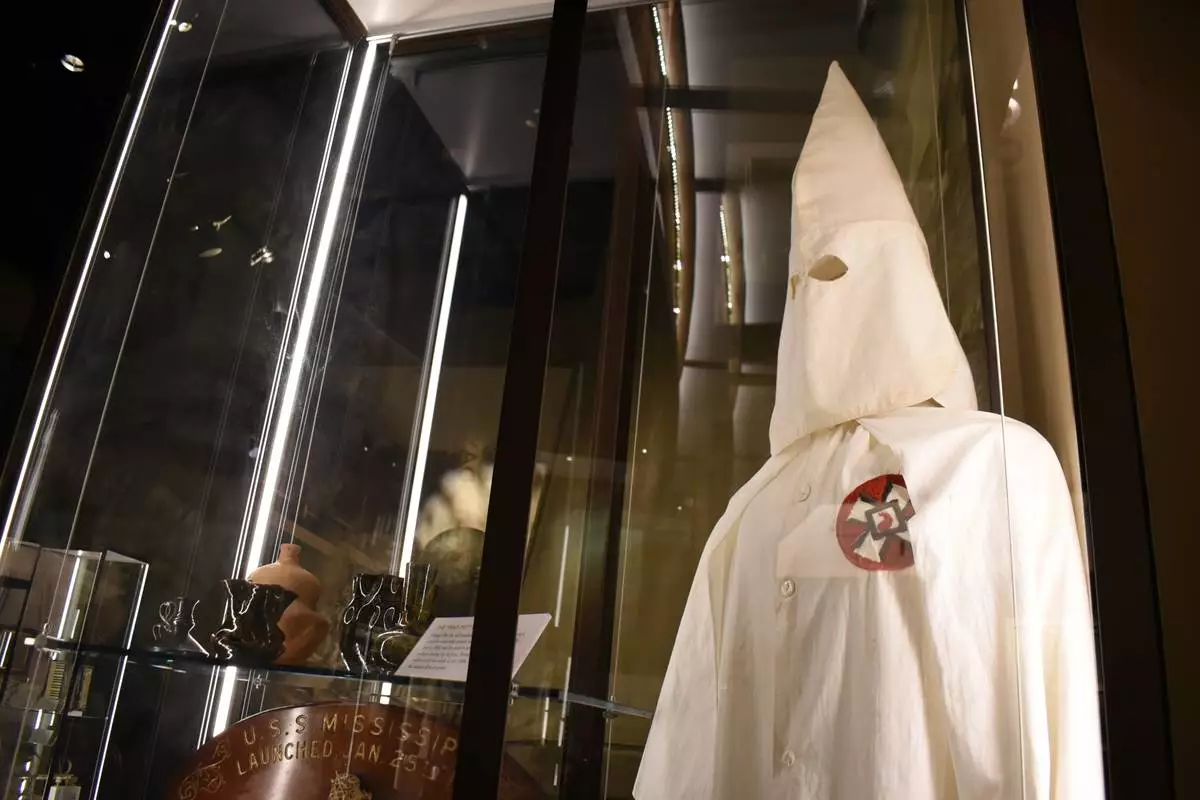
A Ku Klux Klan mask stares out over the Mississippi Museum of History on Friday, March 27, 2026, in Jackson, Miss. (AP Photo/Sophie Bates)
Vice President JD Vance said negotiations between the United States and Iran ended early Sunday without a deal after the Iranians refused to accept U.S. terms to not develop a nuclear weapon.
The high-stakes talks in Pakistan ended after 21 hours, Vance said, with the vice president in constant communication with President Donald Trump and others in the administration.
“But the simple fact is that we need to see an affirmative commitment that they will not seek a nuclear weapon, and they will not seek the tools that would enable them to quickly achieve a nuclear weapon,” Vance told reporters.
The war that has killed thousands of people and shaken global markets entered its seventh week.
The U.S. delegation led by Vance and the Iranian delegation led by parliament Speaker Mohammad Bagher Qalibaf had discussed how to advance a ceasefire already threatened by deep disagreements and Israel’s continued attacks against the Iranian-backed Hezbollah in Lebanon.
Here is the latest:
Across the central Beirut neighborhoods attacked last week in Israel’s deadly bombardment of the city, Orthodox Christians in Lebanon found themselves grasping for solace in their faith and beloved Easter rituals.
Many worshippers said they were still reeling from Wednesday’s Israeli airstrikes, which hit areas of Beirut previously considered safe and killed more than 350 people while wounding over 1,100 others.
“What happened was a crime,” said Ghada Chabo Markossian from Easter services at her Syriac Orthodox church in Msaitbeh, one of several residential neighborhoods devastated in the attack.
“God willing, during this feast, the Lord will set right … these evil things that are happening.”
The priest attributed the low attendance to a chilling fear that has grown more pervasive in the last few days of the Israel-Hezbollah war.
“Many members of the parish are afraid to come, due to the terror they experienced two or three days ago,” the Rev. Daniel Gawriya said.
Leo said Sunday he was “closer than ever” to the people of Lebanon at the end of his noontime prayers, and called on all sides to stop fighting and seek peace.
“The principle of humanity, inscribed in the conscience of every person and recognized in international law, entails the moral obligation to protect the civilian population from the atrocious effects of war,” Leo said.
Though Israel’s strikes over Beirut have calmed in recent days, its attacks on southern Lebanon have intensified alongside a ground invasion it renewed after Hezbollah launched rockets toward Israel in the opening days of the U.S.-Israeli war against Iran.
Leo wished Christians celebrating Orthodox Easter, and said he hoped especially that the international community doesn’t turn its back on the “beloved people of Ukraine.”
He noted that Wednesday marks the third anniversary of the “fratricidal war” in Sudan, and appealed for talks to end what he called an “inhuman tragedy.”
Iran’s First Vice President Reza Aref said Tehran sought U.S. recognition of its control of transit through the Strait of Hormuz in the collapsed Islamabad talks.
Iran having “authority in the Strait of Hormuz” and pursuing compensation for the damage caused by U.S. and Israeli strikes were “the rights of the (Iranian) people," he said.
“This is our firm commitment to a strong Iran,” Aref wrote on social media.
In a series of posts on X, Parliament Speaker Mohammad Bagher Qalibaf said the Iranian delegation provided “forward-looking initiatives” during the 21-hour talks but the Americans could not gain Iran’s trust.
He said now is the time for the U.S. “to decide whether it can gain our trust or not.”
He didn’t elaborate. But Iranian state media reported earlier that major points of disagreement included Iran’s nuclear program and transit through the Strait of Hormuz.
Israeli Prime Minister Benjamin Netanyahu on Saturday criticized Turkish President Recep Tayyip in a post on X in which he wrote: “Israel under my leadership will continue to fight Iran’s terror regime and its proxies, unlike Erdogan who accommodates them and massacred his own Kurdish citizens.”
In response, Omer Celik, spokesperson of the ruling Islamic-oriented Justice and Development Party, or AKP, said Sunday that Israel’s comments aimed to sabotage the peace talks in Pakistan, foment unrest among the Kurdish minority and pit Turkey against Iran.
Numan Kurtulmus, the speaker of Turkey’s parliament, called Netanyahu “the ringleader terrorist of the 21st century’s massacre and terror network.”
“The audacity of someone whose hands are stained with children’s blood — someone pursued by international law — to presume to lecture Turkey on morality is merely an indicator of his efforts to cover up his own crimes against humanity, and it holds no validity whatsoever,” Kurtulmus said.
The strike on Sunday morning hit a home of seven people in the Lebanese town of Maaroub, Lebanon’s state-run National News Agency reported.
The strike came without warning, and Israel did not immediately comment on it.
Israel’s government has said its strikes target operatives or infrastructure belonging to the Hezbollah militant group.
Israeli strikes over Beirut have decreased in recent days, but its attacks on southern Lebanon have intensified alongside a ground invasion.
Iran's state-run TV said the delegation left Pakistan's capital after talks with the U.S. failed to reach a deal.
The East-West pipeline, used to send oil to the Red Sea for transport, was repaired after an attack, the Saudi Energy Ministry said in a statement Sunday. It said it has full capacity of about 7 million barrels a day.
The pumping station was attacked Thursday, affecting about 700,000 barrels of output through the pipeline, which has allowed Saudi Arabia to continue exporting a substantial portion of its oil.
Saudi Aramco operates the pipeline from the Aqaiq oil processing center near the Persian Gulf to the Yanbu port on the Red Sea, avoiding the Iranian chokepoint on the Strait of Hormuz and the Persian Gulf. The ministry said the Manila oil field was also repaired, restoring a capacity of around 300,000 barrels a day.
It said work was still underway at another field, Kurais, to restore a capacity of another 300,000 barrels a day.
Iran’s Foreign Ministry said Sunday that negotiations with the U.S. fell apart over a “gap between our opinions over two or three important issues.”
“Ultimately the talks didn’t result in an agreement,” spokesman Esmaeil Baghaei told Iran’s state TV. He did not detail what those issues were.
On some topics, Baghaei said U.S. and Iranian negotiators “actually reached mutual understanding.” The negotiators discussed the Strait of Hormuz, Baghaei said, but did not mention discussion of nuclear weapons.
Pakistan’s Foreign Minister Ishaq Dar called on Iran and the United States to keep their commitment to maintain a ceasefire, after both countries ended historic face-to-face talks without an agreement.
“It is imperative that the parties continue to uphold their commitment to ceasefire,” Dar said.
He added that Pakistan will continue to play is mediating role and will try to keep facilitating the dialogue between Iran and the U.S. in coming days.
Vice President JD Vance boarded his government plane at 7:08 a.m. local time in Islamabad, planning to depart Pakistan after he said that Iran declined to back down on developing a nuclear weapon.
That’s according to a reporter traveling with Vance.
The war with Iran started at the end of February and the extensive talks ended after 21 hours. The U.S. and Iran agreed to a two-week ceasefire on April 7 for negotiations.
Vice President JD Vance said negotiations between the U.S. and the Iranians have ended without a peace deal after the Iranians refused to accept American terms to not develop a nuclear weapon.
The high-states talks ended after 21 hours, Vance said, with the vice president in constant communication with President Donald Trump and others in the administration.
“But the simple fact is that we need to see an affirmative commitment that they will not seek a nuclear weapon, and they will not seek the tools that would enable them to quickly achieve a nuclear weapon,” Vance told reporters. “That is the core goal of the president of the United States. And that’s what we’ve tried to achieve through these negotiations.”
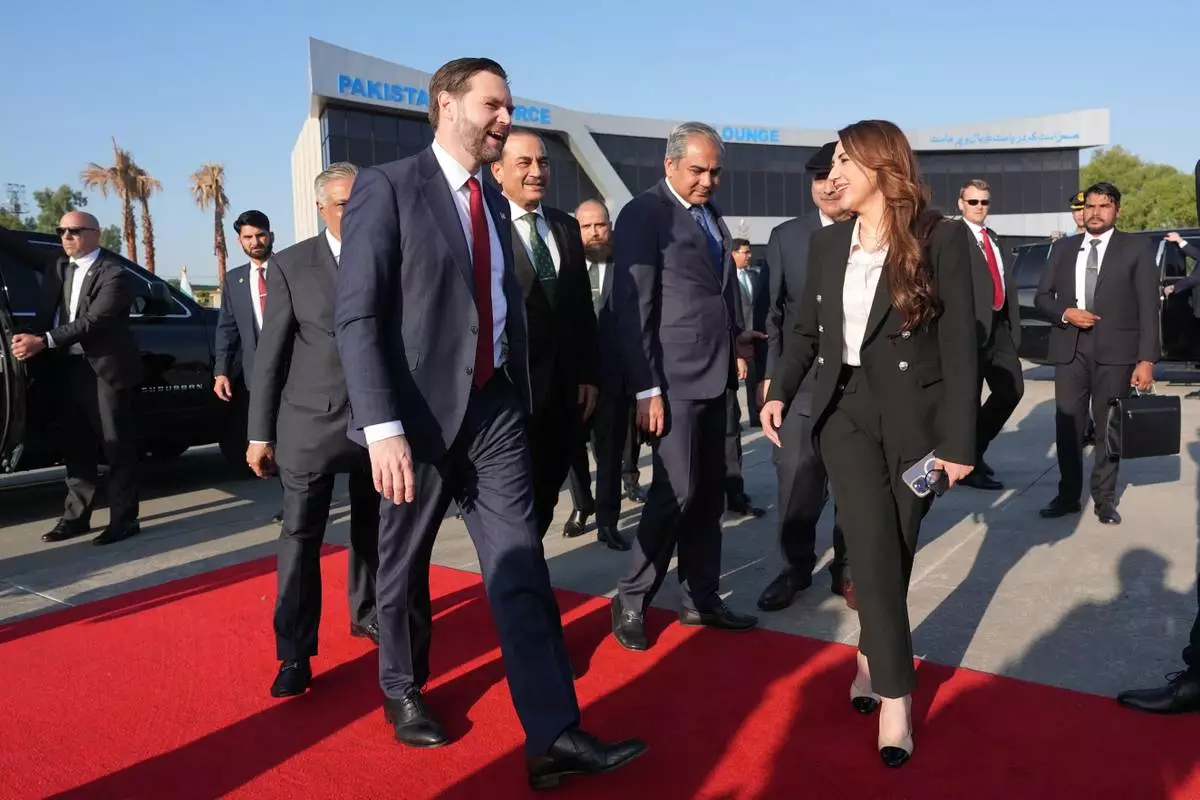
Vice President JD Vance walks with Pakistani Deputy Prime Minister and Foreign Minister Mohammad Ishaq Dar, partially seen on the left, Pakistan's Chief of Defence Forces and Chief of Army Staff Field Marshall Asim Munir, third left, Pakistan's Interior Minister Mohsin Naqvi, and Charge d'Affaires of the U.S. Embassy in Islamabad Natalie A. Baker, right, before boarding Air Force Two after attending talks on Iran in Islamabad, Pakistan, Sunday, April 12, 2026. (AP Photo/Jacquelyn Martin, Pool)
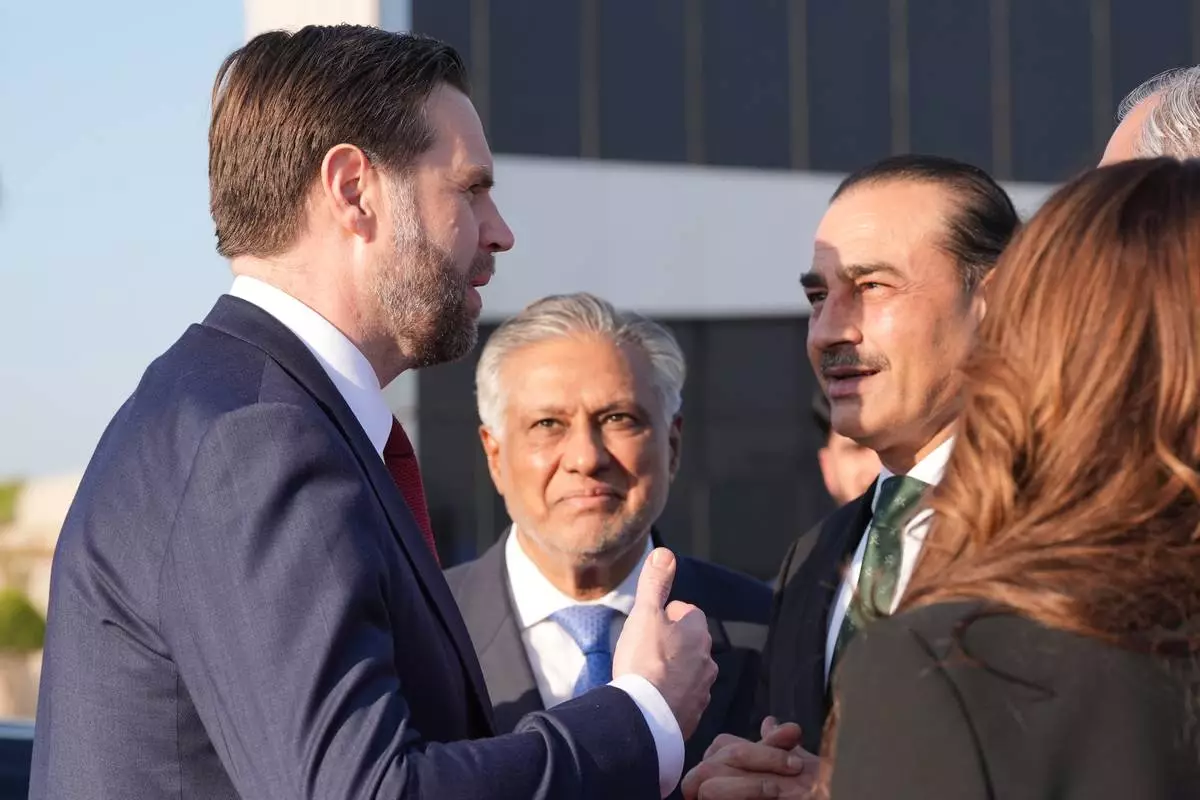
Vice President JD Vance, left, talks to Pakistan's Chief of Defence Forces and Chief of Army Staff Field Marshall Asim Munir, right, and Pakistani Deputy Prime Minister and Foreign Minister Mohammad Ishaq Dar, center, before boarding Air Force Two after attending talks on Iran in Islamabad, Pakistan, Sunday, April 12, 2026. (AP Photo/Jacquelyn Martin, Pool)

Vice President JD Vance gives a thumb up sign as he boards Air Force Two after attending talks on Iran in Islamabad, Pakistan, Sunday, April 12, 2026, . (AP Photo/Jacquelyn Martin, Pool)
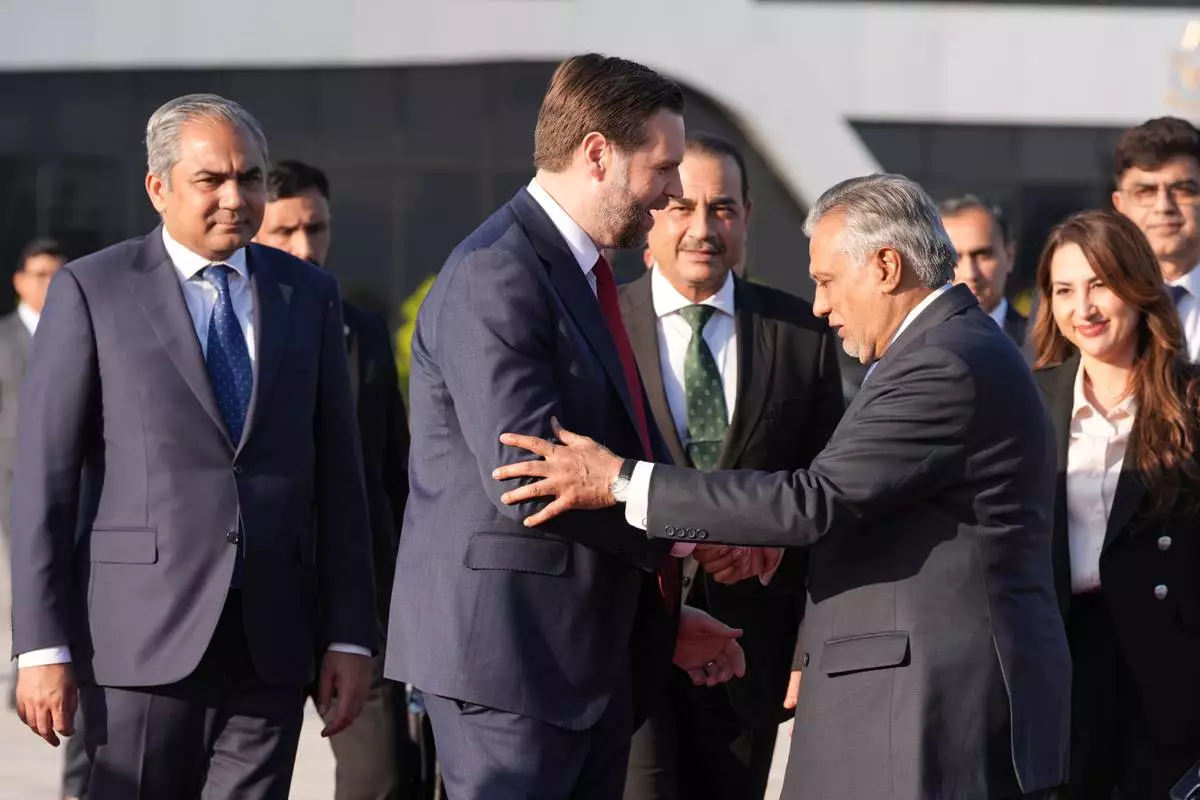
Vice President JD Vance, second left, shakes hands with Pakistani Deputy Prime Minister and Foreign Minister Mohammad Ishaq Dar, as Pakistan's Interior Minister Mohsin Naqvi, left, Pakistan's Chief of Defence Forces Chief of Army Staff Field Marshall Asim Munir, third left, and Charge d'Affaires of the U.S. Embassy in Islamabad Natalie A. Baker, right, look on, as he prepares to board Air Force Two after attending talks on Iran in Islamabad, Pakistan, Sunday, April 12, 2026. (AP Photo/Jacquelyn Martin, Pool)