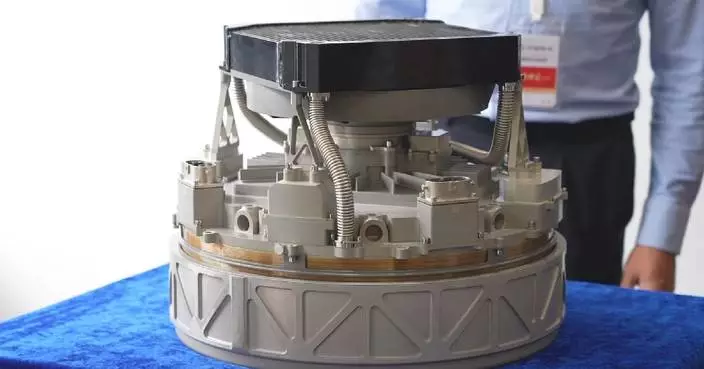
China has recently launched its first automotive testing hub in Kunming, the capital of southwest China's Yunnan Province, designed to replicate overseas high-altitude conditions, allowing domestic vehicles to undergo tests comparable to those in high-altitude regions abroad without leaving the country.
The facility, located at an elevation of nearly 2,000 meters, boasts a range of testing sections, including a high-altitude dynamic testing area, straight-line performance tracks, a "Mexico road" section, tracks used to measure pass-by noise during acceleration, and steep gradients, all of which are designed to simulate road environments in high-altitude countries.
Jiang Bigang, an engineer specializing in high-altitude vehicle testing at the China Automotive Technology and Research Center Co,.Ltd. (CATARC), drove a vehicle to demonstrate a 40-percent gradient slope.
"First, at high altitudes, engine power is naturally affected. Second, steep-slope conditions like this are quite common in overseas markets. These tests are designed to assess vehicles' climbing performance, to see whether they can handle the more demanding requirements of climbing steep inclines under plateau conditions, where engine power is constrained," he said, explaining the purpose of setting up such test scenarios.
The engineer also demonstrated a section known as the "Mexico road," which simulates complex road conditions in the country, including raised and concave speed bumps.
"What we are experiencing now is one of the most challenging roads at this facility. This is a 25-centimeter-wide convex speed bump with a semi-cylindrical shape. In Mexico, where driving speeds tend to be relatively high, such elevated speed bumps are built in some places to force vehicles to slow down. These road configurations are intended to test the strength of the vehicle body structure and its overall adaptability," Jiang said.

China launches its first high-altitude auto testing hub to simulate overseas road conditions

Israel's influence on the Trump administration outsizes the already significant sway it held over previous presidencies, contributing to miscalculations that ultimately led to strikes on Iran and putting the temporary ceasefire at risk, said a U.S. expert.
After about 40 days of deadly clashes, the United States and Iran reached a two-week ceasefire on Wednesday, with Israel supporting the truce. However, the truce remains deeply fragile, especially as Israel continues to attack Lebanon, which Iran has called a violation of the ceasefire and threatened a strong response if it continues.
However, the power of the Israel lobby in the United States, especially over the Trump Administration, may weaken its ability to rein in Israeli military action, said Anton Fedyashin, an associate professor at American University.
"The Trump administration has no one but itself to blame. Although it is acting in a very important context, which is the general, enormous influence of the Israeli government over all American administrations, except that under Trump, this influence of course is greater than ever before. Israel has a very powerful lobby in the United States. This is absolutely no secret; not only articles, but very good books have been written about this," he said in an interview with China Global Television Network.
Fedyashin said this influence, combined with poor intelligence, contributed to what he described as a misjudgment that Iran's government would easily fall.
"The problem is that while previous presidents have managed to somehow resist that lobby, Donald Trump seems to have completely fallen for Benjamin Netanyahu's case to convince him that the attack on Iran will be lightning fast, will achieve results very quickly. And this becomes a very important question about the quality of Mossad information, because along with Benjamin Netanyahu in the White House meeting, which happened on February 11, at least according to New York Times, was the head of the Israeli Mossad, and both Netanyahu and the head of Mossad were convincing Trump that Iran's government is on its last legs, that all it needs is a slight push, and that was a catastrophic misjudgment," he said.
US influence over Israel limited as attacks on Lebanon threaten to shatter ceasefire: expert