China's first independently developed subsea cable inspection robot has been officially put into operation, providing a new technological solution for safeguarding deep-sea energy and communication network security.
The underwater intelligent equipment integrates sonar, electromagnetic detection, and mechanical manipulation capabilities. It can autonomously inspect subsea cables at depths of up to 300 meters. When operating in coordination with unmanned surface vessels, its efficiency will be 10 times greater than that of traditional manual inspections.
Through electromagnetic waves, the robot can detect cables buried in seabed sediment and identify faults such as wear and tear or fractures. It is equipped with a five-degree-of-freedom robotic arm that can flexibly grasp cables from any angle. Its propulsion system consists of eight thrusters, with four dedicated to vertical diving and surfacing, and the other four controlling horizontal forward and backward movement.
Functioning like an underwater "scout," the robot can travel at a speed of 5 to 7 kilometers per hour, which is comparable to a human's brisk walking or jogging pace.
It is equipped with lighting systems to illuminate the seabed, providing a clear view of the underwater environment. The robot also carries magnetic and spectral detectors, enabling it to autonomously inspect subsea cables. This process is similar to a CT scan, allowing it to detect various types of damage to the cables with high precision.
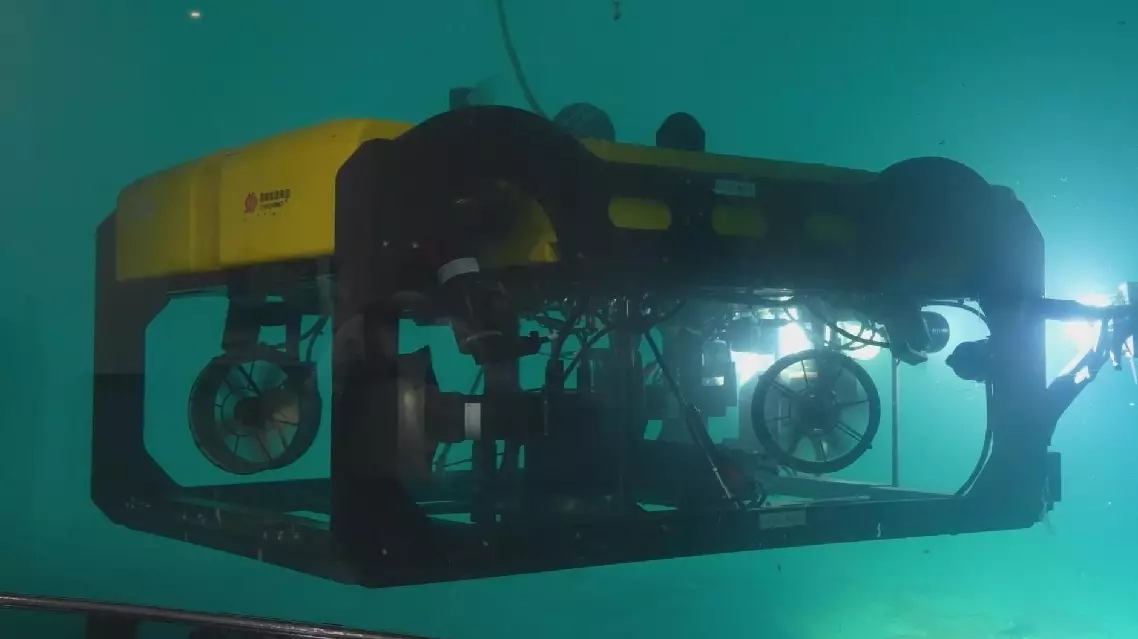
China's first home-grown submarine cable inspection robot put into operation