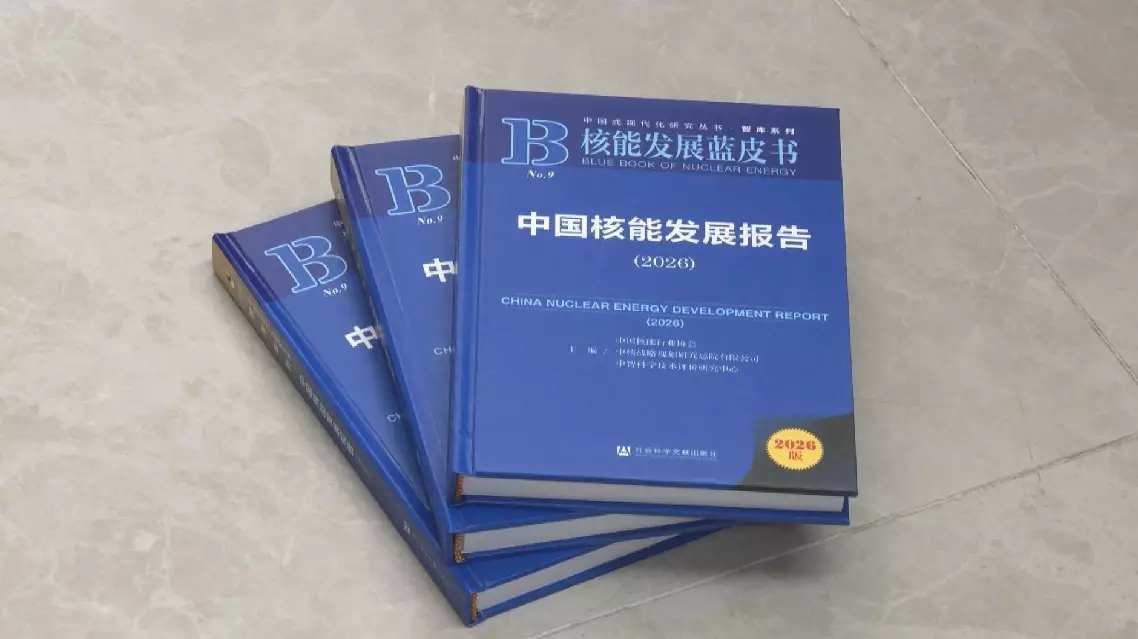
China has become the world leader in total installed capacity of nuclear power, according to a blue book released by the China Nuclear Energy Association (CNEA) on Friday.
Titled "China Nuclear Energy Development Report," the blue book said that China's total installed capacity of nuclear power units in operation, under construction, and approved for construction stands at approximately 125 million kilowatt (KW), ranking first globally.
The blue book shows that China's nuclear power units have maintained long-term safe and stable operation, with steady progress in new unit construction.
In 2025, China proved five nuclear power projects, including 10 units such as the phase III project of the Sanmen Nuclear Power Station in the eastern province of Zhejiang and the phase II project of the Taishan Nuclear Power Plant in the southern province of Guangdong.
So far this year, China has begun construction on two new nuclear power units and is set to complete seven. The scale of nuclear power facilities under construction continues to lead the world.
"So far, China has 60 nuclear power units under commercial operation and 36 under construction, accounting for more than half of the global total under construction. Meanwhile, there are 16 approved units awaiting construction. China's installed capacity of nuclear power continues to grow, reaching 125 million kilowatts and ranking first in the world. This helps to facilitate the clean and low-carbon transformation of China's energy structure," said Cao Shudong, executive vice president of the CNEA.
The report also highlighted that Hualong One, a Chinese Generation III pressurized water reactor, has entered a new phase of batch construction, driven by its time-efficient construction process and stable supply chain.
The latest data shows that the total number of Hualong One units in operation or under construction, both domestically and internationally, has exceeded 40, making it the most widely deployed third-generation nuclear power reactor type in the world.
"During the 14th Five-Year Plan period (2021-2025), the Hualong One maintained an annual construction scale of six to eight units. During the 15th Five-Year Plan period (2026-2030), the Hualong One will continue to see batch and large-scale construction, with ongoing improvements in safety, advanced technology, economic viability, operational maturity, and environmental friendliness," said Tang Qing, deputy general manager of Hualong Nuclear Power Technology Co., Ltd..
The blue book also shows that China's nuclear power generation continues to rise. The total nuclear power generation in 2025 reached 467.7 billion kilowatt-hours, accounting for 4.82 percent of the country's total electricity generation. This represented an annual reduction in carbon dioxide emission equivalent to approximately 350 million tons.
China leads world in total installed capacity of nuclear power: report