PARIS (AP) — Nathalie Baye, a French actor who was a fan's favorite for her her down-to-earth charm and great versatility, has died. She was 77.
French president Emmanuel Macron paid tribute to an actor “with whom we loved, dreamed and grew.” French media reported that Baye died on Friday in Paris from a neurodegenerative disease, quoting a statement from her relatives.
“We loved Nathalie Baye so much,” Macron wrote in a message on X. “Through her voice, her smiles, and her modesty, she accompanied the past decades of French cinema, from François Truffaut to Tonie Marshall.”
Baye featured in more than 80 movies, switching from mainstream comedies to auteur films with ease in a career that spanned over five decades. She twice claimed the prize for best actress at the Césars, France’s equivalent of the Oscars.
Baye, who was Leonardo DiCaprio’s on-screen mother in Steven Spielberg’s “Catch Me If You Can,” won both popular and critical acclaim for her role in “Venus Beauty Institute,” a romantic comedy that follows three women working in a Parisian beauty salon as they search for fulfilment. Marshall won the César award for best director in 2000 for the movie.
The daughter of artists, Baye first trained as a dancer then honed her acting skills at the famed Cours Simon and the Conservatoire. She took the spotlight in François Truffaut's “Day for Night” in 1973 and, five years later, worked with him again on “The Green Room.”
Baye worked with directors Maurice Pialat, Claude Sautet and Bertrand Tavernier, among others. She rose to fame with “The Return of Martin Guerre” in 1982. A year later, her role as a tough-talking streetwalker devoted to her down-and-out gangster boyfriend Philippe Leotard in “La Balance” earned her a César.
Baye liked to work with emerging filmakers such as Xavier Beauvois. She won the César for best actress for his movie “The Young Lieutenant” in 2006.

FILE - Actress Nathalie Baye poses for photographers during a photo call for the film Juste La Fin Du Monde (It's Only The End Of The World) at the 69th international film festival, Cannes, southern France, May 19, 2016. (AP Photo/Thibault Camus, File)

FILE - French actress Natalie Baye acknowledges applause after she received a Cesar award for her performance as best actress, Feb. 25, 2006 during the Cesars Awards, the French Academy Awards in Paris. Baye was awarded for her performance in French director's Xavier Beauvois "Le petit Lieutenant". (AP Photo/Francois Mori, File)

FILE - Actress Nathalie Baye poses for photographers upon arrival at the screening of the film Juste la Fin du Monde (It's Only the End Of The World) at the 69th international film festival, Cannes, southern France, May 19, 2016. (AP Photo/Lionel Cironneau, File)
Iran reversed its decision to reopen the Strait of Hormuz and warned that it would continue to block transit through the strait as long as the U.S. blockade of Iranian ports remained in effect.
The escalating standoff over the critical choke point threatened to deepen the energy crisis roiling the global economy and push the two countries toward renewed conflict, even as mediators expressed confidence that a new deal was within reach.
The strait is closed until the U.S. blockade is lifted, Iran’s Revolutionary Guard navy said Saturday night. Hours earlier, two gunboats from Iran’s Revolutionary Guard opened fire on a tanker transiting the Strait of Hormuz, the British military’s United Kingdom Maritime Trade Operations center said. It reported that the tanker and crew were safe, without identifying the vessel or its destination.
Roughly one-fifth of the world’s oil passes through the strait and further limits would squeeze the already constrained supply, driving prices higher once again. Meanwhile, a 10-day truce between Israel and the Iran-backed Hezbollah militant group in Lebanon appeared to be holding.
The fighting in the Middle East conflict, which is approaching the two-month mark, has killed at least 3,000 people in Iran, nearly 2,300 in Lebanon, 23 civilians and 15 soldiers in Israel, and more than a dozen in Gulf Arab states. Thirteen U.S. service members have also been killed.
Here is the latest:
Speaking at the end of his Mass in Kilamba, Angola, Leo said the ceasefire between Israel and Hezbollah was a “sign of relief for the Lebanese people.”
He said: “I encourage those who have been committed to the search for a diplomatic solution to continue peace talks so that the end of hostilities throughout the Middle East becomes permanent.”
Leo said he prays for a permanent ending of hostilities in the Middle East.
The pope is on an 11-day, four-nation African journey that has been characterized by repeated appeals for peace.
Pakistani authorities have begun tightening security in the capital, Islamabad, ahead of a possible second round of ceasefire talks between the U.S. and Iran.
Authorities on Sunday deployed troops at roadside checkpoints, closed tourist sites and ordered major hotels to cancel bookings and keep facilities available.
Islamabad’s streets are largely deserted, as residents stayed home to avoid road closures seen earlier this month during the first round of talks.
While there were no formal announcements, Pakistani officials said arrangements are in place for talks in the coming days.
A regional official involved in the mediation efforts said mediators were finalizing the preparations. He said U.S. advance security teams are already on the ground. The officials spoke on condition of anonymity to discuss the preparations.
Pakistan has led mediation efforts to end the war. Its military chief visited Tehran last week, while Prime Minister Shehbaz Sharif met with regional leaders in Saudi Arabia, Qatar and Turkey.
The Israeli army says it carried out a series of strikes that killed more than 150 Hezbollah fighters.
Among those killed was Ali Rida Abbas, which it said was Hezbollah’s commander in Bint Jbeil. The southern Lebanese town and its surroundings were the site of intense clashes between Israeli troops and Hezbollah militants in the days leading up to the ceasefire.
Israel gave no evidence to support its claims, and Hezbollah didn't immediately confirm the death of its commander.
The ceasefire took effect early Friday.
Iran’s chief negotiator says his country wants “a lasting peace so that war is not repeated again.”
Parliamentary Speaker Mohammad Bagher Qalibaf made the comments in a televised interview late Saturday, a few days before a ceasefire deadline is set to expire, according to Iranian state media.
“What is fundamental for us is distrust of the United States,” he said. “At the same time, we have good intentions and seek a lasting peace — one that prevents the recurrence of war.”
He said that the Islamabad negotiations didn’t address the mistrust, but that the U.S. and Iranian negotiators “reached a more realistic understanding of one another.”
He said that the two sides achieved progress in the Islamabad talks, but disagreement remained on some key issues, including the nuclear program and the Strait of Hormuz.
“The gaps remain wide and some fundamental issues are still unresolved,” he said.
He didn’t elaborate with further details.
The Lebanese army said in a statement Sunday that it reopened the Khardali road that links the southern city of Nabatiyeh with the town of Marjayoun.
The army said that it also reopened the road that links the port city of Tyre with the village of Bourj Rahhal. The army is also working on reopening other roads, including a bridge on the Litani River in the village of Tayr Filsay.
During Israel’s invasion of southern Lebanon over the past several weeks, Israel’s air force has destroyed several bridges on the river.
After a 10-day ceasefire was declared as of midnight Thursday, the Lebanese army and the Litani Authority have been working on putting up temporary bridges to replace the destroyed ones.
Iran’s parliamentary Speaker Mohammed Bagher Qalibaf says the Strait of Hormuz will remain closed as long as the U.S. imposes a naval blockade on Iran.
“It is impossible for others to pass through the Strait of Hormuz while we cannot,” he said in televised comments aired by Iranian semiofficial media late Saturday.
Qalibaf, who is Iran’s chief negotiator with the United States, said that the strait is now under Iran’s control, linking the choke point’s reopening to the U.S. lifting of its blockade.
“If the U.S. does not lift the blockade, traffic in the Strait of Hormuz will definitely be restricted,” he said.
He said that the ceasefire was on verge of collapse when the U.S. attempted to mine-clear the strait.
He said Iran viewed the U.S. attempt as a violation of the ceasefire.
“The situation escalated to the point of conflict but the enemy retreated,” he said.
Israel’s military says another soldier died in combat in southern Lebanon, the second death announced in under 12 hours.
It brought the total number of soldiers killed in Lebanon to 15, and was the second soldier killed in combat since the ceasefire.
The military said that another soldier was badly wounded, along with four moderately wounded and four slightly injured.
The navy of Iran’s Revolutionary Guard Corps said that it extended the closure to the corridor it had earlier designated for the safe passage of vessels through the strategic waterway and declared the strait fully closed until the U.S. blockade on Iranian ports and ships is lifted.
On Friday, Iran said that vessels could move through the strait in coordination with it and against the payment of a toll.
But in a statement late Saturday carried by Iran’s state media, the navy warned that any violating vessel would be targeted.
Iran considers the U.S. blockade a violation of the ceasefire between the two countries. Two vessels were attacked earlier on Saturday in the Strait of Hormuz and off Oman’s coast, at least one of them by Iranian gunboats.
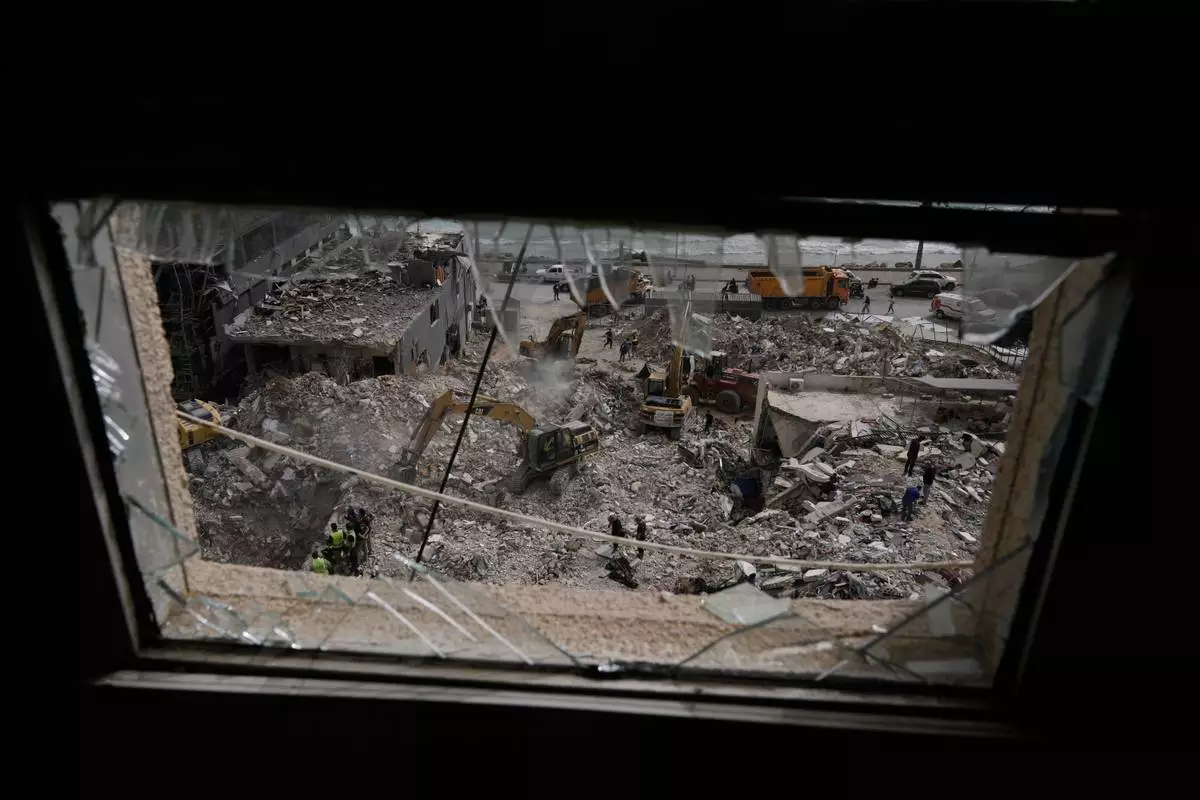
Excavators remove rubble from destroyed buildings that were hit on Thursday by Israeli airstrikes, as they keep searching for victims in Tyre city, southern Lebanon, Saturday, April 18, 2026. (AP Photo/Bilal Hussein)
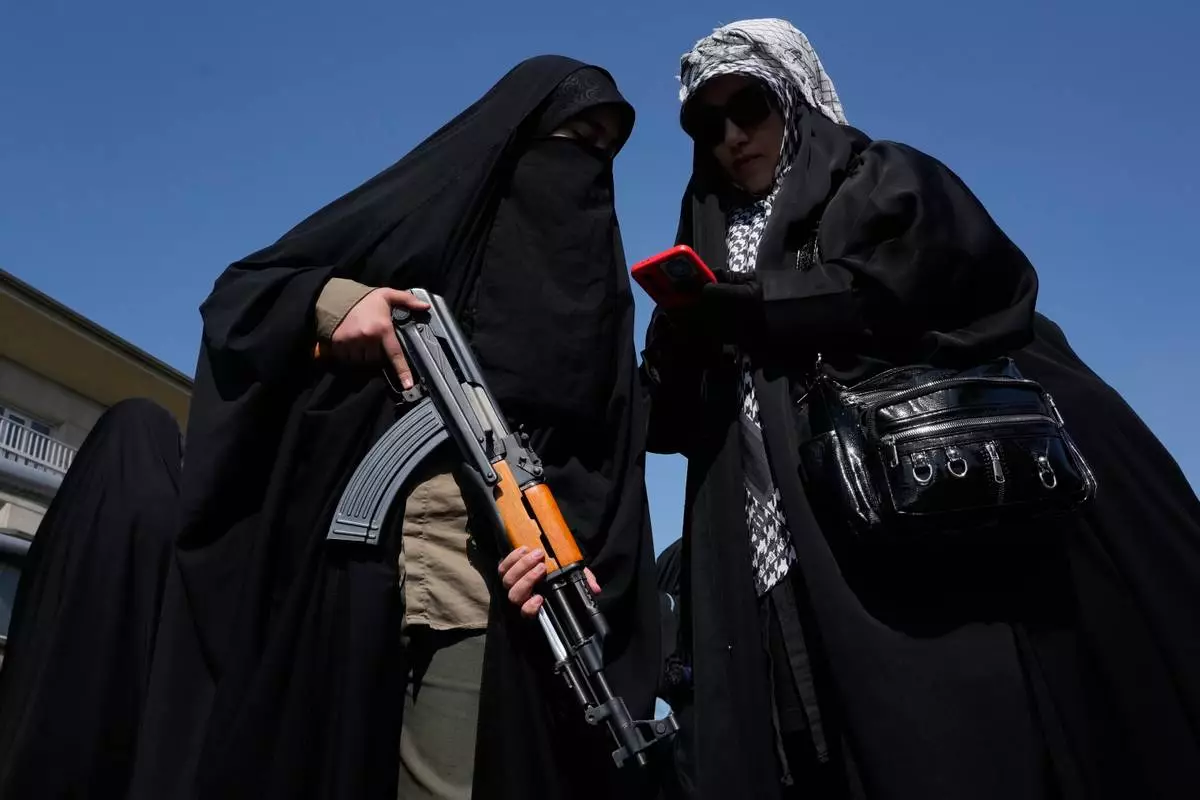
A woman member of the Basij paramilitary, affiliated with Iran's Revolutionary Guard, holds her gun during a state-organized rally in support of the supreme leader marking National Girl's Day in Tehran, Iran, Friday, April 17, 2026. (AP Photo/Vahid Salemi)
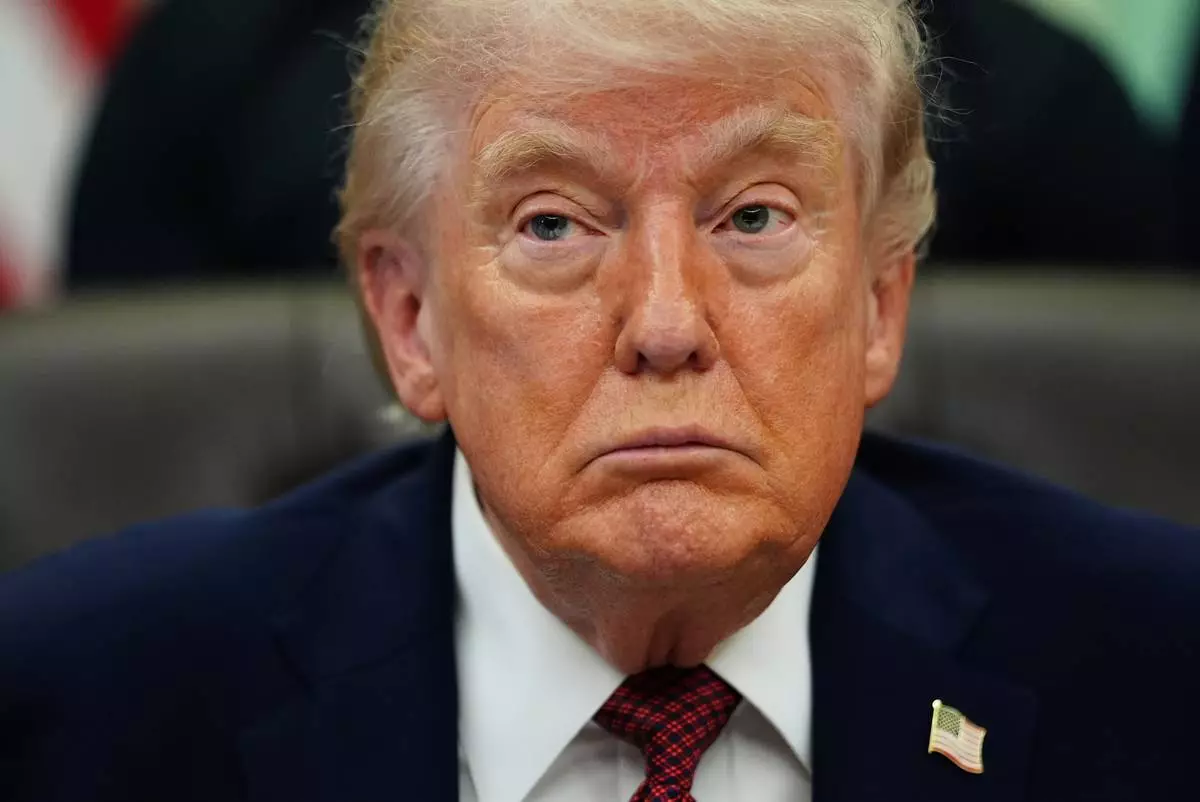
President Donald Trump listens to speeches before signing an executive order in the Oval Office of the White House, Saturday, April 18, 2026, in Washington. (AP Photo/Julia Demaree Nikhinson)
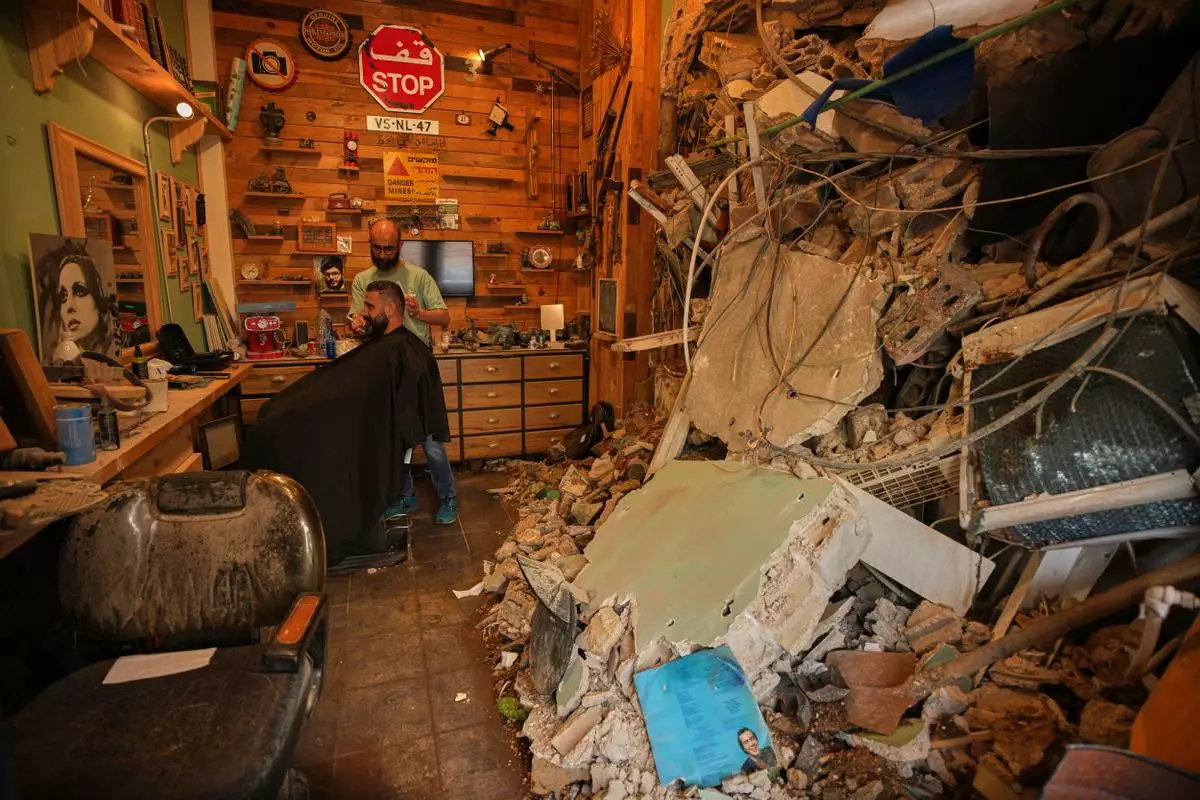
Barber Mohammad Mehdi cuts the hair of his client Ayman Al Zein inside his shop, which was damaged in an Israeli airstrike that also damaged Al Zein's shop, in Dahiyeh, Beirut's southern suburbs, Lebanon, Saturday, April 18, 2026. (AP Photo/Hassan Ammar)
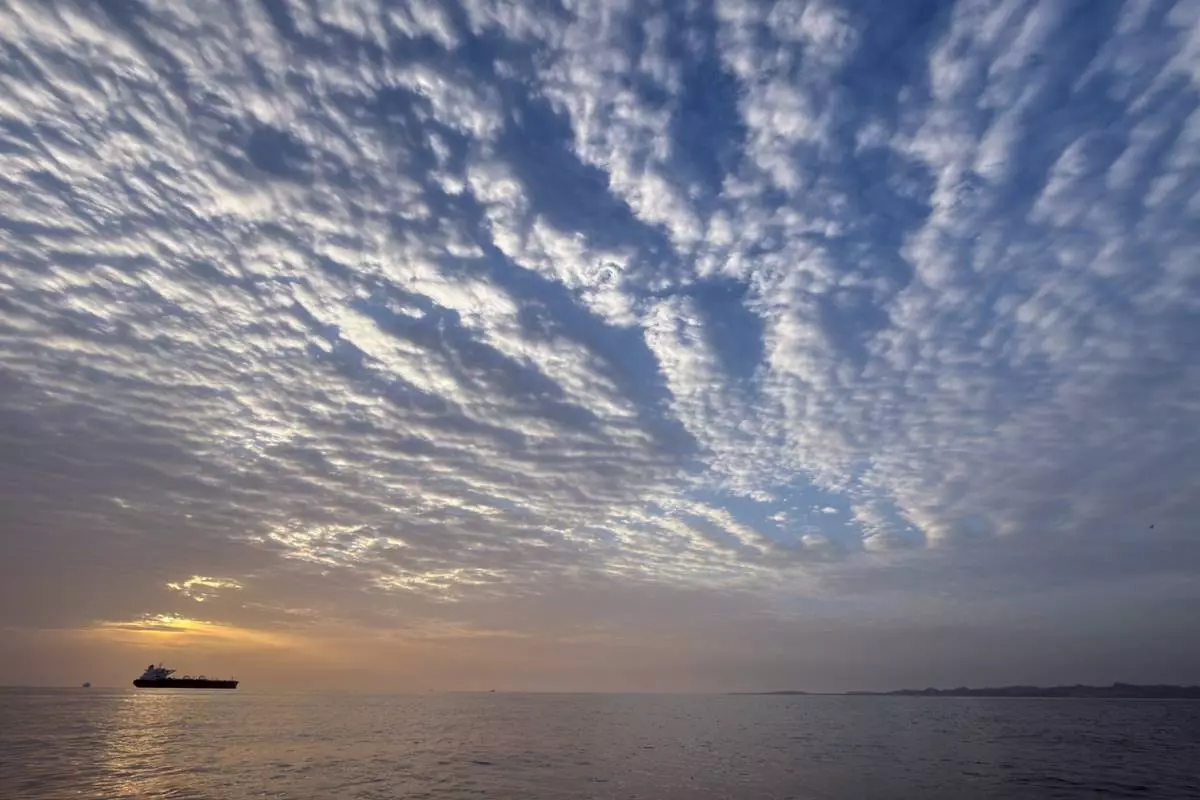
The sun rises behind a tanker anchored in the Strait of Hormuz off the coast of Qeshm Island, Iran, Saturday, April 18, 2026. (AP Photo/Asghar Besharati)