HOUSTON (AP) — Will Anderson Jr. wasn’t really interested in football as a young child but finally tried it at his family’s urging as he approached high school.
Back then he was a running back, but soon his coach informed him that he’d be moving to defensive end.
The news was not well received.
“I cried,” Anderson recalled Tuesday.
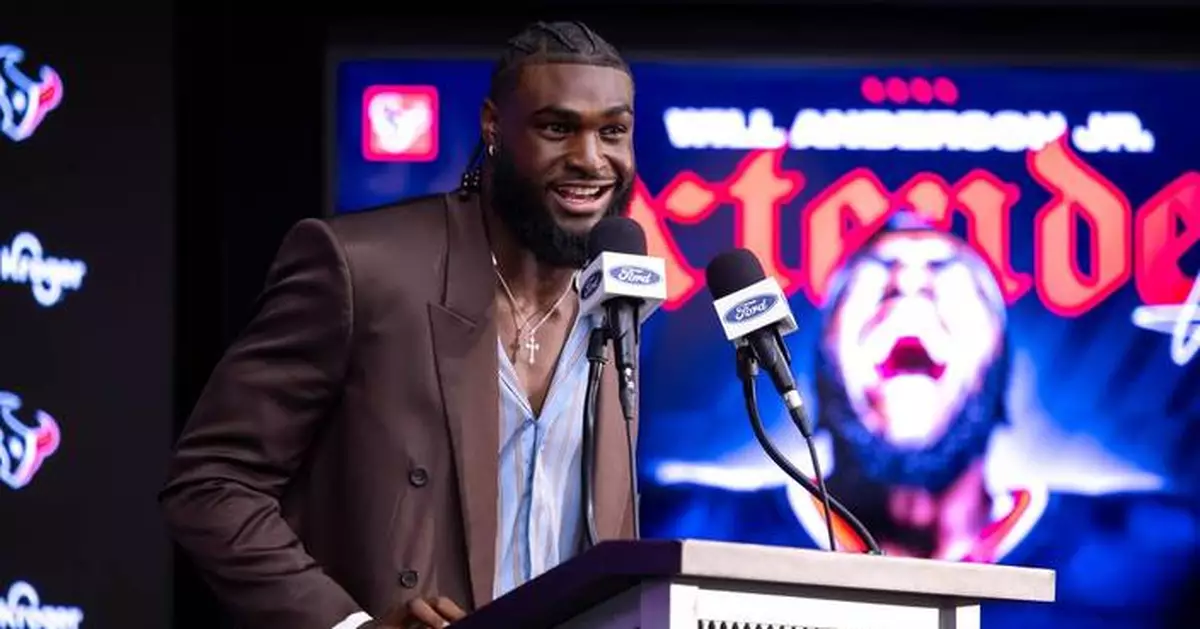
Despite his trepidation, Anderson quickly excelled at the position and on Tuesday he celebrated signing his three-year, $150 million contract extension with the Houston Texans that made him the highest-paid non-quarterback in NFL history.
“It worked out,” he said drawing laughs from everyone in the room.
The extension includes $134 million in guaranteed money.
The $50 million per year Anderson will earn surpasses the $46.5 million per year defensive end Micah Parsons got when he signed a four-year extension with the Packers after a trade from Dallas last year.
“I’ve been so overwhelmed with joy these last couple of days, nonstop tears, and it’s been a blessing,” Anderson said. “And I think for me, I love what I do, and I tell people all the time — they’re like oh, the money… it’s really never ever been about the money for me. It’s always just been about walking to my purpose and doing what God has called me to do.”
The Texans selected Anderson with the third pick in the 2023 draft, trading up to nab the Alabama standout after selecting quarterback C.J. Stroud second in that draft.
Anderson, the 2023 AP Defensive Rookie of the Year, started each game last season and had 12 sacks and 20 tackles for loss — both career highs — to lead a Houston defense that was among the best in the NFL.
His work last season earned him a spot on first team of The Associated Press All-Pro team and he was a finalist for AP Defensive Player of the Year.
In three seasons with the Texans, the 24-year-old Anderson has piled up 30 sacks and 136 tackles, including 46 for loss. He also has 64 quarterback hits in his career and has forced four fumbles and recovered three.
The Texans exercised his fifth-year player option earlier this month so this deal will keep him in Houston through the 2030 season.
His agent Nicole Lynn was asked how the negotiations with Houston general manager Nick Caserio began.
“Nick and I have a really good relationship,” she said. “I don’t know exactly where it started. I think Nick called me, but I think we kind of all knew that it was time for him to get paid.”
Everyone in the Texans’ organization raves about Anderson’s mentality and work ethic. Defensive line coach Rod Wright said that’s what makes him so deserving of this contract.
“The impression he makes on people is like, I’m going to outwork you, I’m going to out study you and he sets the bar for everyone,” Wright said.
Now that Anderson knows he’s going to be in Houston for a long time to come, he’s focused on helping the Texans reach new heights. Houston, which has never been to a conference title game, has lost in the divisional round of the playoffs in each of Anderson’s three seasons.
“Ask me about contract, yeah, the contract is cool, but ask me about winning, that’s more important,” he said. “How we get over this hump, how we can get past the second round is what’s been on my mind.”
According to Next Gen Stats, Anderson ranked second in the NFL last season with 85 total pressures and his 48 pressures on third down were the most by a player since the stat began being tracked in 2014.
While Anderson appreciates those numbers, to him it just means he’s coming up short on getting to the quarterback.
“I haven’t even reached to the period of where I want to be at in my game,” he said. “And I think this offseason I’ve continued to build my body up to be able to bend or to be able to finish on the quarterback. That’s the next step is just be able to finish on the quarterback.”
Anderson isn’t planning to do anything crazy with his money now that he’s signed this huge extension. He really enjoys fishing so he said he’ll likely get a speed boat so that he and his father can continue their fishing trips in style.
Other than that, he’s just thankful that his parents will never have to worry about money again after they went through some lean times while raising him and his five older sisters.
“I think that’s why I got so emotional because these two right here, being in a three-bedroom house with six kids wasn’t easy,” he said pointing to his parents. “Working long nights. My mom got to work overtime. My dad working overtime… it meant the world for me to do what I do.”
AP NFL: https://apnews.com/NFL
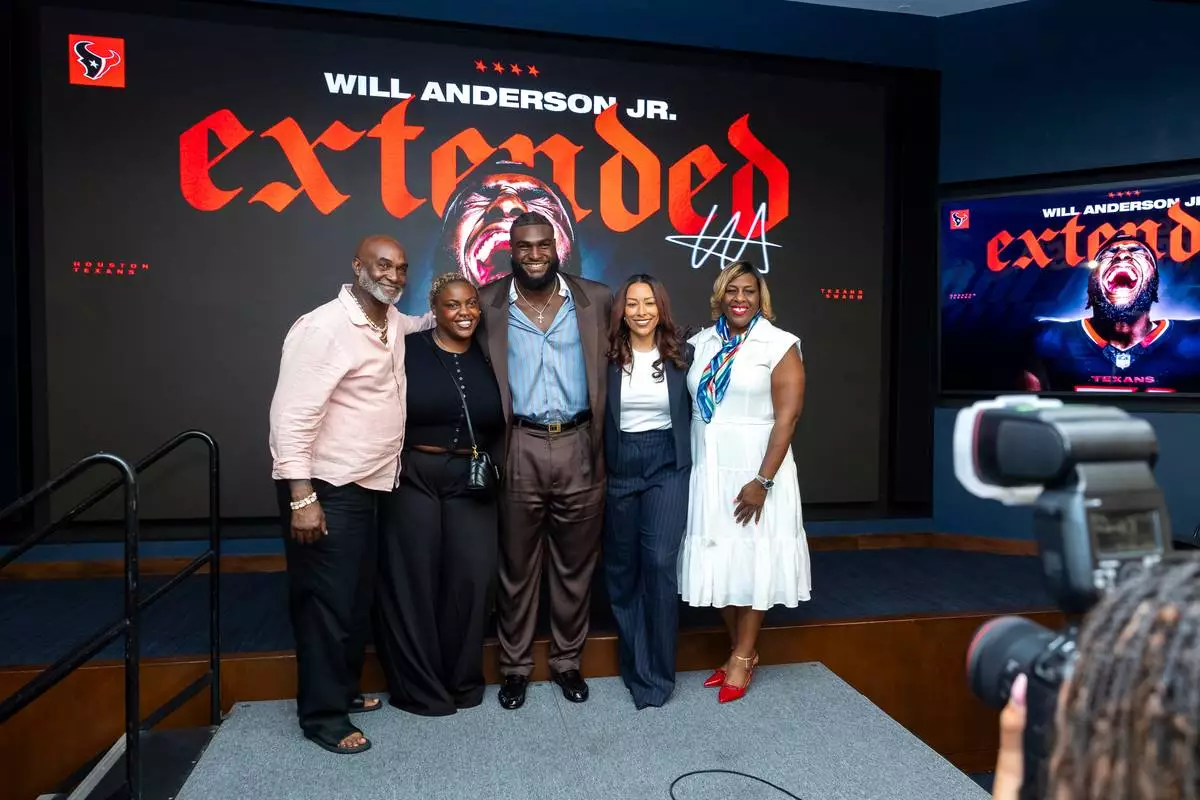
Texans defensive end Will Anderson Jr. poses for a photo with his family and agent during an NFL football press conference in Houston, Texas, Tuesday, April 21, 2026. (AP Photo/Annie Mulligan)
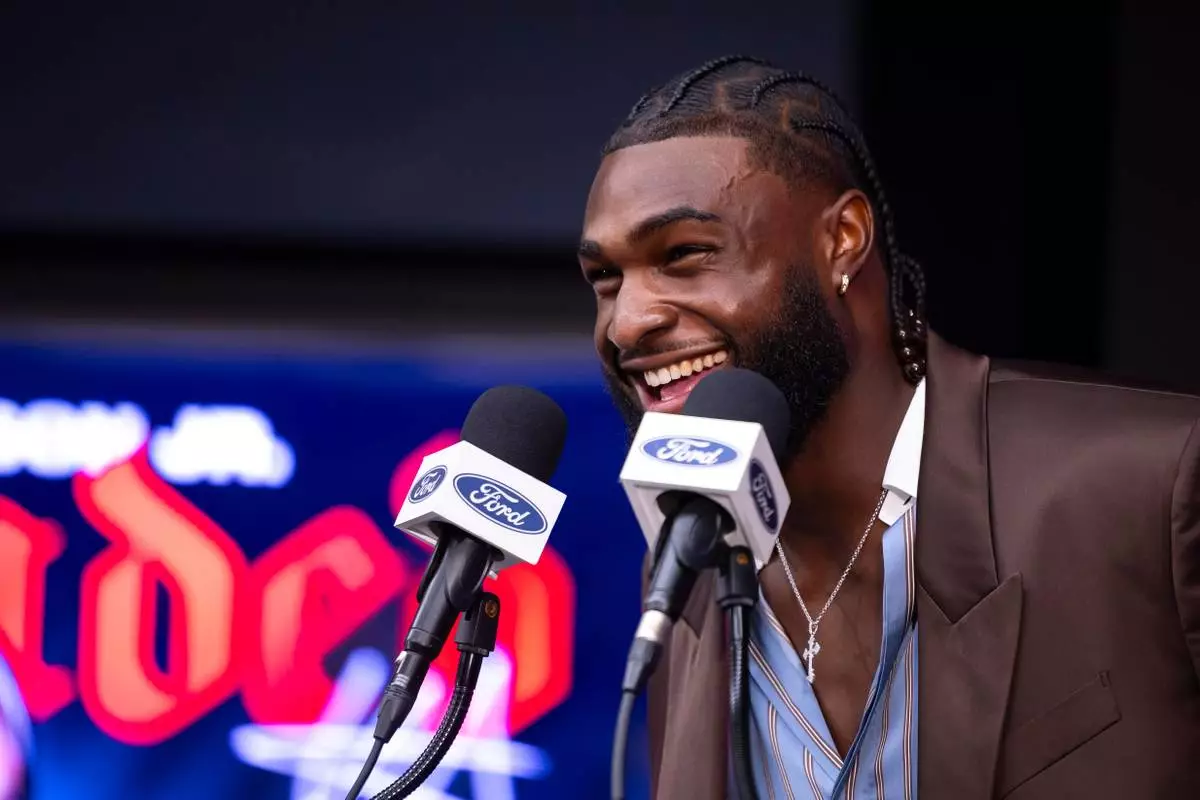
Houston Texans defensive end Will Anderson Jr. speaks during an NFL football press conference in Houston, Texas, Tuesday, April 21, 2026. (AP Photo/Annie Mulligan)
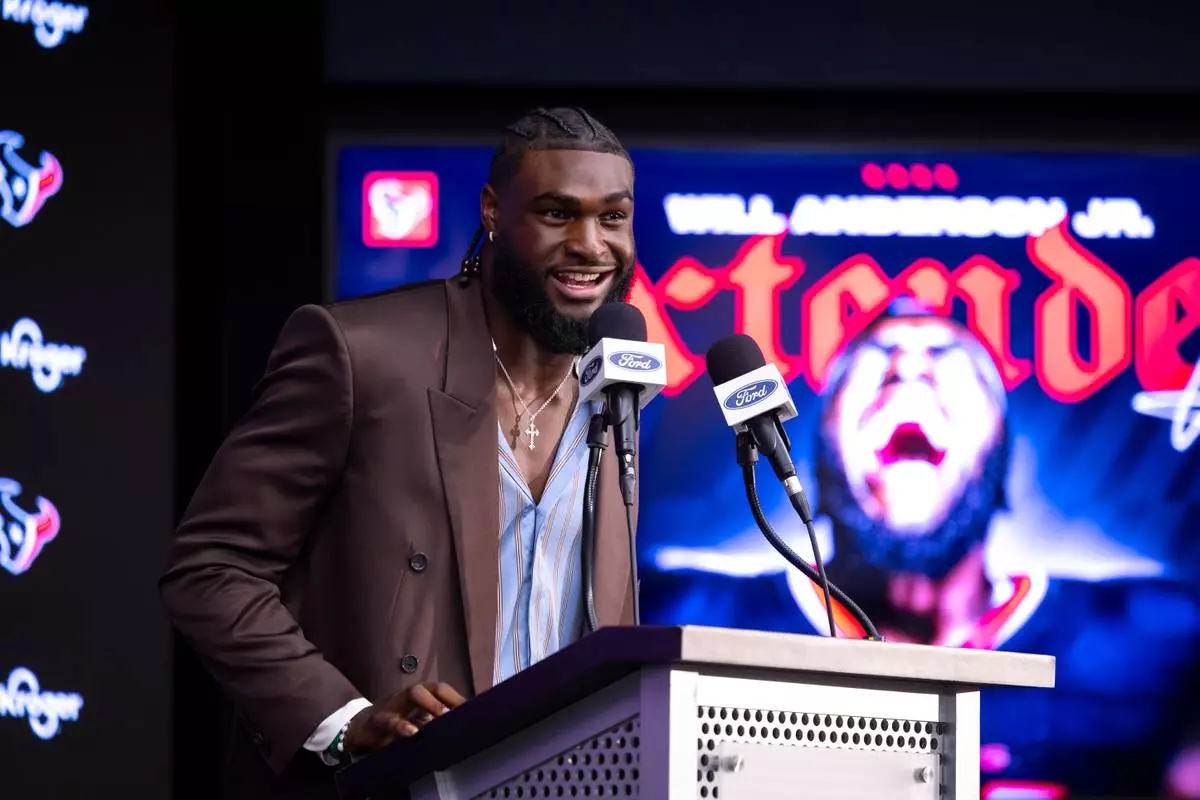
Houston Texans defensive end Will Anderson Jr. speaks during an NFL football press conference in Houston, Texas, Tuesday, April 21, 2026. (AP Photo/Annie Mulligan)
The Southern Poverty Law Center was indicted Tuesday on federal fraud charges alleging it improperly paid informants to infiltrate extremist groups without disclosing the payments to donors, acting Attorney General Todd Blanche said.
The center's CEO Bryan Fair said the payments went to confidential informants in order to monitor threats of violence from the extremist groups — and that the information the center received was frequently shared with the FBI and other law enforcement agencies. The information gathered by the informants helped save lives, Fair said Tuesday.
“We are outraged by the false allegations levied against SPLC,” Fair said.
The Justice Department alleged that the civil rights group defrauded donors by using their money to fund the same extremism that it claimed to be fighting. The indictment says payments of at least $3 million went to informants affiliated with the Ku Klux Klan, the Aryan Nations, the National Socialist Party of America and other groups between 2014 and 2023.
The charges, filed in Alabama where the center is based, include wire fraud, bank fraud and conspiracy to commit money laundering.
Here are some things to know about the Southern Poverty Law Center's history and controversies:
Alabama lawyer Morris Dees founded the organization in 1971, starting a civil rights-focused law practice for people who were poor or disenfranchised. At the time, federal laws and U.S. Supreme Court rulings designed to end Jim Crow-era segregation were still fairly new, and widespread resistance to desegregation persisted in the South.
People who faced continued discrimination often struggled to find attorneys who were willing to represent them in court; lawyers were reluctant to bring the first lawsuits to test the civil rights laws.
Dees and another attorney, Joe Levin, took on some of those cases, representing their clients for free. Some of those earliest cases resulted in the desegregation of recreational facilities, the integration of the Alabama state trooper force and other reforms, according to the center's website.
By the 1980s, the civil rights group was monitoring white supremacist organizations in the U.S. The effort, initially called “Klanwatch” and focused on the Ku Klux Klan, was later renamed the “Intelligence Project,” and expanded to include other extremist groups.
Many of the groups did not appreciate being called out, monitored and sometimes sued by the center. Members of the KKK tried to burn down the center's Montgomery offices on July 28, 1983, in retaliation for lawsuits filed against Klan groups.
The fire damaged the building, office equipment, the center's law library and files. More than a year later, three KKK members were arrested in connection with the blaze, and all three plead guilty and were sentenced to prison.
The center previously used paid informants to infiltrate extremist groups and gather information on their activities, often sharing it with local and federal law enforcement, Fair said. They were used to monitor threats of violence, he said, adding that the program was kept quiet to protect the safety of informants.
The nonprofit organization gets most of its funding from donor contributions, and those contributions have added up. Its endowment had just under $732 million in hand as of last October, according to the center.
The center's “Intelligence Project” has grown over the years, and the organization has faced criticism for some of the groups it has added to the tracker. Conservatives have said adding some groups unfairly maligns them because of their viewpoints. The conservative religious organization Focus on the Family was added in part because of its anti LGBTQ+ rhetoric, for instance.
That criticism escalated after the September 2025 assassination of conservative activist Charlie Kirk at a college campus in Utah. That brought renewed attention to the center's inclusion of Kirk's group, Turning Point USA.
The center included a section on Turning Point in a report titled “The Year in Hate and Extremism 2024” that described the group as “A Case Study of the Hard Right in 2024.”
A month after Kirk's death, FBI Director Kash Patel announced that the bureau would sever its relationship with the center, asserting that the organization had been turned into a “partisan smear machine” and criticizing it for its use of a “hate map.”
That move marked a dramatic rethinking of longstanding FBI partnerships with prominent civil rights groups.
The indictment says the center told donors the money would be used to help dismantle violent extremist groups, but did not disclose that some of the funds would actually be used to pay members of those groups. Some legal experts say it's an unusual legal approach.
“That's a new way of going after a charity — I'm somewhat surprised," said Phil Hackney, a law professor at the University of Pittsburgh. Typically, when a nonprofit group is charged with fraud, it's because someone is accused of pilfering donated funds to line their own pockets, Hackney said.
But in this case, the government is targeting the method and intent in which a nonprofit used its money, he said.
The government is looking at the informant payments “as an intent to further hate — and I doubt Southern Poverty Law Center had that intent,” Hackney said.
The law has never required nonprofit groups to hand donors a line-item receipt for every sensitive operation, said Todd Spodek, a federal criminal defense attorney with Spodek Law Group P.C. in Manhattan.
“From a defense perspective, this isn’t a fraud case. It is a political attack on standard investigative tradecraft,” said Spodek. “We are talking about high stakes intelligence work where discretion isn’t a form of deception, it is a matter of survival.”
In order to win a conviction, the government will have to prove the center engaged in a deliberate scheme to lie, Spodek said.
“They simply cannot. Silence of tactical details is not a crime, and you don’t get to call it fraud just because the government dislikes the methods used to get results,” he said. He later continued, “The prosecution is trying to turn operational discretion into a felony, which is a massive overreach.”
Other nonprofit groups also have sent people undercover or used confidential informants to get information. For instance, the nonprofit conservative group Project Veritas, founded in 2010, is best known for conducting hidden camera stings that have embarrassed news outlets, labor organizations and Democratic politicians.
The anti-abortion organization Center for Medical Progress was behind secretly recorded videos of Planned Parenthood executives in California. The videos were then edited in a way to falsely suggest that the executives were selling fetal remains. The videos triggered several investigations, and Planned Parenthood was cleared of any wrongdoing but two of the activists with Center for Medical Progress were ultimately convicted of illegally recording someone without consent.
Fair says the organization began working with informants to monitor threats of violence during a time of increased risk, and the program was kept quiet to protect informants' safety.
“When we began working with informants, we were living in the shadow of the height of the Civil Rights Movement, which had seen bombings at churches, state-sponsored violence against demonstrators, and the murders of activists that went unanswered by the justice system,” Fair said. “There is no question that what we learned from informants saved lives.”
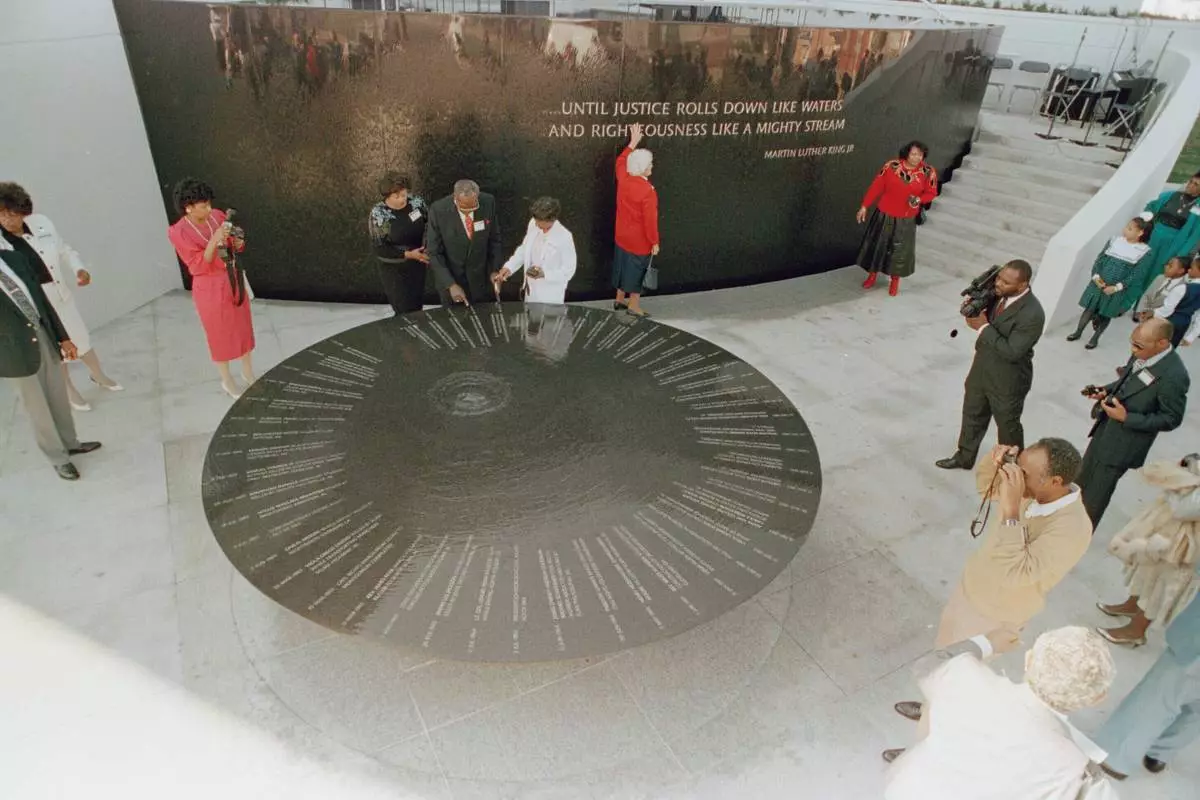
FILE - Family members of fallen civil rights activists view the Civil Rights Memorial at the Southern Poverty Law Center during a private family viewing, Nov. 5, 1989, in Montgomery, Ala. (AP Photo/Dave Martin, File)
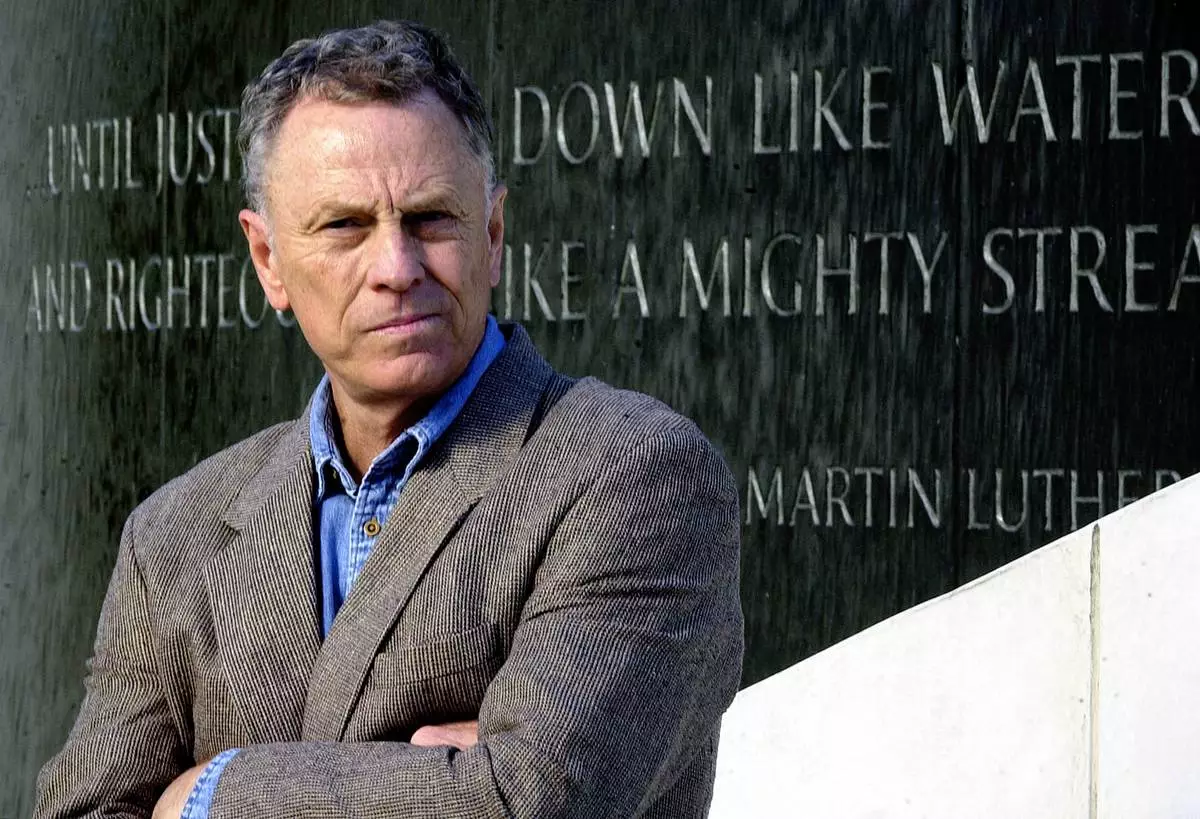
FILE - Southern Poverty Law Center Director Morris Dees attends a news conference Nov. 18, 2002, at the Civil Rights Memorial at the Southern Poverty Law Center in Montgomery, Ala. (AP Photo/Dave Martin, File)