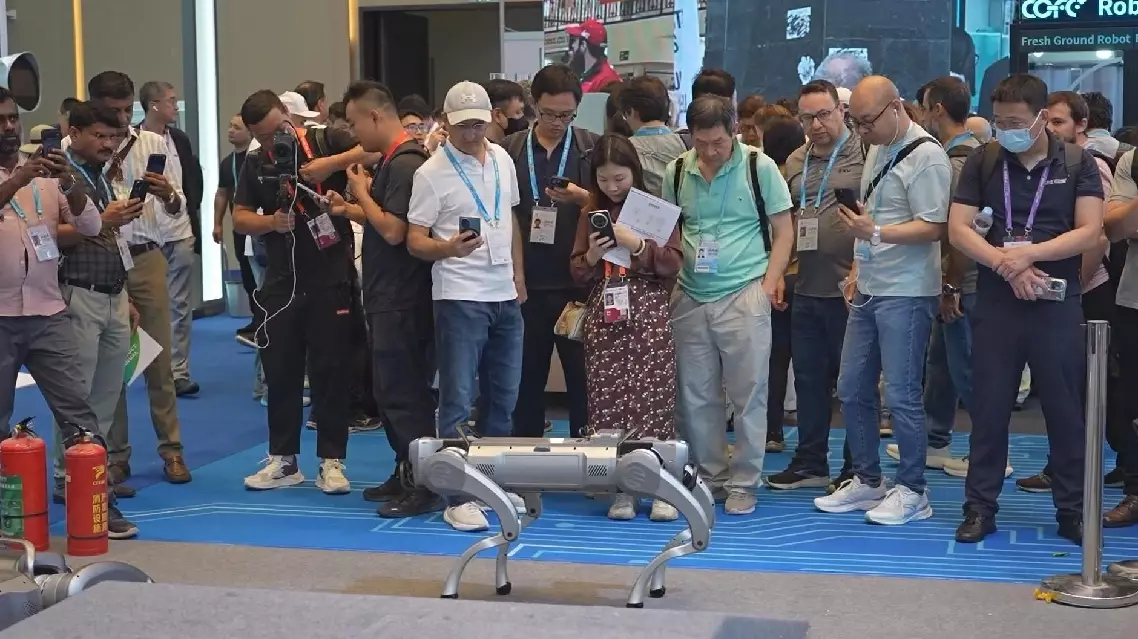
High tech products and industrial robots are taking the spotlight at the 139th China Import and Export Fair, or Canton Fair, in south China's Guangzhou, where global buyers are seeking solutions they can put to work immediately.
The world’s largest biannual trade fair runs from April 15 to May 5 in three phases, each highlighting categories from advanced manufacturing to home living and lifestyle products. Covering 1.55 million square meters, the fair features 75,700 booths and more than 32,000 enterprises, including about 3,900 first time exhibitors.
The service robot section, modest in size within the sprawling exhibition complex, returns this year with 46 companies.
"Because in Brazil employees are very expensive. So robots are interesting for Brazilians to substitute the people," said Eduardo Rulli, a buyer from Brazil.
"I think that you guys are leaders, you develop a lot of new products and we don't see this in other countries, so good work," said Maciej Marchwicki, a buyer from Poland.
Robots are clearly getting the "rockstar" treatment again.
New exhibition zones like this reflect a broader push toward higher-value, tech-driven exports. But beyond the buzz, deals are being made. Many companies are no longer just selling products; they are combining hardware, software and services, solving real challenges across industries.
"We have customers from the US, Europe, and Southeast Asia. Some use the products themselves, others work in senior care or sports brands. We're also seeing many returning clients; they bought from us last year and are now here to try the new generation. We expect our exports to grow by 5 to 10 times this year," said Allen Liang, CEO of Hangzhou Technik Technology.
After refining and scaling their products in the domestic market, Chinese companies are now shifting toward customized solutions for global clients.
One local robotics firm says its overseas orders have seen double-digit growth in recent years. In the workshop, machines are doing more than assisting production, they are building other machines. This is a facility where "robots make robots."
From aerospace to laboratory automation, systems like these are now being deployed across industries around the world.
"In 'dark labs' or hazardous environments, robots can take over tasks that are unsafe for humans. They help improve efficiency, safety, and consistency," said Cao Yuran, senior sales manager of Li-Gong Industrial.
This is just one of the more than 160,000 robotics-related firms based in Guangdong, spanning the full supply chain.
That ecosystem also allows companies to offer more flexible solutions: systems that can be integrated without major factory overhauls or heavy upfront costs.
For many smaller businesses, that lowers the barrier to automation.
"Beyond the robot itself, we've improved development efficiency and reduced component costs. With Guangdong's supply chain, we can respond quickly and offer a wide range of solutions. It doesn't have to be a mass order, we can deliver a smaller setup with different skills," said Cao.
As global industries look to cut costs and cope with labor shortages, China is reshaping what smart manufacturing looks like.
What stands out is speed; the ability to test, refine and scale quickly, using a vast manufacturing base as a proving ground. In a more uncertain global trade environment, that may be where the competitive edge lies.
Intelligent products take center stage at Canton Fair as growth driver