The Trump administration took the unusual step this week of sending a government plane to Cuba to return a 10-year-old from Utah who is at the center of a complicated and contentious custody fight involving the child’s gender identity.
The child's parent, Rose Inessa-Ethington, a transgender woman, is accused of taking the child to Cuba without the permission of the biological mother. Federal and state authorities sought the return of the child after a family member expressed concern that Inessa-Ethington went to Havana to get the child gender transition surgery.
Inessa-Ethington was arrested along with her partner, Blue Inessa-Ethington, and charged in the U.S. with international parental kidnapping.
The couple traveled with the child to Canada ostensibly for a camping trip in late March with Blue’s 3-year-old child. However, the two adults turned off their phones after telling the older child’s mother they had arrived in Canada. They flew from Vancouver to Mexico and then to Cuba on April 1, according to a criminal complaint filed Monday in federal court in Utah.
The charges don't say if the couple actually planned on getting the child gender-affirming surgery in Cuba or how they would get it because that surgery isn't legal for children in Cuba.
The FBI said that Blue Inessa-Ethington withdrew $10,000 from her checking account before leaving. Agents also found at their home a note with instructions from a mental health therapist in Washington, D.C., “to send the therapist the $10,000.00 and instructions on gender affirming medical care for children.” That note didn't mention Cuba.
The use of the Department of Justice plane in a parental kidnapping investigation comes after President Donald Trump’s administration has sought to block access to gender-affirming care for minors and pressured health care providers over the issue.
The Associated Press left telephone and email messages with the court-appointed attorneys who represented Blue and Rose Inessa-Ethington in Virginia. The defendants will be returned to Utah to face one count each of international parental kidnapping, according to court filings.
The search for the child began on April 3 when they were not returned to the mother in Utah as scheduled, court documents show. The 10-year-old’s mother, who was divorced from Rose Inessa-Ethington and had shared custody of the child, filed a missing-person report with police in Logan City, Utah, about 70 miles (115 kilometers) north of Salt Lake City.
Logan City Police Chief Jeff Simmons said his department’s initial focus was on the custodial interference allegations in the case, and he said investigators did not learn until later about the concerns over gender-affirming surgery.
Logan police spokesperson Sgt. Brandon Bevan said those concerns were raised by one family member. He declined to say who.
“They just had the concern about it, no actual physical evidence” Bevan said.
A Utah state judge ordered the return of the 10-year-old to the child’s mother on April 13. Three days later, a federal magistrate judge issued an arrest warrant for the Inessa-Ethingtons. On the same day, Cuban law enforcement located the group. They were deported to the U.S. aboard the government plane Monday and arraigned in federal court in Richmond, Virginia.
The 10-year-old was returned to the child’s biological mother, First Assistant U.S. Attorney Melissa Holyoak in Utah indicated in a statement. Representatives of the FBI and U.S. attorneys office in Utah declined to say what happened to the 3-year-old child who had been with the group.
The custody dispute between the parents does not appear to be a new development. An online fundraiser created five years go by Blue Inessa-Ethington titled “Help a Trans Mother Keep Custody of Her Child” raised $9,766.
“Last week, Rose’s ex relocated several counties away, negatively impacting Rose’s parent-time with the child,” she wrote in the fundraiser. She said the money would be used to seek a court order that would keep the child “safe and stable throughout this process.”
Anyone who has spent time with Rose knows “how much care and thought she puts into parenting her gender open child,” she wrote.
She later continued, “While her ex is not making an issue of Rose’s gender, as a trans woman, Rose is at a disadvantage against her cishet ex-wife. Rose also lacks the family resources and connections to face this litigation on her own.”
Family members said the child was assigned male at birth but identifies as a girl because of what they believed to be “manipulation” by Rose Inessa-Ethington, according to an April 16 affidavit from FBI Special Agent Jennifer Waterfield.
The Trump administration moved in December to cut off gender-affirming care for minors, prompting a third of states to sue.
It was the latest in a series of clashes between an administration that says transgender health care can be harmful to children and advocates who say it’s medically necessary.
Gender-affirming surgery is rare among U.S. children, research shows. And fewer than 1 in 1,000 U.S. adolescents receive gender-affirming medications.
In February, the nation’s largest professional organization for plastic surgeons recommended gender-affirming surgeries be delayed until patients turn 19, diverging from several other major medical organizations’ guidance.
In Cuba, gender-affirming surgeries are banned for minors and only performed for adults through the public health system under strict supervision in designated public hospitals for Cuban citizens. They must be authorized by a medical commission after a comprehensive review of the patient’s file. That process often takes years because it requires a wide range of medical and psychological evaluations.
Associated Press journalists Eric Tucker in Washington, Cristiana Mesquita in Havana and Devi Shastri in Milwaukee contributed to this report.
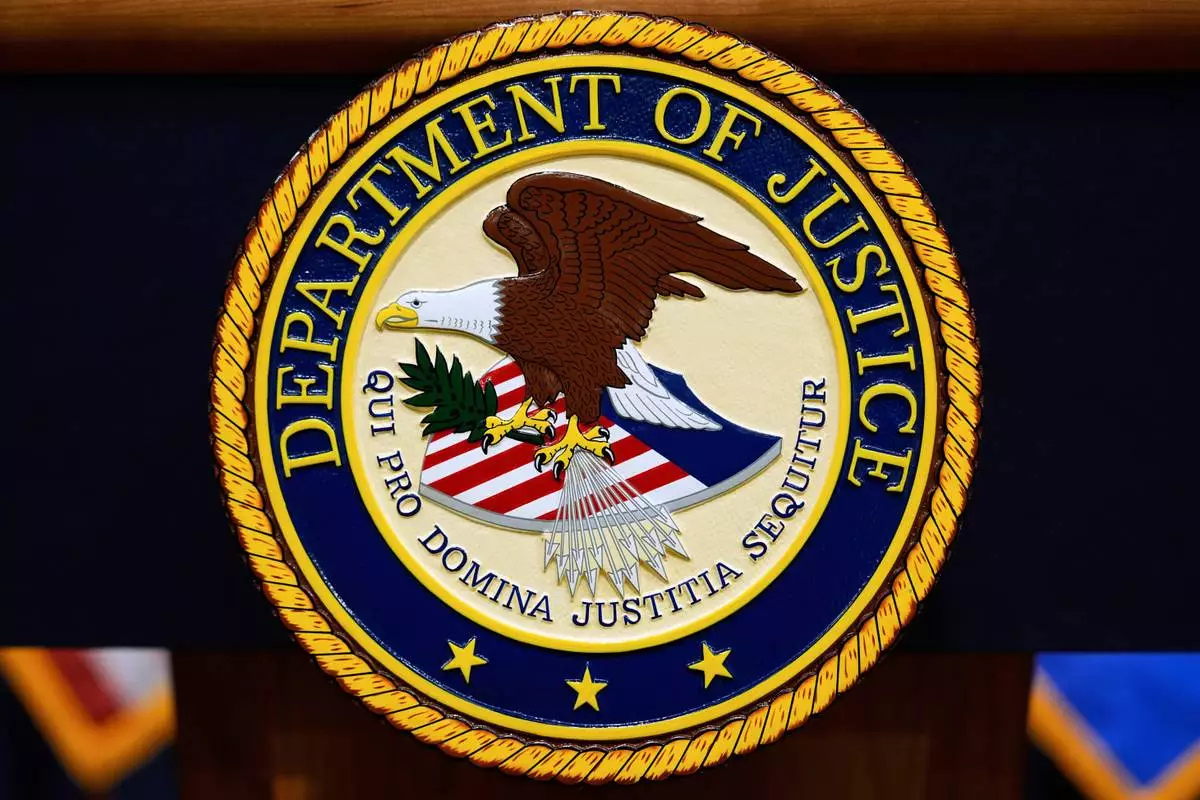
FILE - The U.S. Department of Justice logo is seen on a podium before a news conference at the Justice Department in Washington, on May 6, 2025. (AP Photo/Julia Demaree Nikhinson, File)
SAN JUAN TEOTIHUACAN, Mexico (AP) — Officers with bomb-sniffing dogs circled cars and searched bags of tourists filing into historic pyramids outside of Mexico City on Wednesday just days after a man opened fire on tourists.
The heightened surveillance was part of a promise by Mexican authorities following the tragedy to beef up security at touristic and archaeological sites across Mexico, less than two months before the country hosts the FIFA World Cup jointly with United States and Canada.
The Monday shooting, carried out by a lone gunman on top of one of the Teotihuacan pyramids — a UNESCO Heritage Site and one of Mexico's most frequented tourist attractions — killed one Canadian tourist and injured a dozen more.
It also set off a flurry of questions the next morning by reporters to Mexican President Claudia Sheinbaum about what security protocols her government was taking ahead of the sports competition.
About an hour from Mexico City, Teotihuacan was slated to be a key site for visitors during the festivities. Just days before the shooting, local lawmakers even pushed forward an initiative to revive a nighttime interactive light show projected on the pyramids for World Cup visitors, which was previous suspended at the beginning of the COVID-19 pandemic.
The unexpected act of violence came as Sheinbaum's government has gone to great lengths to project an image of safety ahead of the soccer competition, following a surge of cartel violence February in the World Cup host city of Guadalajara.
"Events like this only further magnify the negative images that Mexico has on security issues, undermining the narrative that President Sheinbaum is trying to build that Mexico is a safe country," said Mexican security analyst David Saucedo.
Mexico’s government has sought to turn the page on the attack and reopened the pyramids on Wednesday after closing them temporarily.
That morning, tourists were already climbing up the pyramid still stained by blood to take selfies.
Among those filing into the archaeological site was 76-year-old physician Mark Diamond, who said he was saddened to see the bloodshed but that he wasn't dissuaded in seeing a site he had long hoped to visit. He noted bluntly: “I'm from Baltimore, Maryland. I'm not concerned.”
“It's presumably a deranged individual and it can happen anywhere,” he said. “In the United States, we have plenty of shootings, unfortunately.”
On Tuesday, Sheinbaum acknowledged that the archaeological site lacked security filters to prevent the attack in part, she said, because the shooting “was an isolated incident" that hasn't occurred before in such a public space.
While Mexico suffers from cartel violence, especially in strategic and rural areas, mass shootings in public spaces are rare in Mexico compared with the U.S., where it is much easier to legally obtain a gun.
She noted that the shooter appeared to be motivated by “outside influences," particularly the 1999 Columbine massacre in Colorado.
“Our obligation as a government is to take the appropriate measures to ensure that a situation like this does not happen again. But clearly, we all know — Mexicans know — that this is something that had not previously taken place,” Sheinbaum said Tuesday morning.
Mexican Security Secretary Omar García Harfuch, the face of the government's crackdown on cartels, said on Tuesday that security forces had been ordered to “immediately strengthen security" at archaeological sites and major tourist destinations across the country.
He said the government will increase the presence of Mexican National Guard, boost security checks at key sites and fortify surveillance systems to “identify and prevent any threats” against citizens and visitors.
The announcement was an effort by Mexican authorities to assuage ongoing concerns about violence in Mexico ahead of the tournament.
Sheinbaum's government has touted security successes under her leadership. Homicides have dipped sharply since she taken office to the lowest levels in a decade, government figures show. The government has also taken out a number of top capos and highlighted a dip in fentanyl seizures at the U.S.-Mexico border.
But they have hit hurdles in recent months, namely a burst a violence in Guadalajara in February, triggered by the killing of Mexico’s most powerful cartel boss. The bloodshed was met with a wave of concern by people in and outside of Mexico. Sheinbaum vowed there would be “no risk” for fans coming to the tournament and FIFA president Gianni Infantino said he had “full confidence” in Mexico as a host country. Sheinbaum later met with FIFA representatives to assess security for the World Cup matches to be played in Mexico.
Mexico’s government doubled down on security measures, which include deploying 100,000 security forces across the country, particularly concentrated in the country’s three host cities, Mexico City, Guadalajara and Monterrey. Officials said it would deploy more than 2,000 military vehicles, as well as dozens of air crafts and drones, and establish security perimeters around areas like stadiums and airports in key cities.
"As you can see, we are very prepared for the World Cup," Sheinbaum said in early March.
Despite the rare nature of the Monday shooting at the pyramids, the extreme act of violence reignited scrutiny by some about the government's capacity to prevent violence during the soccer tournament, and once again boosted pressures on the government.
FIFA was approached for comment about the pyramid shooting, but the soccer body typically does not address security issues and incidents that happen away from tournament venues.
Saucedo, the security analyst, said that pressures to concentrate security in host cities and tourist areas like Teotihuacan may come at the expense of other more crime-torn areas in greater need of police and military. He said the shooting was sign that “public safety agencies are overwhelmed.”
Others like Maria de Jesús Román, who traveled to see the pyramids from Guadalajara, said while the shooting “might change the perception of tourists that come to the World Cup" she said she feels safe.
“There's a lot of security, this is the safest place you could go in Mexico right now,” she said.
——
Janetsky reported from Mexico City. Associated Press photojournalist Eduardo Verdugo contributed to this report from San Juan Teotihuacán.
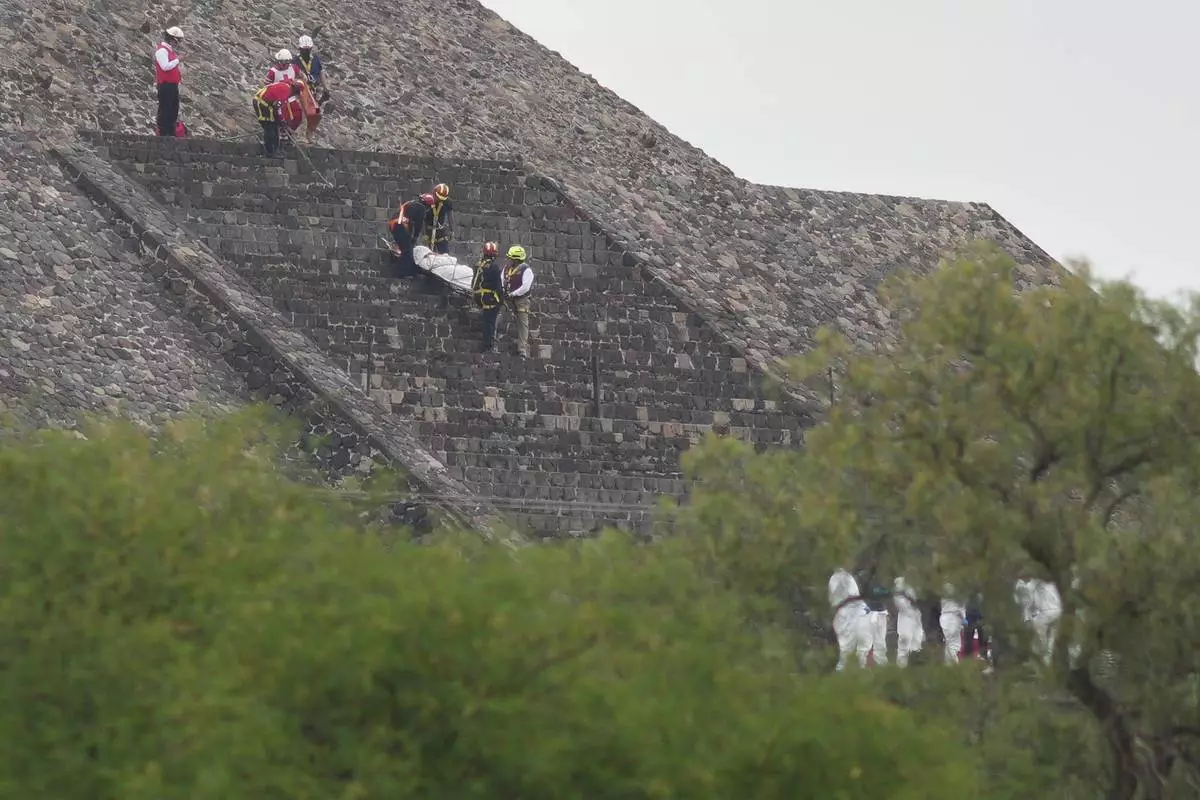
Forensic workers carry the body of a victim down a pyramid after authorities said a gunman opened fire, in Teotihuacan, Mexico, Monday, April 20, 2026. (AP Photo/Eduardo Verdugo)
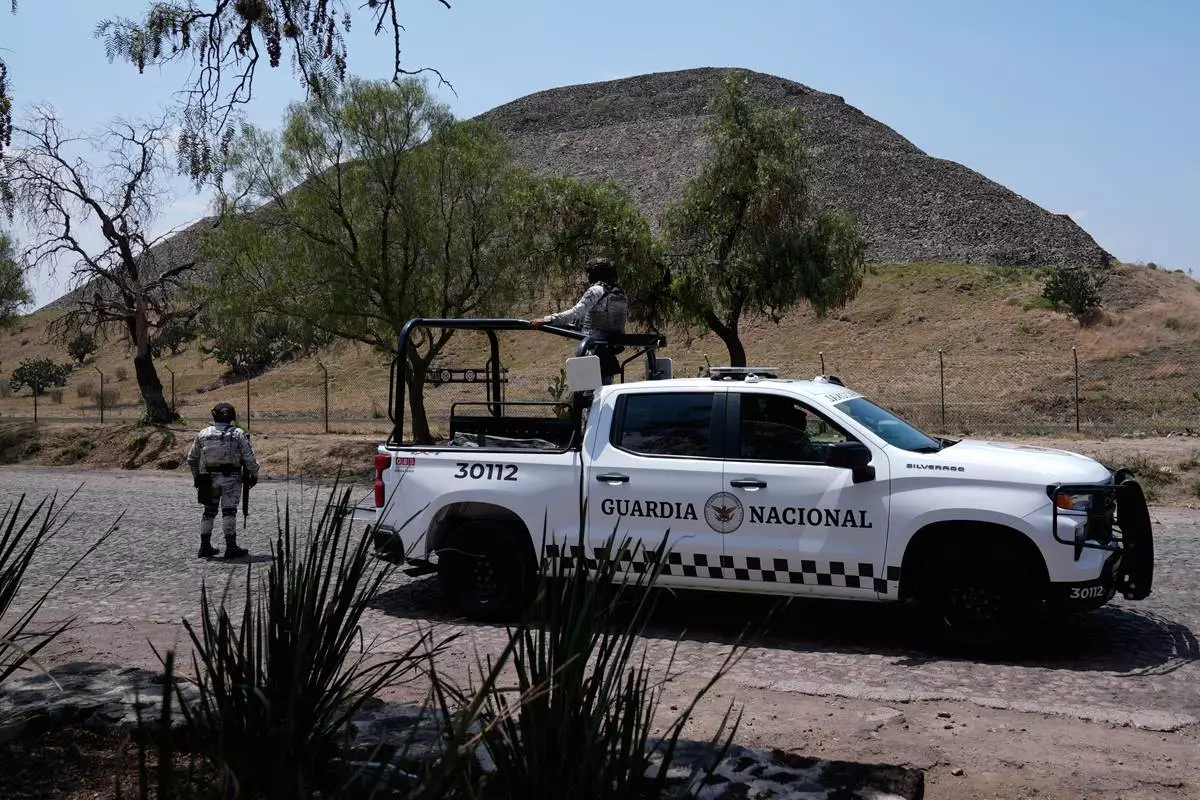
National Guard troops patrol the Teotihuacan pyramids, which remained closed a day after a gunman opened fire on tourists at the archaeological site outside Mexico City, Tuesday, April 21, 2026. (AP Photo/Marco Ugarte)