Three congressional candidates wagered on the outcome of their own elections on Kalshi, according to the prediction market, which said Wednesday that it fined and suspended the men from their platform for five years.
It is the latest high-profile case of alleged insider trading on prediction markets including Kalshi and Polymarket, which have brought bipartisan scrutiny from Congress and calls for stricter regulations of the websites where people can put money on just about anything.
Kalshi's disciplinary documents named Mark Moran, who is running as an independent in Virginia's U.S. Senate race; Ezekiel Enriquez, who ran in a Texas Republican primary for a U.S. House seat; and Matt Klein, a Democratic state senator running for a U.S. House seat in Minnesota.
Klein and Enriquez both placed bets less than $100 related to their “own candidacy,” Kalshi said. Moran said on social media that he “traded $100 on myself.”
These relatively small bets follow mammoth wagers on prediction markets earlier this year that raised eyebrows. In one case, an anonymous Polymarket user made a $400,000 profit in January on a wager that former Venezuelan President Nicolás Maduro would soon be out of office.
In March, after two U.S. senators announced legislation that threatened prediction markets, Kalshi and Polymarket highlighted new rules, including against political candidates trading on their own campaigns.
Moran refused to reach an agreement with Kalshi and was fined the most at more than $6,200, while Klein and Enriquez did reach agreements and face penalties of over $530 and $780, respectively, the company said. All were suspended from Kalshi for five years.
Some politicians have said the punishments didn't go far enough. U.S. Rep. Mike Levin slammed the repercussions as a “timeout."
"That’s not a punishment. That’s a parking ticket," Levin wrote.
The agreements are with the company, and not with the Commodity Futures Trading Commission, which regulates predication markets. The agency is chaired by Michael Selig, who is considered friendly to the burgeoning industry.
Far from denying the allegations, Moran took to social media on Wednesday to say he placed the bets because he wanted to draw attention to the issue.
“We live in a Country destroyed by vice, which Kalshi directly contribute to,” Moran wrote on X, saying the goal of the trade was to "highlight how this company is destroying young men.”
Klein also confirmed Kalshi's findings in a post on social media on Wednesday. The $50 wager he placed in October was the first time he had used a predictions market, he said in a statement on X, and he was “curious about how it worked.”
“This was a mistake and I apologize,” he wrote, saying that the experience made it clear that the markets need more regulation.
Klein is a cosponsor of a bill working its way through the Minnesota Legislature to ban most wagering on predictive markets, including the outcome of elections. In an interview, he said he didn’t think there was an inconsistency between his betting $50 on himself to win his primary and his sponsorship of legislation.
Klein said he spent the winter learning about predictive markets and signed onto the bill well before he learned that his bet violated Kalshi’s rules.
Associated Press reporter Steve Karnowski contributed from St. Paul, Minnesota.

FILE - The prediction market app Kalshi is displayed on a mobile phone, April 16, 2026, in Chicago. (AP Photo/Erin Hooley, File)
JUNEAU, Alaska (AP) — Voting and civil rights groups sued Alaska elections officials Wednesday, alleging that their sharing of the state's full voter registration list with the U.S. Department of Justice violates the state constitution.
Alaska is one of at least 12 states that has provided or said it would provide detailed information about its voters — including date of birth, driver's license number or partial Social Security number — to the Trump administration, according to the Brennan Center. Alaska and Texas also signed agreements when they shared data in which the department outlined plans for its own analysis of voter files, its plans to flag voter list issues and directions for removing voters deemed ineligible.
Several other states provided the data, but refused those agreements, as part of a wide-ranging effort by the Justice Department to obtain detailed voter data from every state. Some elections officials have expressed concern the information being sought could be used by the Trump administration to search for possible noncitizens.
The Alaska lawsuit was filed in state court against state Division of Elections officials by the League of Women Voters of Alaska and Alaska Black Caucus. It alleges the handing over of personal data on the voter list violates the right to privacy under the state constitution. It also says the memorandum of understanding violates due process by allowing the Justice Department to flag voters for removal “without any apparent notice or process for impacted voters to challenge those decisions.”
The lawsuit names as defendants Republican Lt. Gov. Nancy Dahlstrom, who oversees the division, and division Director Carol Beecher.
Sam Curtis, a spokesperson with the state Department of Law, said by email that it would be premature to comment on specific claims raised in the lawsuit. But Curtis said the department has previously explained in public hearings that state law “expressly permits the sharing of this information for authorized governmental purposes. That statute is on the books, and we will defend it.”
"Alaska statutes contain numerous provisions that allow the sharing of otherwise non-public or confidential information with law enforcement," Curtis said.
The plaintiffs are represented by the American Civil Liberties Union of Alaska, ACLU Voting Rights Project and the Electronic Privacy Information Center.
The Justice Department has sued at least 30 states and the District of Columbia to try to force the release of the data, according to a tally by the Brennan Center. Judges have rejected those efforts in California, Massachusetts, Michigan, Oregon and most recently, Rhode Island. A judge in Georgia dismissed a Justice Department lawsuit after ruling it had been filed in the wrong city. It was subsequently refiled.
In the Rhode Island case, Justice Department attorneys acknowledged the department was seeking unredacted voter information so it could be shared with the Department of Homeland Security to check citizenship status.
In addition to the state court lawsuit in Alaska, at least four federal lawsuits have been filed around the U.S. seeking to stop the Justice Department from collecting information from unredacted voter registration files or to prevent states from taking steps to cancel or suspend people’s voter registrations based on the federal project.
During a legislative hearing in Alaska last month, Rachel Witty, an attorney with the state Department of Law, told lawmakers the state had a “compelling interest” to comply with the federal request.
"To ensure the integrity of elections, there was a mutual interest in maintaining voters rolls that were accurate and current,” she said.
The Alaska lawsuit describes the process under state law for maintaining voter rolls and states that there are only limited circumstances under which a voter's registration can be promptly canceled — “upon death or conviction of a felony involving moral turpitude." It says that while elections officials have said they will only remove voters “to the extent allowed by state and federal law,” that interpretation is “irreconcilable with the plain language” of the agreement signed with the Justice Department.
The plaintiffs are asking a judge to void the agreement and require the elections division to make “reasonable efforts" to ensure the immediate destruction by the Justice Department of any hard copies and electronic versions of the list that was shared.
“Rather than fiercely defending the rights of Alaska’s voters, our Division of Elections acceded to federal overreach,” Eric Glatt, legal director for the ACLU of Alaska, said in a statement. “Now, we are asking the court to step in and ensure that DOE upholds its constitutional and legal obligations to Alaskans.”
Associated Press reporter John Hanna in Topeka, Kansas, contributed.
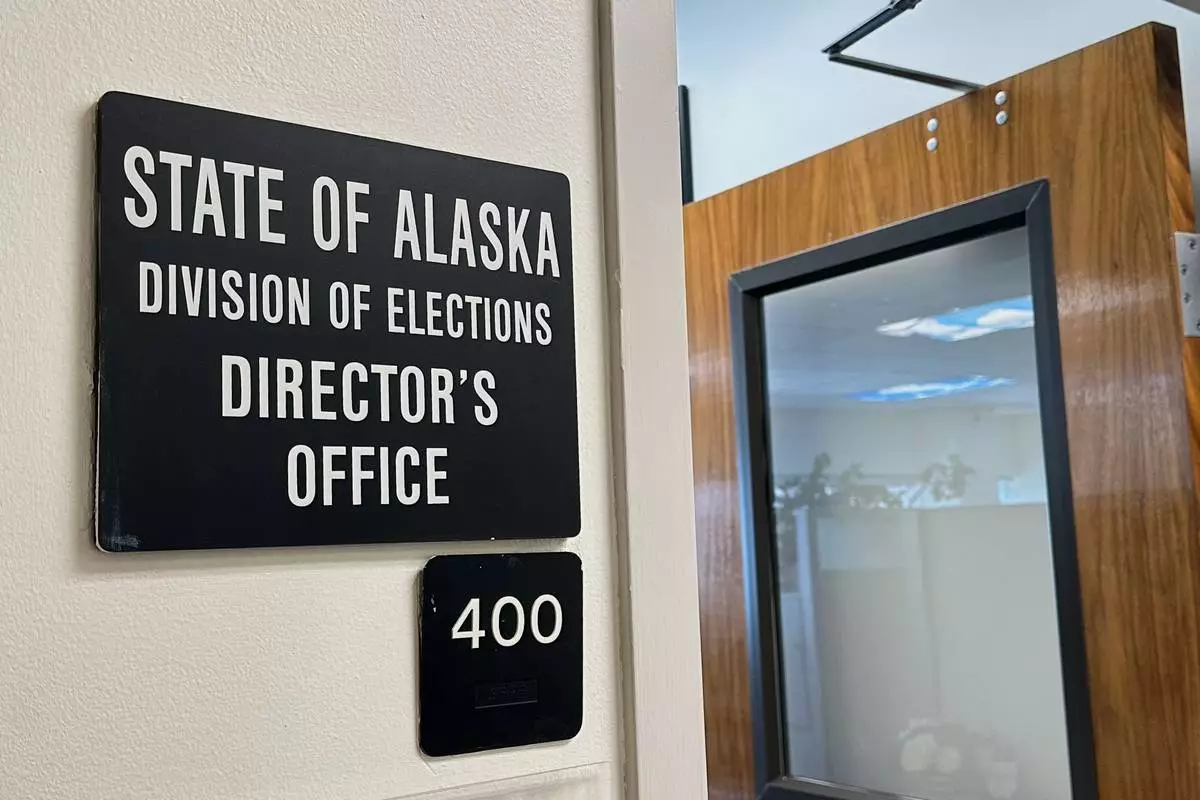
FILE - A sign hangs outside the director's office of the Alaska Division of Elections, March 19. 2026, in Juneau, Alaska. (AP Photo/Becky Bohrer, File)