WASHINGTON (AP) — The Senate took the first steps in a new effort to reopen the Department of Homeland Security early Thursday, voting to adopt a budget plan that would fund ICE and Border Patrol over Democratic objections and sending it to the House.
The entire department has been shut down since mid-February as Democrats have demanded policy changes in the wake of fatal shootings of two protesters by federal agents. Republicans are now trying to fund the two immigration enforcement agencies through the complicated, time-consuming process called budget reconciliation, a maneuver that they also used to pass President Donald Trump’s package of tax and spending cuts last year with no Democratic votes.
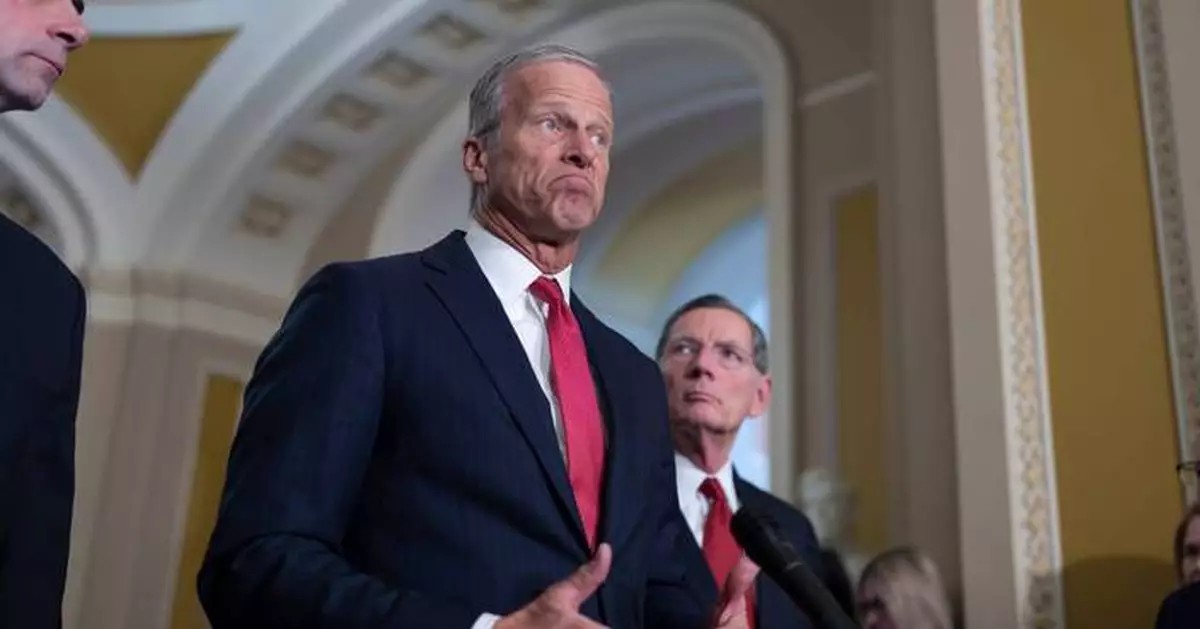
“We have a multistep process ahead of us, but at the end Republicans will have helped ensure that America's borders are secure and prevented Democrats from defunding these important agencies,” said Senate Majority Leader John Thune, R-S.D.
The budget process only requires a simple majority in the Senate, bypassing filibuster rules that require Republicans to find 60 votes on most bills when they only hold 53 seats. But it also comes with increased scrutiny from the Senate parliamentarian and a long, open-ended series of amendment votes at the beginning and the end of the process.
The Senate held the first series of votes through the night, starting Wednesday evening and into early Thursday morning, with Democrats proposing amendments to lower health care expenses and other costs in an effort to contrast with Republicans’ focus on Trump’s campaign of immigration enforcement.
“Instead of pumping hundreds of billions of dollars into ICE and Border Patrol, Republicans should be working with Democrats to lower out-of-pocket costs,” said Senate Minority Leader Chuck Schumer, D-N.Y.
The Senate adopted the final resolution 50-48, just past 3:30 a.m.
Once the House approves the framework and the Senate Parliamentarian approves it, the two chambers can then move to pass the measure.
The Senate has already voted on a bipartisan basis to reopen the rest of the department, but Republican leaders in the House say they won’t take that bill up until the Senate shows progress toward funding ICE and Border Patrol, as well.
The $70 billion budget resolution would fund the two agencies for three years, through the rest of Trump’s term. Thune and other GOP leaders say they hope to keep the bill narrowly focused on ICE and Border Patrol and get it to Trump’s desk in the coming weeks, along with the rest of Homeland Security Department funding that has already passed the Senate.
But that could prove difficult as many in the party see the budget bill as the last real chance this year to enact their priorities. Republicans in both the Senate and House have pushed to add other items, including money for farmers and Trump’s proof of citizenship voting bill, called the SAVE America Act.
Sen. John Kennedy, R-La., briefly held up the vote series late Wednesday, frustrated that the bill would not include parts of the SAVE America Act or other legislation.
“This is the last train leaving the station,” Kennedy said, predicting they would not be able to pass any other major bills ahead of November's midterm elections. But he withdrew his objections and allowed the voting to proceed.
Democrats say any funding bill for the Homeland Security Department should place restraints on federal immigration authorities, including better identification for federal officers and more use of judicial warrants, among other asks.
After federal agents shot Renee Good and Alex Pretti in Minneapolis in January, Trump agreed to a Democratic request that the Homeland Security bill be separated from a larger spending measure that became law. But bipartisan negotiations went nowhere, and the DHS funding lapsed with no agreement on changes to the Trump administration’s immigration enforcement tactics.
In March, the Senate passed the legislation by voice vote that would separate out ICE and Border Patrol and fund the rest of the department, including the Transportation Security Administration as security lines grew long at some airports. But Republicans in the House refused to consider it, saying they wouldn’t support any bill that didn’t include money for immigration enforcement.
Congress then left town for a two-week recess, leaving the issue unresolved. Trump has used executive orders to pay some department salaries in the meantime, but the future of those paychecks is uncertain.
During the recess, Thune and House Speaker Mike Johnson announced that they would pursue a two-track approach — pass the Senate bill that includes most of the department’s funding through regular order and use the party-line bill to pass ICE and CBP funding.
Weeks later, though, Johnson has still not said when the House will take up the Senate’s legislation that would fund the rest of the department. And it is unclear if members of his GOP conference will unite behind the narrowed budget bill as some House Republicans have argued, like Sen. Kennedy, that they should add other priorities to the legislation.
Johnson said this week that the sequencing of the two bills is important. House lawmakers don’t want to see the rest of the department funded without ICE and Border Patrol, he said.
But Thune warned after the Senate vote that other parts of the Homeland Security Department may run out of money before they are able to finish the winding budget process and fund those two agencies. He said he hopes the adoption of the budget resolution is a signal to the House that “we're going to be following through."
“We'll see what they can do with it," Thune said. “And if they can't, I guess we will go to the next plan.”
Associated Press writer Kevin Freking contributed to this report.
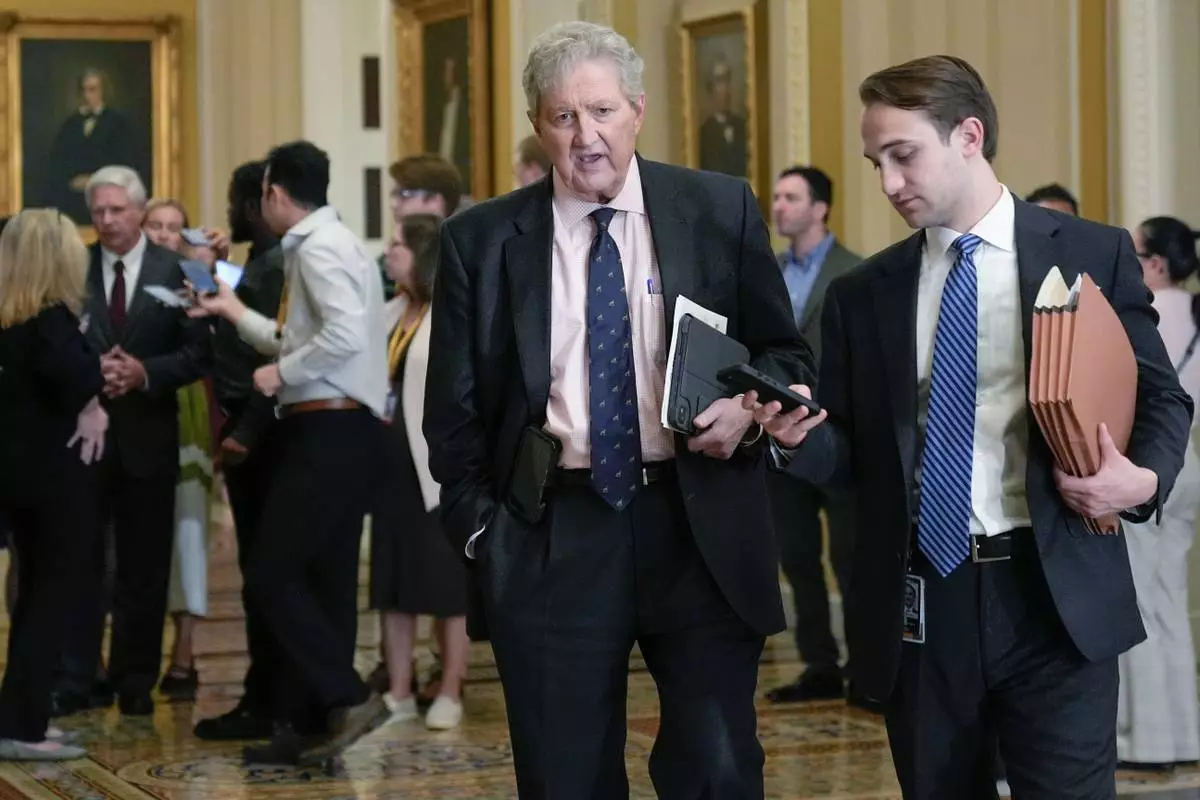
Sen. John Kennedy, R-La., center, speaks with a reporter, Tuesday, April 14, 2026, in Washington. (AP Photo/Mariam Zuhaib)
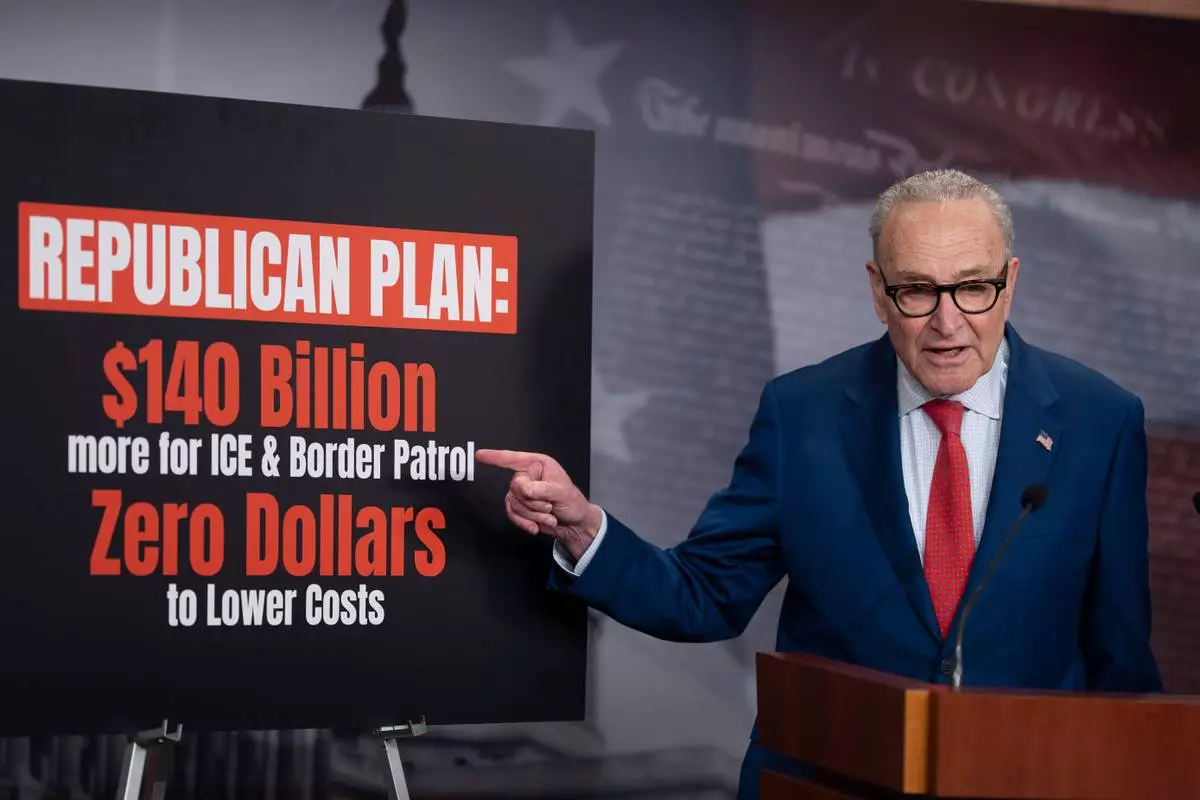
Senate Minority Leader Chuck Schumer, D-N.Y., holds a news conference about the budget process that Republicans hope will fund Immigration and Customs Enforcement and Border Patrol, at the Capitol in Washington, Wednesday, April 22, 2026. (AP Photo/J. Scott Applewhite)
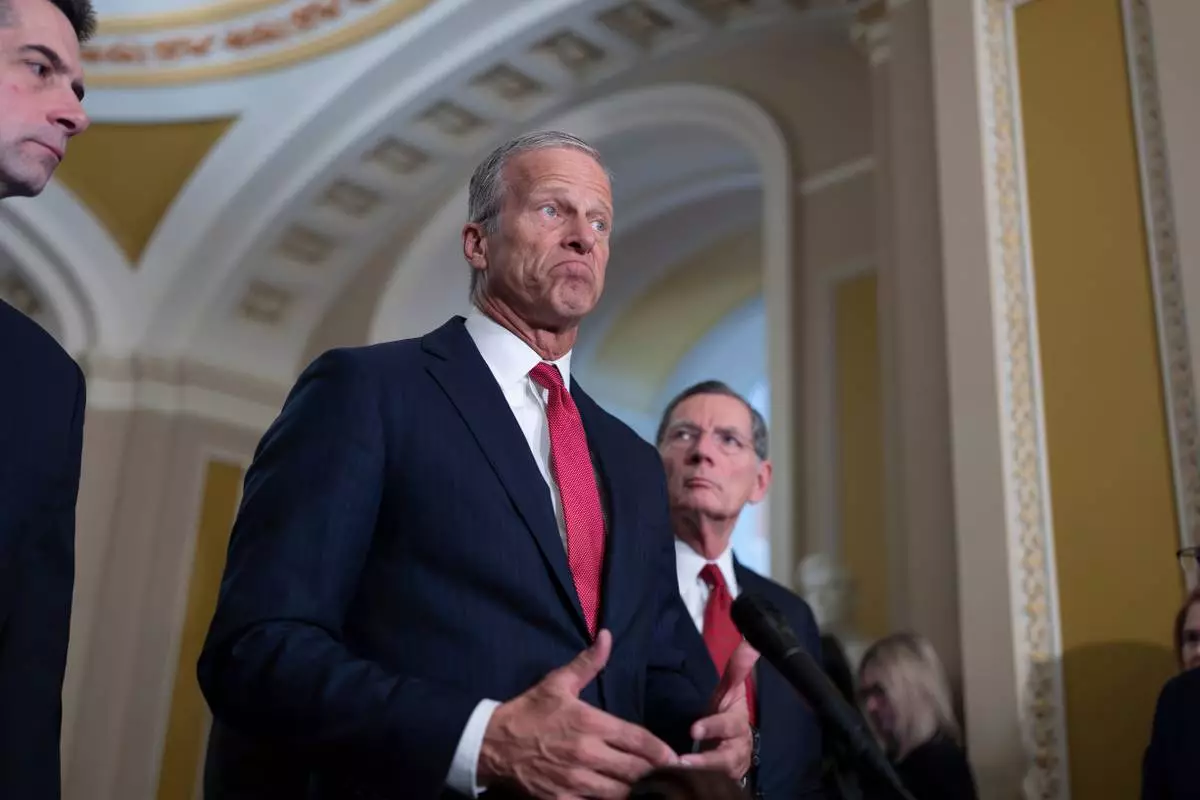
Senate Majority Leader John Thune, R-S.D., flanked by Sen. Tom Cotton, R-Ark., left, and Sen. John Barrasso, R-Wyo., speaks to reporters following a closed-door party meeting, at the Capitol in Washington, Tuesday, April 21, 2026. (AP Photo/J. Scott Applewhite)

DUBAI, United Arab Emirates (AP) — Iran’s top diplomat said Tuesday that the tentative deal to end the war with the United States would require Israel to withdraw from Lebanon — a condition Israel has already rejected and that could sink the agreement, leading to the resumption of all-out war.
The deal, which is between the U.S. and Iran, has not been made public, and officials have sometimes offered contradictory interpretations of what is in it. While Israel is not party to the agreement, it is part of the war: It joined the U.S. in launching strikes on Iran on Feb. 28, and has since fought the Iran-backed Hezbollah militant group in Lebanon and seized large swaths of that country.
Iranian Foreign Minister Abbas Araghchi said Israel’s continued occupation of southern Lebanon would violate the deal.
“Without the withdrawal of Israeli forces from the territories they occupied during this war, the war has not fully come to an end,” Araghchi said.
A U.S. official, who spoke on condition of anonymity to discuss outlines of the agreement, has said the deal does not call for an Israeli withdrawal. And Israeli Prime Minister Benjamin Netanyahu said Monday that Israel would remain in Lebanon “as long as necessary.”
The negotiations to end the war have been plagued by such disagreements before, leading to a prolonged but uneasy ceasefire that has failed to develop into a permanent end to hostilities and has left the Strait of Hormuz, a crucial waterway for the world’s energy supplies, effectively shut.
In other developments, Switzerland’s foreign ministry said the signing ceremony for the deal will take place Friday at the Bürgenstock resort near the city of Luzern. Ministry officials said Tuesday that the location was proposed by Pakistani and Qatari mediators, along with the U.S. and Iran.
Pakistan, a key mediator, has said the deal called for an end to military operations, including in Lebanon, as Iran long insisted. But Araghchi’s call for an Israeli withdrawal adds a new wrinkle.
It puts Israel into a dilemma as it tries to degrade Hezbollah’s military capabilities without undermining an agreement championed by its most important ally, the United States. Israel invaded southern Lebanon after Hezbollah fired missiles across the border during the first week of the war. Since then, it has expanded its military footprint to levels unseen in decades and struck targets deep inside Beirut.
Though Hezbollah has been weakened, it retains the ability to strike Israel, leaving open questions about the effectiveness of Israel’s campaign.
As of Tuesday evening, Netanyahu had not seen the memorandum of understanding between the U.S. and Iran, said a person familiar with the situation, who spoke on condition of anonymity to discuss closed-door details. Another person, who also spoke on condition of anonymity to discuss private conversations between Israel and the U.S., said Israeli officials have not asked U.S. negotiators for the memorandum.
Netanyahu’s office did not immediately respond to a request for comment from The Associated Press. The White House declined to comment on whether Netanyahu or Israeli officials have reviewed the agreement.
The Israeli ambassador to the U.S., Yechiel Leiter, told NPR that while Israel does not know the details of the deal, the apparent inclusion of Lebanon is “unnecessary and unhelpful.”
The extent of Israel’s strikes have at times opened a public fracture between its leaders and U.S. President Donald Trump, who told reporters Tuesday that he was “not happy with the way Israel has handled themselves with Lebanon and with Hezbollah.”
“It just goes on forever,” he said of Israel’s strategy. Israeli strikes in Lebanon have killed nearly 4,000 people, including hundreds of civilians, and displaced more than 1 million. “Israel’s fighting Hezbollah too long, and too many people are being killed,” he said.
Trump said he’s open to sending the emerging agreement to the U.S. Congress for review.
Speaking on the sidelines of the Group of Seven summit in the French Alps, Trump said, “I like the idea, send it to Congress please." He added, “I mean who wouldn’t approve it.”
Republicans on Capitol Hill say they want Trump to provide more information about the agreement, with some expressing skepticism that the deal can deter Iran from pursuing a nuclear weapon.
Israel and the Lebanese government have entered into their own U.S.-mediated direct negotiations, of which Hezbollah was not a part. Those talks have yielded several announced ceasefires that were never implemented on the ground. Lebanese officials initially tried to keep Lebanon separate from the U.S.-Iran negotiations, not wanting to be seen as beholden to Iran, but they have since welcomed the announcement that the deal to end the U.S.-Iran war would include a ceasefire in Lebanon.
Araghchi’s latest comments appear to match the understanding of two regional officials with direct knowledge of the interim deal. The officials, speaking to AP on condition of anonymity to discuss the closed-door negotiations, said it would require Israel to leave nearly all the territory it occupies in Lebanon, minus a few hilltop points along the border seized earlier.
The officials say Iran insisted the accord include Lebanon in the last days of the negotiations.
Lebanon is only one of several major questions hanging over the ceasefire ahead of the planned ceremonial signing.
The agreement is meant to provide a meaningful truce in a monthslong war that has killed thousands across the Middle East, including the top leaders of Iran’s theocracy, and raised the prices of fuel, food and other basic goods far beyond the region.
The agreement provides for the “immediate” opening of the Strait of Hormuz and the lifting of the American naval blockade of Iranian ports, according to a senior U.S. official who spoke to reporters Monday on condition of anonymity to discuss outlines of the agreement.
Pakistani officials who helped broker the agreement also described plans for the simultaneous lifting of Iran’s closure of the strait and the U.S. blockade.
The United States and Iran will then begin 60 days of negotiations over Iran’s nuclear program and the potential lifting of sanctions, Pakistani officials who helped broker the interim deal said, speaking on condition of anonymity about the unpublished text.
The pact also includes the possibility of releasing Iran’s frozen funds and a $300 billion fund to help rebuild Iran if Tehran meets certain benchmarks, senior U.S. officials told reporters Monday. Trump later said the United States would not “invest” funds in Iran.
Regarding the timeline, regional officials who spoke to AP about the deal said the release of frozen Iranian assets would be tied to Tehran implementing the deal. Gulf Arab states also have pledged to inject billions of dollars in Iran’s economy, they added, speaking on the condition of anonymity to discuss the negotiations.
Iran's nuclear program, specifically the fate of its stockpile of highly enriched uranium, would be subject to the 60-day clock. Iran has agreed to discuss ways to possibly “dilute or remove” it, the officials said. However, it remains unclear whether Tehran would agree to that, particularly with hard-liners opposing to giving it up.
U.S. officials have not yet explained how they see the agreement addressing Iran’s nuclear program, including who will be in charge of verifying that Iran is in compliance and who will destroy or remove highly enriched uranium believed to be buried under nuclear sites that were badly damaged by U.S. strikes last summer.
Tankers and cargo vessels are seen in the Gulf of Oman, along shipping routes linking the Strait of Hormuz and the Arabian Sea, Tuesday, June 16, 2026. (AP Photo)
A man who returns to his village following the announcement of an initial ceasefire agreement between the United States and Iran, flashes victory sign as he stands on the rubble of his destroyed house in Nabatiyeh town, southern Lebanon, Tuesday, June 16, 2026. (AP Photo/Hussein Malla)
People walk along Tajrish square in northern Tehran, Monday, June 15, 2026. (AP Photo/Vahid Salemi)
A woman waves an Iranian flag during a pro-government campaign as a portrait of the slain Supreme Leader Ayatollah Ali Khamenei, who was killed in U.S. and Israeli strikes on Feb. 28, is displayed at right, in downtown Tehran, Iran, Monday, June 15, 2026. (AP Photo/Vahid Salemi)