Japan's younger generation is now taking to rallies and protests to voice their concerns over constitutional revision and neo-militarism as the country has sought to revamp its security and defense policies and deviated from its postwar pacifist path.
Step by step, Japan is quietly but proactively dismantling the postwar architecture that has kept it anchored as a pacifist nation for nearly 80 years.
In about a month, a cascade of provocative, tightly coordinated actions -- from honoring war criminals and lifting bans on lethal weapons to deploying offensive missiles and projecting military power abroad -- has laid bare a deliberate, systematic agenda: to rearm without restraint, rewrite history without accountability, and reposition itself as an openly offensive military power.
The pattern is no accident and sounds alarming. It appears to be a carefully crafted blueprint for neo-militarism, putting regional and global peace at greater risk.
Article 9 of Japan's constitution, which renounces war and bans "war potential," has long been a legal pillar of the post-World War II order. Now it is under sustained attack.
Earlier this month, Japanese Prime Minister Sanae Takaichi, in her first address as party president at the Liberal Democratic Party's national convention, declared that "the time has come" to reform the constitution, saying that "we would like to hold next year's convention with a proposal for a constitutional amendment in sight."
Policy changes are outpacing formal amendments. Passed this week, the new defense equipment rules allow Japan to export lethal weapons without prior Diet approval, tearing down a longstanding firewall against Japan becoming a major arms exporter.
The Japanese government has reportedly begun considering the nationalization of manufacturing facilities such as defense equipment factories, which is expected to be one of the key topics when Japan moves to revise its three security documents later this year.
The Takaichi administration's attempt to revise the constitution has drawn rounds of protests at home. A group of young Japanese participated in a rally in Tokyo focused on anti-war and peace on Sunday.
"As for the Takaichi administration, there is a part of it. That is using military means to cover up domestic problems, while also intensifying authoritarian tendencies, with an aim to seek support by stirring up authoritarian sentiments," said a protester.
Japan's defense budget for fiscal year 2026 has reached a record high of 9.04 trillion yen (around 56.81 billion U.S. dollars), sparking widespread opposition at home. At a time when Japan's economy faces sluggish growth and shrinking fiscal space, the public hopes that the government will prioritize revitalizing the economy and improving social welfare.
A renewed turn toward military expansion has only deepened concerns among thoughtful voices in Japan. The demonstrators said they oppose the Japanese government's significant increase in defense spending, the lifting of bans on lethal weapons exports, and the push for constitutional revision.
"Isn't that murder? Weapons are used to kill people, to fight wars. Why only the military industry, which manufactures weapons, profits in the end? These weapons are even manufactured with our tax money. There is no way I can agree with such a thing," one of the protesters said.
"More and more young people are standing up, which I think is truly encouraging. Previously, those who participated in rallies are in their 60s, 70s, and 80s. But now, I find they have finally come to hold demonstrations in front of the Diet and join penlight demonstrations," said another protester.
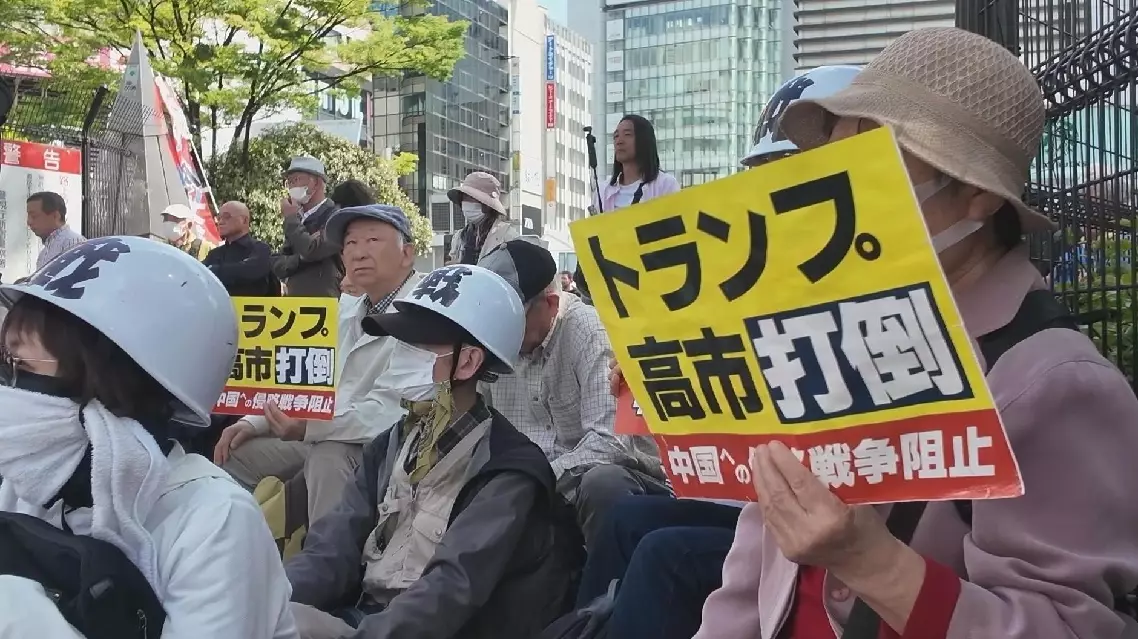
Japan's youth rises up to protest against neo-militarism