Skip to Content Facebook Feature Image

Clarion Partners Reports Record Leasing Activity Across Its U.S. and European Industrial Business, Highlighting the Resilience of Class A Industrial Assets

Business

Clarion Partners Reports Record Leasing Activity Across Its U.S. and European Industrial Business, Highlighting the Resilience of Class A Industrial Assets
Business

Business

Clarion Partners Reports Record Leasing Activity Across Its U.S. and European Industrial Business, Highlighting the Resilience of Class A Industrial Assets

2026-04-27 22:43 Last Updated At:22:50

NEW YORK--(BUSINESS WIRE)--Apr 27, 2026--

Clarion Partners, a leading investor in industrial real estate, today announced robust leasing activity across its global portfolio, with more than 8 million square feet of newly executed leases year-to-date, including 7.1 million square feet (MSF) in the U.S. and 1.0 MSF in Europe. Additionally, both regions of the business set new leasing records for a first quarter (for the U.S. region, this was the strongest first quarter in the Firm’s 40+ year history; for Europe, it represented the strongest Q1 since the firm began building its European platform in 2020).

This press release features multimedia. View the full release here: https://www.businesswire.com/news/home/20260427273510/en/

Clarion’s U.S. leasing activity includes 35 new leases spanning key logistics and distribution markets including Dallas/Fort Worth (1.1MSF), Lehigh Valley (1.0 MSF), Indianapolis (800k SF), Inland Empire (756k SF), and New Jersey (445k SF). The vacancy rate for the Firm’s nearly 220 MSF U.S. industrial portfolio declined by 175 basis points (bps) over the first quarter.

Clarion Europe’s leasing activity was most robust in markets including the Netherlands (454k SF), Spain (238k SF), France (205k SF), and the United Kingdom (102k SF), contributing to platform vacancy levels .

Tenant demand in both markets has been driven primarily by e-commerce and 3PLs, reflecting the ongoing evolution of global supply chains and the need for modern, efficient distribution networks.

“Despite ongoing macroeconomic uncertainty and supply chain recalibration, we continue to see strong absorption in our portfolio, particularly across well-located Class A assets,” said Dayton Conklin, Managing Director and Head of Clarion Partners’ U.S. Industrial Platform. “With two thirds of U.S. inventory built before 2000, obsolescence continues to support positive rent growth in newer, state-of-the-art facilities.”

“Tenants continue to prioritize modern facilities that provide higher clear heights, advanced loading capabilities, ESG features, automation readiness, and proximity to labor and transportation nodes,” said Clarion Partners Europe CEO Alistair Calvert. “This trend is particularly evident in urban infill and major distribution corridors, where supply remains constrained and demand for best-in-class space continues to outpace availability.

Class A Activity Gains Momentum

For the overall U.S. market, Q1 industrial vacancy remained stable at 6.7%, the first time without a quarterly increase since early 2022. In addition, Class A warehouse net absorption specifically accelerated both quarter-over-quarter and year-over-year, exceeding new construction deliveries for the first time in almost five years. Leasing in the 1MSF+ segment was particularly robust, with 19 MSF of net absorption in Q1. Vacancy in that segment fell 170 bps year-over-year to 4.2% (the lowest among size segments) nationally. Leasing in the big box / e-commerce segment has historically served as a leading indicator for increased activity across other industrial tenant types and building sizes. 1

In Europe, overall market vacancy stabilized at 5.5% in Q4 2025, 2 signaling that the market is approaching, or may already be at, peak vacancy. As in the U.S., a growing bifurcation is evident between modern Grade A buildings and older stock, with vacancy for the former remaining below 3% in core Western European markets. 3

Positioned for Continued Growth

Clarion Partners remains focused on growing its industrial platform through development, strategic acquisitions, and active asset management across high-conviction markets in the U.S. and Europe. The firm’s disciplined approach and emphasis on location and quality continue to drive leasing performance and long-term value creation.

1 CBRE-EA with additional calculations from Clarion Partners Global Research, Q1 2026
2 CBRE, Q4 2025
3 Green Street, January 2026

About Clarion Partners

Clarion Partners, an SEC registered investment adviser with FCA-authorized and FINRA member affiliates, has been a leading U.S. real estate investment manager for more than 40 years. Headquartered in New York, the firm maintains strategically located offices across the United States and Europe. With over $72 billion in total real estate and debt assets under management, Clarion Partners offers a broad range of real estate strategies across the risk/return spectrum to 500 institutional investors across the globe. Clarion is scaled in all major property types and was an early entrant into the Industrial sector. The Firm’s global industrial team manages a 945+ property portfolio in the U.S. and Europe consisting of more than 245 million square feet. For more information visit www.clarionpartners.com and follow us on LinkedIn and YouTube.

About Franklin Templeton

Franklin Templeton is a trusted investment partner, delivering tailored solutions that align with clients’ strategic goals. With deep portfolio management expertise across public and private markets, we combine investment excellence with cutting-edge technology. Since our founding in 1947, we have empowered clients through strategic partnership, forward-looking insights, and continuous innovation – providing the tools and resources to navigate change and capture opportunity.

With more than $1.7 trillion in assets under management as of January 31, 2026, Franklin Templeton operates globally in more than 35 countries. To learn more, visit franklintempleton.com and follow us on LinkedIn. Franklin Resources, Inc. [NYSE: BEN]

Copyright © 2026. Franklin Templeton. All rights reserved.
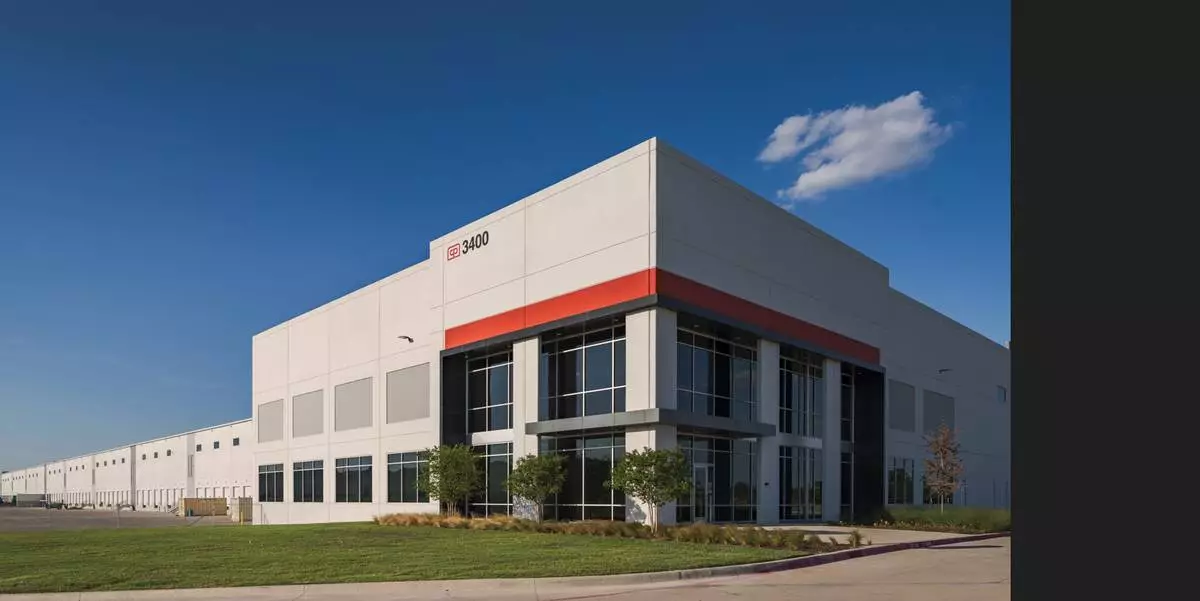
35 Northlake, a multi-building industrial park located in the Dallas, TX market

35 Northlake, a multi-building industrial park located in the Dallas, TX market
DUBAI, United Arab Emirates (AP) — Diplomatic efforts to end the Iran war stalled again over the weekend as both sides dug in on their demands, even as they face mounting pressure to reach a compromise.

Iran said it won’t reopen the Strait of Hormuz unless the United States lifts its blockade and ends the war. U.S. President Donald Trump wants a broader deal that would end Iran’s nuclear program and address other issues like its missile program and support for regional proxies.

For both sides, the clock is ticking.

The continued closure of the strait has sent gas prices soaring and could cause further damage to the world economy ahead of U.S. midterm elections. The blockade is strangling Iran’s economy.

Each side is waiting for the other to blink. Here is what to know.

Iran's latest proposal would put off negotiations on its nuclear program to a future date.

Instead, the deal would only see Tehran end its chokehold on the Strait of Hormuz in exchange for Washington lifting its blockade on Iranian ports and a long-term or permanent truce, according to two regional officials with knowledge of the proposal who spoke on condition of anonymity to discuss the closed-door negotiations.

That offer will likely be rejected by Trump. For one, it doesn't address the core issue he cited when he began bombing on Feb. 28: finding a way to ensure that Iran cannot build an atomic weapon. It also appears to be silent on other major questions, like Iran's missile program and its support of proxies in the region.

This weekend, Trump held back sending envoys to Pakistan, which has been playing a crucial mediating role. By saying the Iranians could call Washington with any proposal, Trump appears to be signaling he's content to try to continue to squeeze Iran via a blockade.

The U.S. blockade both squeezes Iran's oil sales — a key source of hard currency for its theocracy — and threatens to force Tehran to eventually shut down its production if it can't get its crude to market. Already, Iran has faced troubles at home over its economy, and it could worsen as time goes on.

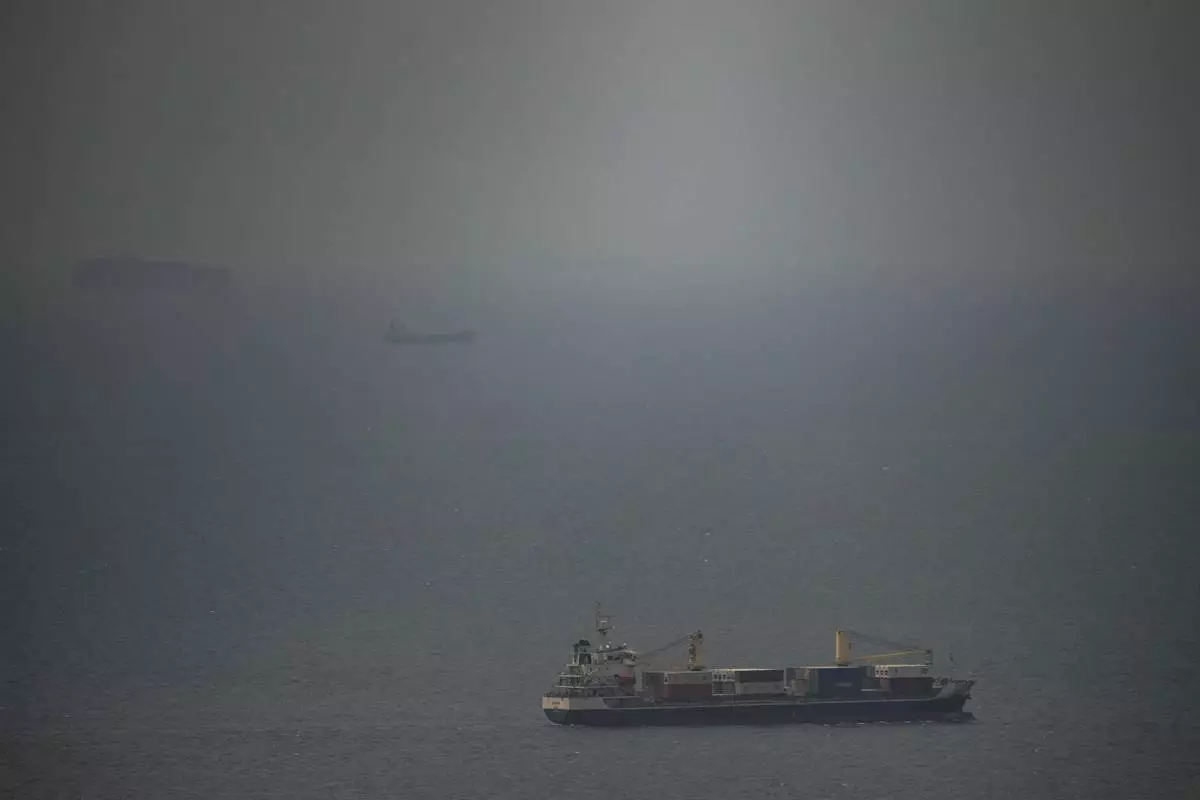
The global economy also is suffering: With few ships able to cross the strait, through which about 20% of all traded oil and natural gas passes, oil and gasoline prices are skyrocketing and jet fuel, cooking gas and other energy products are starting to become scarce in parts of the world.

The closure has particularly put pressure on Trump's Gulf allies, which also use the waterway to export their oil and gas.

The current truce began April 8 after multiple deadlines posed by Trump that threatened Iran’s very “civilization” at one point. A separate ceasefire between Israel and the Iran-backed Hezbollah militant group in Lebanon also has taken effect.

Trump has now extended the ceasefire with Iran indefinitely after whipsawing between various timelines for the conflict.

But negotiations for ending the war have stalled.

U.S. Vice President JD Vance took part in an earlier round of talks days after the truce began — the highest-level ones between America and Iran since the 1979 Islamic Revolution. They ended without agreement.

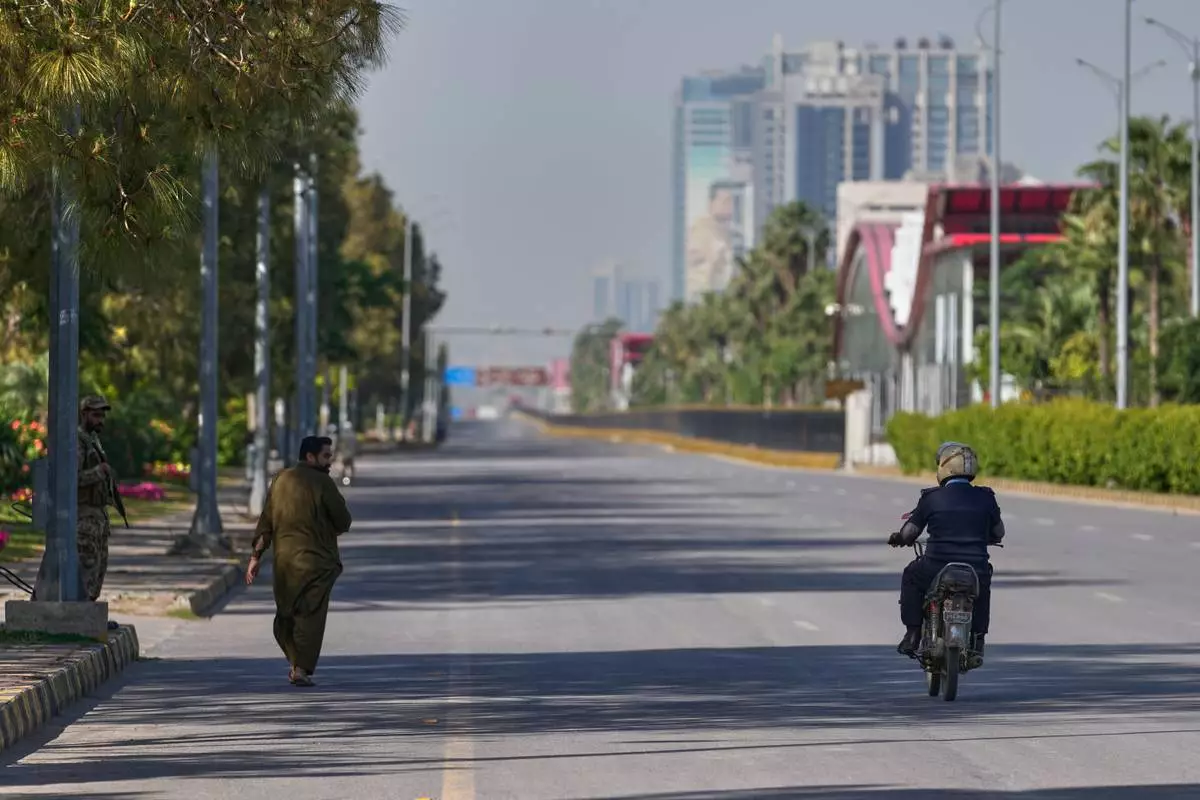
Pakistan is trying to get the two sides back to the table in Islamabad. But this weekend it took down all the checkpoints and security it had in place in anticipation of negotiations. That signals there’s no immediate hope of talks resuming.

While negotiations appear at a stalemate, the U.S. military presence in the Middle East continues to grow. As of Monday, the U.S. Navy had three aircraft carrier groups in the region: the USS Abraham Lincoln, the USS Gerald R. Ford and the USS George H.W. Bush.

Those carriers include some 15,000 sailors and Marines, as well as over 200 aircraft and additional ships. An amphibious assault group led by the USS Tripoli is also in the Mideast, with its own sailors, Marines and aircraft.

That comes on top of the warplanes, refuelers and other troop deployments to the region.

Iranian Foreign Minister Abbas Araghchi met with Russian President Vladimir Putin on Monday, Russian state news agency Tass said. That followed Araghchi's visits to Pakistan and Oman in recent days. Pakistan has been a key mediator in this war, and Oman has long has been a key interlocutor between the U.S. and Iran.

But Russia broadly has stayed out of the latest conflict. Moscow has been floated as a possibility to take in Iran's highly enriched uranium — removal of which Trump has insisted on. That uranium could be used to build a bomb, should Iran choose to pursue one — though Tehran insists its program is only for civilian purposes.

Russia has signaled it is willing to assist, though Tehran maintains it will not give up its stockpile.

All of Iran’s highly enriched uranium remains in the country, likely entombed at enrichment sites bombed by the U.S. during a 12-day war last June.

Associated Press writer Samy Magdy in Cairo contributed to this report.

A cargo ship sails in the Persian Gulf toward the Strait of Hormuz, Wednesday, April 22, 2026. (AP Photo)

A cargo ship sails in the Persian Gulf toward the Strait of Hormuz, Wednesday, April 22, 2026. (AP Photo)

An army soldier, left, walks as police officer drives motorcycle on an empty road ahead of second round of negotiations between the U.S. and Iran, in Islamabad, Pakistan, Monday, April 20, 2026. (AP Photo/Anjum Naveed)

An army soldier, left, walks as police officer drives motorcycle on an empty road ahead of second round of negotiations between the U.S. and Iran, in Islamabad, Pakistan, Monday, April 20, 2026. (AP Photo/Anjum Naveed)

A soldier stands guard on a bridge ahead of second round of negotiations between the U.S. and Iran, in Islamabad, Pakistan, Monday, April 20, 2026. (AP Photo/M.A. Sheikh)

A soldier stands guard on a bridge ahead of second round of negotiations between the U.S. and Iran, in Islamabad, Pakistan, Monday, April 20, 2026. (AP Photo/M.A. Sheikh)

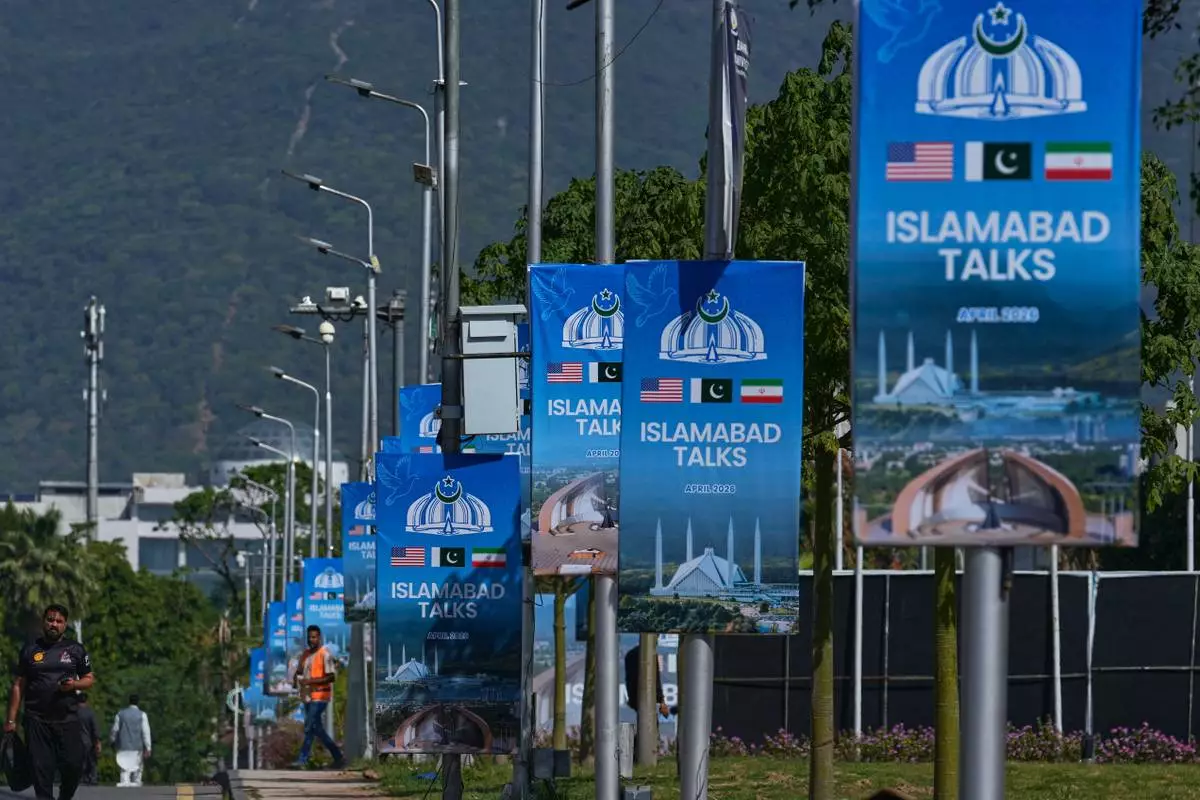
Workers walk past billboards near the Serena Hotel ahead of the second round of negotiations between the U.S. and Iran, in Islamabad, Pakistan, Monday, April 20, 2026. (AP Photo/Anjum Naveed)

Workers walk past billboards near the Serena Hotel ahead of the second round of negotiations between the U.S. and Iran, in Islamabad, Pakistan, Monday, April 20, 2026. (AP Photo/Anjum Naveed)

Recommended Articles