Skip to Content Facebook Feature Image

China's HH-200 aircraft aims to expand logistics network to remote, less-developed areas

China

China

China

China's HH-200 aircraft aims to expand logistics network to remote, less-developed areas

2026-04-27 17:03 Last Updated At:04-28 17:19

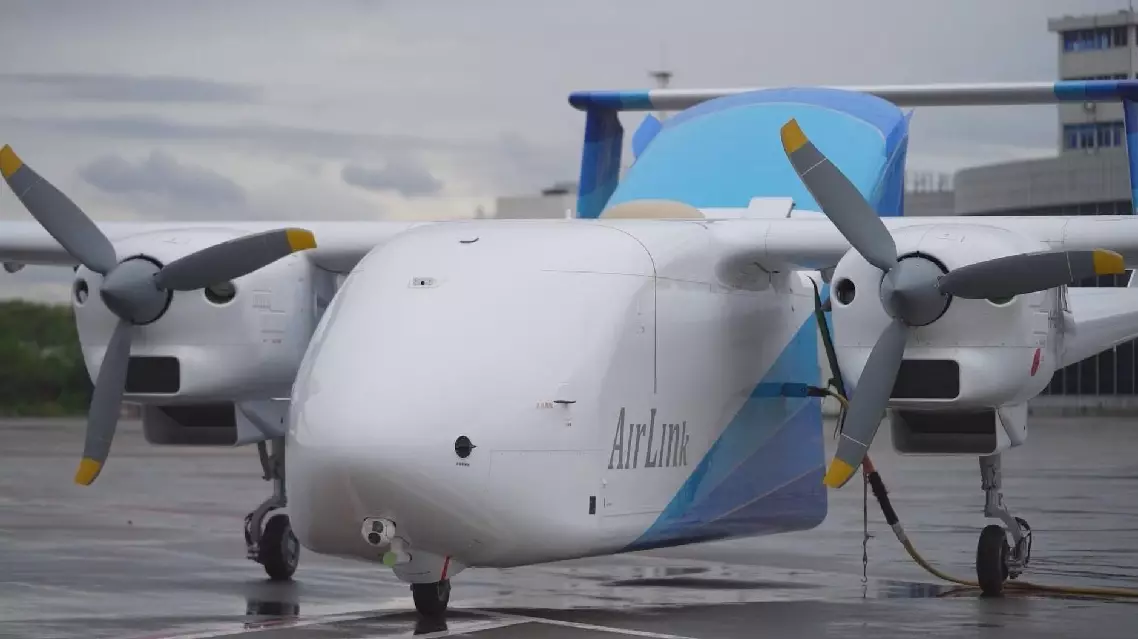
China's commercial unmanned cargo aircraft, the HH-200, successfully completed its maiden flight this month, aiming to expand the logistics network to remote and less developed regions, according to its developer.

The HH-200 can perform fully autonomous flight and AI-powered obstacle avoidance. It is intended to provide logistics service for areas not covered by main delivery routes, marking new progress in the country's development of large-scale unmanned cargo aircraft.

AVIC XAC Commercial Aircraft Co., Ltd. started to develop the Xinzhou Honghu HH-series unmanned aircraft in northwestern China's Shaaxi Province in September 2021. After nearly five years of efforts, the maiden flight of the HH-200 was completed on April 15 in Shaanxi Province's Pucheng.

The HH-200 features a square, straight-through fuselage, twin-engine high-wing configuration, and twin-boom layout. The aircraft has a cargo hold with a standard volume of 12 cubic meters, expandable to 18 cubic meters, a maximum payload of 1.5 tonnes, a cruising speed of 310 kilometers per hour, and a range of 2,360 km.

Dong Jianhong, chief designer of AVIC XAC Commercial Aircraft Co., Ltd., said the aircraft is used to further expand China's logistics network.

"Ensuring remote and less-developed areas enjoy the same logistics treatment as other places, and enabling people to enjoy the same quality of life no matter where they are in China are the primary responsibility of our unmanned logistics and air transportation systems," said Dong.

The HH-200 has a service life of 50,000 flight hours or 15,000 takeoff and landing cycles, with a full life-cycle operating cost of 4.7 yuan (about 0.69 U.S. dollars) per tonne-kilometer.

The aircraft demonstrates strong environmental adaptability. It can take off and land on runways as short as 500 meters and at high-altitude airports above 4,200 meters. It operates in extreme temperatures ranging from minus 40 degrees Celsius to 50 degrees Celsius and under complex weather conditions, effectively bridging transportation gaps in mountainous areas, islands, snowy regions and plateaus, thereby enabling an efficient low-altitude logistics network.

"It is an aircraft capable of autonomous flight. No matter what kind of weather it encounters along the route -- such as wind, frost, rain, or snow -- it will act according to the preset requirements, avoiding when necessary and enduring when required. It also has communication link and remote-control function. What are these remote-control functions for? When problems arise, any temporary mission change requests can be transmitted through this link. Without these conditions, the aircraft flies autonomously according to the predetermined plan, but it must ensure safety in the given environment," Dong said.
China's HH-200 aircraft aims to expand logistics network to remote, less-developed areas


China's HH-200 aircraft aims to expand logistics network to remote, less-developed areas

The fragile and frequently violated ceasefire in Lebanon is coming under mounting strain amid rising political and military pressures across the Middle East, according to Daniel Levy, a former senior adviser to Israeli Prime Minister Ehud Barak.

In an interview aired on Wednesday by China Global Television Network (CGTN), Levy said tensions remain high, with clashes continuing, despite an extension of a ceasefire, with developments on other fronts in the region likely to determine whether hostilities between Israel and Hezbollah forces in Lebanon fully resume.

"Partly, that depends on whether the U.S. allows Israel sufficient destructive freedom of operation, that if Iran conditions one deal on another, it brings the whole thing crumbling down. So, in order to uphold this ceasefire, America has imposed certain limitations on Israel's actions in Lebanon. However, first of all, the reverse probably applies. If there is a collapse and a further escalation on the Iran front, one can almost guarantee that Israel will re-escalate in Lebanon," said Levy, who is now president of the U.S./Middle East Project, which focuses on solutions to the Israeli-Palestinian conflict.

A major conflict between Israel has and Hezbollah ignited in early March, with Israel sending troops into south Lebanon to battle the Iran-backed militant group which had launched rocket attacks at Israel following joint Israeli-U.S. strikes on Iran.

A 10-day ceasefire took effect on April 17 and was extended by three weeks on April 23, after U.S. President Donald Trump announced the extension shortly after the two sides held their second round of ambassador-level talks in the U.S.

"There are now Israel-Lebanon negotiations taking place, hosted, sponsored, by the U.S. One of the things to look out for is the framework of that negotiation, is the content of that negotiation, designed to achieve a mutually dignified, pragmatic, sustainable deal, or are the Americans and the Israelis trying to push things into that deal equation which reality cannot sustain? So you have a Lebanese government which wants to move forward, but is being pushed into a civil war," he said.

Despite the ceasefire, the violence continues with both sides blaming each other for violations of the truce.

Lebanon's health ministry said Israeli strikes on Tuesday killed eight people, including three rescue workers, in the country's south.

Fragile Israel-Lebanon ceasefire under mounting pressure amid regional tensions: expert

Fragile Israel-Lebanon ceasefire under mounting pressure amid regional tensions: expert

Recommended Articles