The U.S.-Israel war on Iran is battering Yemen’s economy, as soaring energy costs, disrupted transport and rising trade expenses ripple through the country.
In late February, Israel and the United States launched joint strikes on Iranian cities, prompting Tehran to retaliate with waves of missile and drone attacks on Israel and U.S. interests across the Middle East. Iran also tightened its control over the Strait of Hormuz, a vital artery through which nearly one‑fifth of the world’s oil passes.
The disruption has driven up global energy prices and triggered inflationary pressures across multiple economies, amplifying the conflict’s reach.The spillover effects of the conflict have been keenly felt in Yemen, a nation heavily dependent on imports and external assistance.
"Since the outbreak of the war, fuel and food prices in Yemen have risen, and transportation costs have increased as well. Meanwhile, due to a rise in marine insurance premiums by international insurers driven by heightened risks at sea, shipping and insurance costs have also gone up. Overall, the Yemeni economy itself has been in an extremely fragile state," said Mohammed Jamel Al-Shuaibi, professor of political economy at Aden University.
Facing these mounting economic pressures, the Yemeni government has moved to mitigate the impact.
"The war in Iran would directly affect the entire world and have a particularly severe impact on Yemen. The Yemeni government has already recognized this dangerous signal and has taken a series of measures to ensure the sustainability of its fuel supply and maintain the continued operation of air transport," said Haidera Al-Qadi, director general of the Information Office in Aden Governorate.

Yemen's economy hammered by US-Israel war on Iran
Rescue and recovery work is ongoing at the site of a deadly train collision at a station on the outskirts of the Indonesian capital Jakarta which has killed at least 15 people and left dozens injured, while the search for potential survivors trapped in the wreckage continues.
The incident unfolded at around 20:50 local time on Monday when a commuter train on the Jakarta-Bekasi route hit an electric taxi and came to a halt. Minutes later, a long-distance express train traveling from Jakarta to Surabaya crashed into the stationary commuter train from behind. The rear carriage, designated for women only, bore the full force of the impact.
One anxious mother, Fitria Yunis, said she had been waiting at a hospital overnight following the crash. Her daughter, who was on board the commuter train, suffered serious injuries and is receiving treatment in the ICU.
"My daughter didn't realize at first that a train had hit a taxi. She was on her phone. When the second crash happened and the train collided, she was immediately thrown across the carriage. Her legs flew up in the air, and she became trapped between two metal poles. She screamed for help, and after several hours, they were able to evacuate her through a nearby window," she said.
Rescue teams have remained on-site since the collision and have been using heavy-duty equipment to reach victims who who are trapped inside the damaged carriages. Officials say the scale of destruction has made the operation slow and highly challenging.
Indonesian President Prabowo Subianto visited survivors at a hospital in Bekasi on Tuesday morning, extending condolences on behalf of the government and promising a swift investigation.
Agus Yudhoyono, Coordinating Minister for Infrastructure and Regional Development of Indonesia, gave an update from the site of the tragic incident.
"Right now we are in the second stage: the recovery process. We aim to have the damaged carriages lifted from the tracks. We will continue to evaluate the technical and operational side of this accident. We are aware that having a rail network that overlaps with our road and land transport is challenging, but we will investigate this further to find out what steps are needed to prevent a similar incident from happening," he said.
The accident has disrupted services across Jakarta's commuter rail network, which carries nearly one million passengers daily, affecting hundreds of thousands of commuters who rely on the trains for their daily journeys.
An investigation into the cause of the incident is being conducted by the rail operator and the National Transportation Safety Committee.
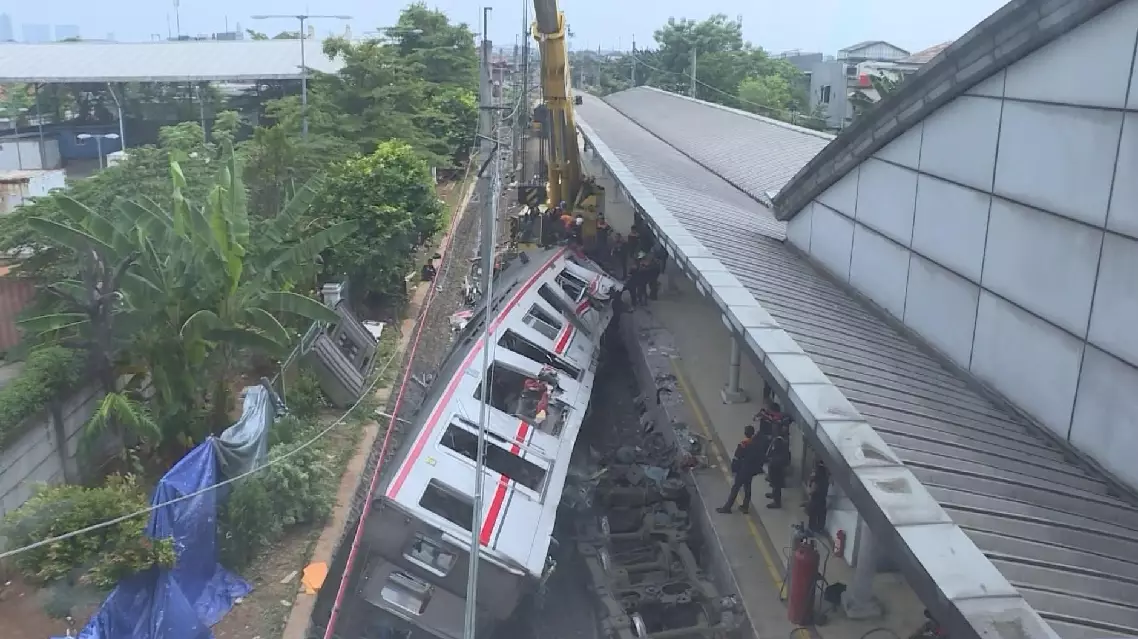
Death toll rises in Indonesian train collision as rescue, recovery work continues