The increasing integration of artificial intelligence (AI) will be a decisive factor in shaping the future competitiveness of the automotive sector as the motoring world continues to modernize, according to a senior expert at Roland Berger, a global consultancy firm headquartered in Germany.
Felix Mogge, a senior partner in Roland Berger's Automotive Practice, gave his assessment of the current trends and challenges in the auto sector in an interview with the China Global Television Network (CGTN) during the ongoing 2026 Beijing International Automotive Exhibition.
Also known as Auto China 2026, this year's edition of the world's largest auto show opened in the Chinese capital on Friday and is scheduled to run until May 3 under the theme "Future of Intelligence".
With over 1,450 vehicles on display, including 181 debutants and 71 concept cars, Mogge stressed how the auto show provides a platform to showcase how smart technologies have been well integrated into the automotive industry.
"This year's Auto Show in Beijing very clearly sets proof on how far the automotive industry has come from moving smart mobility from a vision into a reality. So new technological innovations are not just niche applications but they really became mass products. We are seeing them at literally every booth and every vehicle. So advanced features like autonomous driving, the next level for urban scenarios car to infrastructure communications and as well new smart cockpits integrating AI, integrating communication between customer and the vehicle have been becoming the new normal. And I think that's a good thing and it shows how far cars are in the meantime integrated in our digital universe [and] everyday life," he said.
Mogge also noted the leading role the Chinese auto industry is playing in driving these new trends, as a number of Chinese brands showcase their latest models.
At the auto show, the concept of physical AI, which refers to the ability of vehicles to perceive, reason and act in the real world, has emerged as a new auto industry buzzword.
Mogge defined the era of intelligence for automobiles, such as physical AI, from a wider perspective, covering the whole industry, products and supply chains.
"Just as with many other industries, AI has for sure become from a nice [thing] to have into a fundamental and differentiating factor also for the automotive industry. And that goes for both the vehicle in itself and also the underlying value chain process. So on the latter, AI is a key lever across all different value chain steps whether it's on manufacturing, on procurement or in sales and distribution to drive up efficiency and also help players to manage the immense cost pressure that we are having. I think it's also one of the big themes here at the Auto Show how competitive the Chinese car market is these days," Mogge said.
"On the product itself, it's the fundamental [aim] to drive new functionalities of the vehicle to the next level: smart cockpits, autonomous driving functionalities, but also charging infrastructure and so on -- all are proliferated by AI. And once again I think this shows that proof about the quality and the capabilities of the ecosystem in China in driving this. Many of the companies that we are seeing here around have very interesting innovations on display and showing what AI can actually do in order to modernize the vehicle of today and tomorrow," he continued.
Mogge also highlighted the importance of restructuring supply chains in order to deal with the impact of global shocks.
"The industry has been under big stress, we already talked about this when we last met at Auto Shanghai a year ago. Things have been not getting any better in the meantime, and OEMs (Original Equipment Manufacturers) as well as suppliers continue to restructure their supply chains, diversify the sourcing of critical components like semiconductors, like raw materials, and trying to prepare themselves to become more resilient against global political as well as macroeconomic shocks," he said.
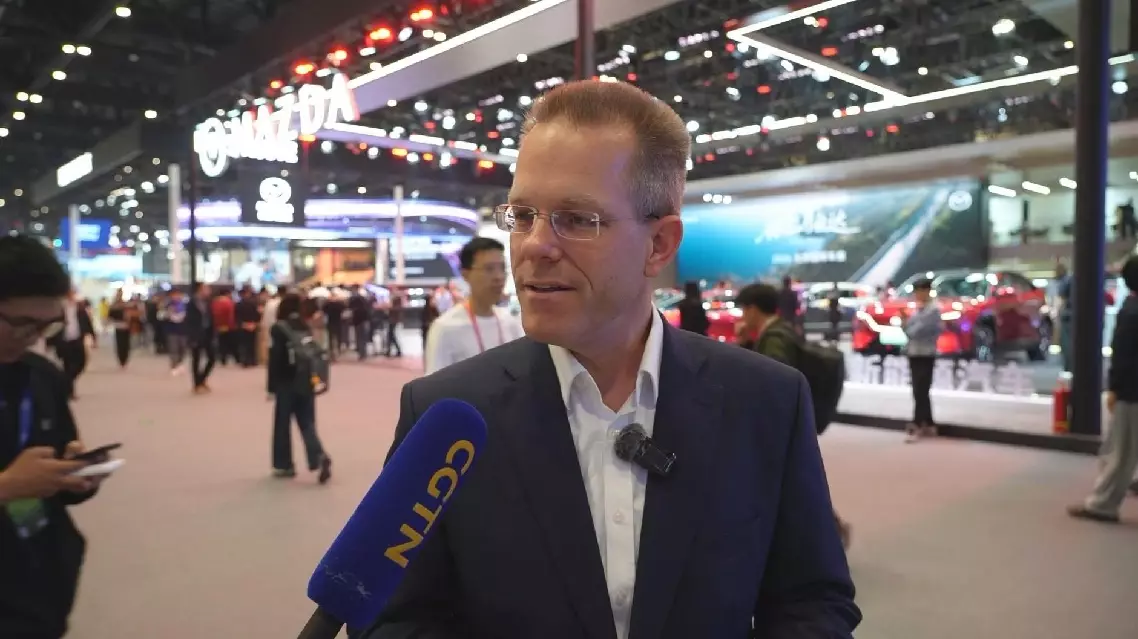
AI holds key to ensuring future automotive competitiveness: auto expert