DORAL, Fla. (AP) — Scottie Scheffler doesn't have much familiarity with Trump National Doral. Then again, hardly does anyone else in the field this week for the Cadillac Championship.
The PGA Tour is back in Doral for the first time in a decade, this time as a 72-player, $20 million signature event. Some in the field are playing Doral as pros for the first time, and the overwhelming majority of players in this week's field didn't play in the most recent tour event on the Blue Monster in 2016.
Scheffler — the world's No. 1 player — is among the first-timers. After a couple of practice rounds at Doral this week, he seems to know what awaits over the next 72 holes. Figuring it all out, well, that's another story.
“There’s not really many tricks to this golf course,” Scheffler said. “It’s just very, very difficult. It’s a flat piece of land. There’s just a lot of bunkers, a lot of water and the golf holes are long. So, with that combination, it’s going to be tough.”
Indeed, it is a tough course and a field including 10 of the world's top 15 players. Even more of the world's best likely would have been at Doral if it wasn't such a jam-packed time on the golf calendar, with either five signature events or majors within this current six-week span that started with the Masters and ends with the PGA Championship in mid-May.
Among those not playing this week: back-to-back Masters champion Rory McIlroy.
“If I had it my way I would play every single week out here,” Scheffler said. “But just (with) the nature of our sport and the demand on our time and everything, it’s not really possible. I have to set up my schedule in certain type of cadence.”
Doral first became part of the PGA Tour schedule in 1962. It became a World Golf Championship in 2007, and then the PGA Tour struggled to find a title sponsor when President Donald Trump bought the resort. LIV Golf has played events at Trump National Doral in the past, and now the PGA Tour returns.
The last PGA Tour winner on the Blue Monster was Adam Scott in 2016. That tournament was called the WGC-Cadillac Championship; this one is the Cadillac Championship, and no, Scott isn't the defending champion. Technically, this is a new event.
“Good memories for me,” said Scott, who beat Bubba Watson by a shot to win at Doral a decade ago. “Obviously winning the last time we were here, but I've always enjoyed playing this golf course. It’s a challenge. It’s called the Blue Monster for a reason. It’s a big golf course, very penal. The wind can blow, and that’s the biggest challenge out here. So, you’ve got to strike it well, just demanding tee to green. It’s great that we’re back and looking forward to this week.”
Justin Rose is also a past winner at Doral, after winning the WGC-Cadillac in 2012. He's one of 18 players in this field who have competed in PGA Tour events at the course in the past — though Rose noted the course has undergone a few changes since then.
He, like Scott, beat Watson by one shot for his win at Doral. Rose made bogey on the 72nd hole that year, then exhaled when Watson missed an 8-foot birdie putt that would have forced a playoff. And the 18th hole now, just like then, is still so brutal that when Rose saw it for the first time this week said he asked his caddie how many balls they still had in the bag.
Into the wind, Scheffler said, he might be hitting 4-iron into the green. Wind at his back, it might be a wedge. And the fairway opens up considerably if it is playing downwind.
“You’re in the lap of the gods there in terms of the lie you get, what have you. Just a very narrow tee shot, and then obviously hazards along the way,” Rose said. “You’re trying to manage the risk really on that hole. To play it properly you have to stand up and make two great swings.”
AP golf: https://apnews.com/hub/golf

Scottie Scheffler prepares to putt on the 17th hole during the final round of the RBC Heritage golf tournament Sunday, April 19, 2026, in Hilton Head, S.C. (AP Photo/Mike Stewart)
WASHINGTON (AP) — A Trump administration plan to cut in half the Environmental Protection Agency’s budget has been the focus of contentious congressional hearings over the future of an agency that Democrats have accused of abandoning its mission to protect the environment and public health.
EPA Administrator Lee Zeldin appeared before a Senate committee on Wednesday, in the last of three budget hearings this week, to argue for sharply reduced funding for the agency, which already has seen its staffing reduced to its lowest level in decades under his leadership. The former Republican congressman from New York took an aggressive approach, responding to Democrats with his own questions and at times accusing them of being unprepared or failing to care about the EPA’s track record.
Zeldin has eliminated major climate change programs, promoted deregulatory efforts he calls the biggest in American history and canceled billions of dollars in Biden-era environmental justice grants to halt what he calls “EPA’s radical diversity, equity, and inclusion programs.”
“This budget proposal captures significant efficiencies and a return focus on what Congress has directed us to do, demonstrating our commitment to a leaner, more efficient and accountable EPA focused on environmental work that directly benefits the American people,” Zeldin told senators Wednesday.
The Republican administration’s proposed $4.2 billion EPA budget would sharply reduce support for state environmental programs and state-administered loans for water projects. It also would halt what it calls “radical climate research” and cut resources for enforcement and compliance. Officials asked for more money for faster project permitting and to address drinking water disasters.
“Zeldin has executed the fossil fuel industry’s agenda. A massive reckoning is coming," said Sen. Sheldon Whitehouse, D-R.I. He said those who help industry instead of the public “will be exposed.”
On budgets, Congress gets the final say and lawmakers commonly depart from White House requests.
Last year, they rejected most of Trump’s proposed cuts, reducing agency spending by just 3.5% despite an administration request to cut spending by more than half. Democrats said the new budget plan shows that Zeldin is a friend to industry and ignores the cancers, asthma and other consequences of pollution.
“The budget proposal reads like a climate change deniers’ manifesto,” said Connecticut Rep. Rosa DeLauro, the top Democrat on the House Appropriations Committee. At a hearing Monday, she asked how the EPA can justify abandoning its duty to protect people in the United States “under the false flag of economic growth?”
The EPA has proposed rescinding a landmark finding that climate change is dangerous, loosened rules from the Biden administration limiting pollution from coal plants and proposed scrapping greenhouse gas emission limits for certain vehicles.
In response to DeLauro, Zeldin asked where the Clean Air Act mentions fighting climate change and whether she had heard of a recent Supreme Court decision that restricted the EPA’s authority to write aggressive regulations.
“You do not have the right to say climate change does not exist, that it’s a hoax,” DeLauro said.
Zeldin shot back: “You’re just somebody who likes to have the microphone on."
DeLauro said the administration's behavior was “arrogant” and that it was ”making a mockery of what the agencies are all about.”
Zeldin told Rep. Josh Harder, D-Calif., that data he cited on the agency's rollback of certain coal plant emissions limits was worthless.
“Have your dog pee on it. It is not accurate,” Zeldin said.
Harder's office later provided the EPA report from which it said the numbers came.
Zeldin argued that even with less money, the EPA has continued to enforce environmental laws. As examples, he cited an agreement with Mexico to reduce sewage flows into the heavily polluted Tijuana River and sped-up work to address radioactive contamination in the St. Louis region.
That work complements strict adherence to the law, a departure from what Zeldin says was the regulatory overreach of President Joe Biden's Democratic administration that wanted to strangle vital industries such as coal.
Republicans were largely supportive of Zeldin’s message that “not only will we be able to fulfill all of our statutory obligations, we will be able to do more with less.”
The 2021 bipartisan infrastructure law provided tens of billions of dollars for drinking and wastewater loans through programs administered by states. That boost, however, ends this year, and the EPA’s proposed budget would cut off most of the agency’s support.
“It was never intended to be a new norm for spending,” said Rep. Morgan Griffith, R-Va.
But that would choke off money to remove harmful chemicals known as PFAS, which take decades or more to break down, from drinking water. The agency’s contention that better technology could do the job for less was unpersuasive, according to Rep. Jake Auchincloss, D-Mass.
“How do we get rid of PFAS in municipal water supplies with 90% fewer dollars?” he asked.
Zeldin responded that technologies were promising and then mentioned congressional earmarks. Lawmakers have used them to fund projects in their districts with money that would otherwise go to states for loans — a practice many experts have criticized.
“I know that members of Congress are going to raid it, and they have been doing it for a long time,” Zeldin said.
Auchincloss replied that Zeldin was not in charge of earmarks and that “hope is not a strategy.”
Zeldin was also questioned about industry influence on policymaking, with a particular focus on the “Make America Healthy Again” movement, which has attacked environmental harms from products like fertilizer. The movement's biggest champion is Trump's health secretary, Robert F. Kennedy Jr.
Rep. Chellie Pingree, D-Maine, asked Zeldin whether he understood concerns from those advocates about industry influence at the EPA and the administration's support of more pesticides.
Zeldin called much of the lengthy question inaccurate and then mentioned plans to look at microplastics as a potential contaminant in drinking water and an upcoming review of the high-profile herbicide glyphosate.
“I get it, you have an agenda," Zeldin said. “I mean, I understand you’d like to have a gavel in your hand.”
Associated Press writer Matthew Daly contributed to this report.
The Associated Press receives support from the Walton Family Foundation for coverage of water and environmental policy. The AP is solely responsible for all content. For all of the AP’s environmental coverage, visit https://apnews.com/hub/climate-and-environment.
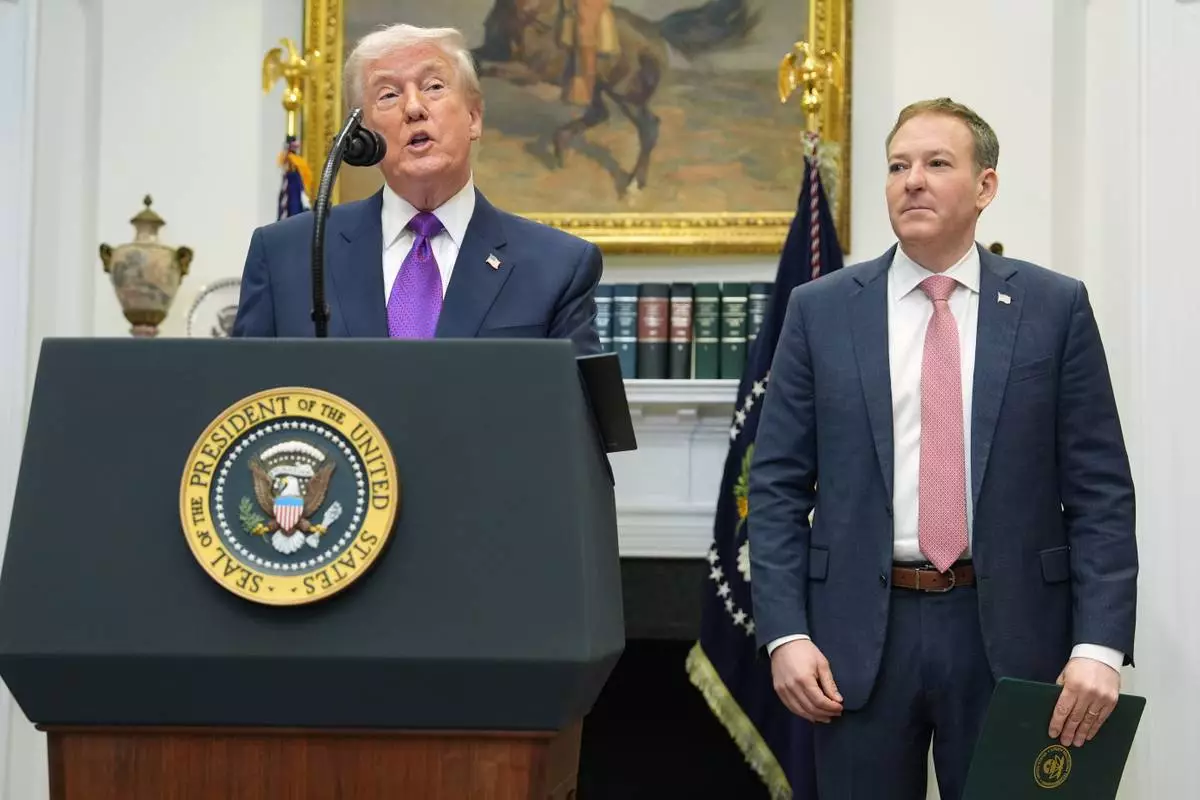
FILE - President Donald Trump, left, speaks during an event with Environmental Protection Agency director Lee Zeldin in the Roosevelt Room of the White House, Feb. 12, 2026, in Washington. (AP Photo/Evan Vucci, File)