Skip to Content Facebook Feature Image

Teens embrace social media and influencers for news but remain skeptical

ENT

Teens embrace social media and influencers for news but remain skeptical
ENT

ENT

Teens embrace social media and influencers for news but remain skeptical

2026-04-30 19:01 Last Updated At:19:10

NEW YORK (AP) — Teenagers are more inclined than their elders to get news from nontraditional sources such as social media and influencers, heralding a generational shift in how people seek out information.

A national study by the Media Insight Project finds 36% of U.S. adults say they get news from social media at least once a day. But for people ages 13 to 17, that number rises to 57%.

Similarly, 43% of adults say they get information on national issues and events from influencers or independent content creators at least “sometimes," compared with 57% of teenagers. The project is a collaboration among The Associated Press-NORC Center for Public Affairs Research, the American Press Institute and journalism schools at Northwestern University and the University of Maryland.

The new poll points to the pervasiveness of social media in teenagers’ lives and shows how more teens are consuming their news from these platforms or independent content creators, rather than directly from national or local news sources.

While Americans haven't abandoned traditional journalism, they are reevaluating what sources they trust, said Robyn Tomlin, executive director of the American Press Institute.

“Traditional national and local outlets continue to stand out as a trusted source, but people, especially younger audiences, are also building relationships with younger creators they believe are transparent and authentic,” Tomlin said. “That reality has enormous implications for the future of news.”

Besides social media, teenagers are also more likely to turn to search engines and artificial intelligence chatbots as they hunt for news.

The survey found that about 4 in 10 teens get news daily from search, while about 2 in 10 say that about AI chatbots.

There's little difference among age groups in people who said they get news from digital sites or apps, and television and streaming, the survey found. About 4 in 10 U.S. adults and a similar share of teenagers are getting news from TV at least once a day, with a similar share tuning into digital news sites.

“The idea that television is going away is a misapprehension,” said Tom Rosenstiel, journalism professor at the University of Maryland who worked on the survey. “Watching news through video is not going away. It's changing. The way you see it on YouTube is different than on the ‘CBS Evening News.’”

Despite the fact that many teenagers are getting news from influencers and AI, many have a healthy dose of skepticism.

Though teens are more likely than adults to say they have “a great deal of confidence” in the information they are getting from AI chatbots, relatively few have high confidence in AI’s output. Just 11% of teenagers have a high level of certainty in the information coming from AI, compared with 4% of adults.

Teens are also more confident in their ability to determine whether something was made by a human or AI. About one-third of teens expressed a high level of confidence in their ability to distinguish AI-generated content from human-generated content, compared with about 2 in 10 adults.

When it comes to influencers, there are similar doubts. Only 12% of teenagers also have “a great deal of confidence” in the information they get from independent creators or influencers, whether that’s coming from TV, social media or other sources. That’s higher than the 6% of U.S. adults who say the same, but still very low.

Not surprisingly, the survey also found that teenagers are more interested in news about celebrities, music, movies, sports and other entertainment. Adults have more interest in political news, business issues or the economy.

For teenagers and adults alike, there’s a significant news fatigue, particularly around political news, Rosenstiel said. Most U.S. adults and teenagers say they “often” or “sometimes” try to avoid news stories about national government and politics, and about 6 in 10 say they try to sidestep news related to President Donald Trump.

“People are tired of the feeling that things are spinning out of control that they’re very judicious in what they’re spending their time on,” Rosenstiel said.

Rosenstiel said many teens also hunt for news and information in different ways. They are much less likely than adults to say they avoid celebrity news or news that is delivered via social media. It’s possible, Rosenstiel added, that the most important journalism for some people is what helps them live their lives, even if it falls outside conventional news sources.

“Part of the problem for traditional journalism," Rosenstiel said, “is the traditional journalism definition of what is real news.”

Sanders reported from Washington. David Bauder writes about the intersection of media and entertainment for the AP. Follow him at http://x.com/dbauder and https://bsky.app/profile/dbauder.bsky.social.

The Media Insight Project survey is an initiative of the American Press Institute, Northwestern University Medill School of Journalism, Media, Integrated Marketing Communications, Local News Network at the University of Maryland’s Philip Merrill College of Journalism and The Associated Press-NORC Center for Public Affairs Research. The poll of 2,101 Americans included 1,092 U.S. adults ages 18 or older and 1,009 teenagers ages 13 to 17. The poll of adults was conducted Feb. 5-8 and the poll of teens was conducted Feb. 2-16 using a sample drawn from NORC’s probability-based AmeriSpeak Panel, which is designed to be representative of the U.S. population. The margin of sampling error for adults overall is plus or minus 4.1 percentage points, and the margin of sampling error for teenagers overall is plus or minus 4.3 percentage points.
FILE - A woman walks by a giant screen displaying the Google logo at an event at the Paris Google Lab on the sidelines of the AI Action Summit in Paris, Feb. 9, 2025. (AP Photo/Thibault Camus, File)

FILE - A woman walks by a giant screen displaying the Google logo at an event at the Paris Google Lab on the sidelines of the AI Action Summit in Paris, Feb. 9, 2025. (AP Photo/Thibault Camus, File)
DUBAI, United Arab Emirates (AP) — Iran's supreme leader said Thursday that the Islamic Republic will protect its “nuclear and missile capabilities” as a national asset, likely seeking to draw a hard line as U.S. President Donald Trump seeks a wider deal to cement the shaky ceasefire now holding in the war.

Ayatollah Mojtaba Khamenei, speaking in a written statement read by a state television anchor as he has since taking over as Iran's supreme leader, struck a defiant tone, insisting the only place Americans belonged in the Persian Gulf is “at the bottom of its waters."

However, his remarks come as Iran's oil industry has begun to be squeezed by a U.S. Navy blockade halting its oil tankers from getting out to sea. Meanwhile, benchmark Brent crude for June delivery reached as much as $126 a barrel in trading on Thursday as Iran maintains its chokehold on the Strait of Hormuz, the narrow mouth of the Persian Gulf through which a fifth of all crude oil and natural gas traded passes.

“By God’s help and power, the bright future of the Persian Gulf region will be a future without America, one serving the progress, comfort and prosperity of its people,” Khamenei said in the statement, read like all others since he reportedly was wounded in the Feb. 28 attack that killed his father, the 86-year-old Supreme Leader Ayatollah Ali Khamenei.

“We and our neighbors across the waters of the Persian Gulf and the (Gulf) of Oman share a common destiny. Foreigners who come from thousands of kilometers away to act with greed and malice there have no place in it — except at the bottom of its waters.”

With a fragile ceasefire in place, the U.S. and Iran are locked in a standoff over the strait. The U.S blockade is designed to prevent Iran from selling its oil, depriving it of crucial revenue while also potentially creating a situation where Tehran has to shut off production because it has nowhere to store oil.

The strait’s closure, meanwhile, has put pressure on Trump, as oil and gasoline prices have skyrocketed ahead of crucial midterm elections, and it has pressured his Gulf allies, which use the waterway to export their oil and gas.

A recent Iranian proposal would push negotiations on the country’s nuclear program to a later date. Trump said one of the major reasons he went to war was to deny Iran the ability to develop nuclear weapons. Iran long has maintained its program is peaceful, though it enriched uranium at near-weapons-grade levels of 60%.

Speaking to mark Persian Gulf Day in Iran, Khamenei's remarks signaled that nuclear issues and Iran's ballistic missile program wouldn't be traded away.

“Ninety million proud and honorable Iranians inside and outside the country regard all of Iran’s identity-based, spiritual, human, scientific, industrial and technological capacities — from nanotechnology and biotechnology to nuclear and missile capabilities — as national assets, and will protect them just as they protect the country’s waters, land and airspace,” Khamenei said.

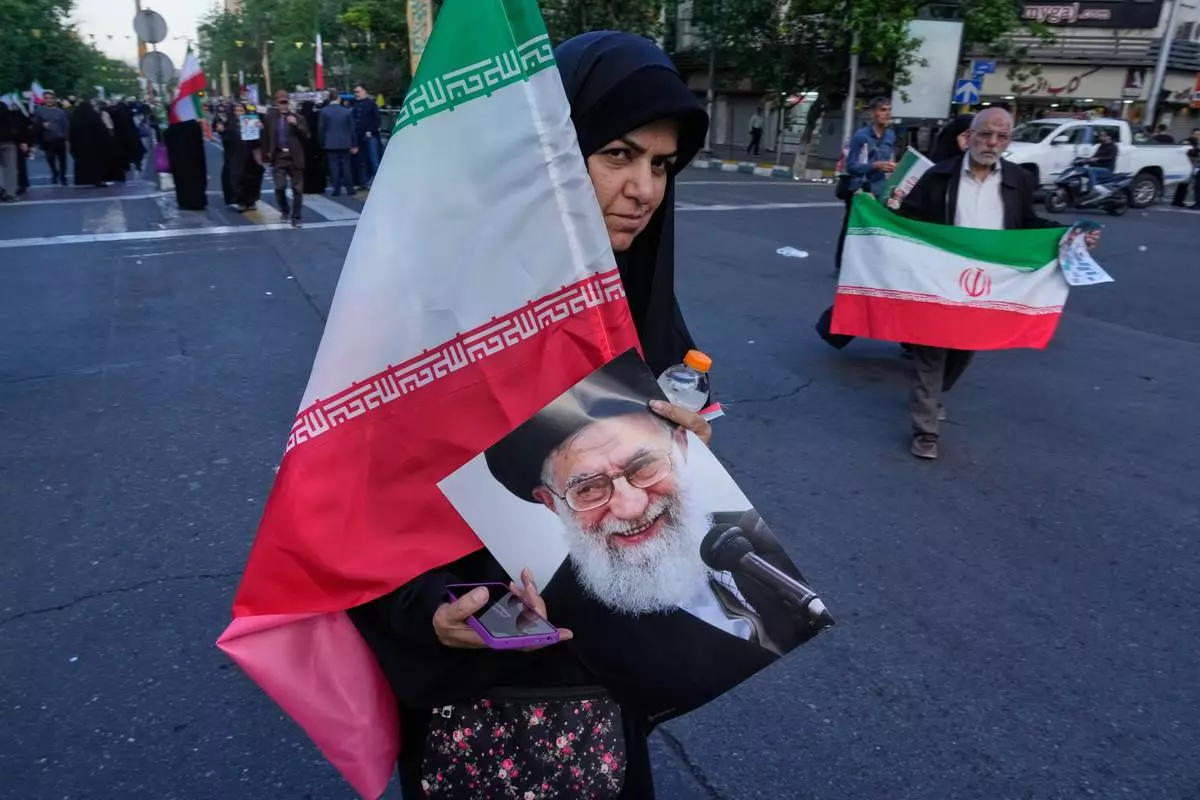
A woman carries an Iranian flag and a poster of the late Supreme Leader Ayatollah Ali Khamenei during a state-organised rally in Tehran, Iran, Wednesday, April 29, 2026, celebrating the birthday of Imam Reza, the 8th Shiite Muslims' Imam, and supporting Supreme Leader Ayatollah Mojtaba Khamenei. (AP Photo/Vahid Salemi)

A woman carries an Iranian flag and a poster of the late Supreme Leader Ayatollah Ali Khamenei during a state-organised rally in Tehran, Iran, Wednesday, April 29, 2026, celebrating the birthday of Imam Reza, the 8th Shiite Muslims' Imam, and supporting Supreme Leader Ayatollah Mojtaba Khamenei. (AP Photo/Vahid Salemi)

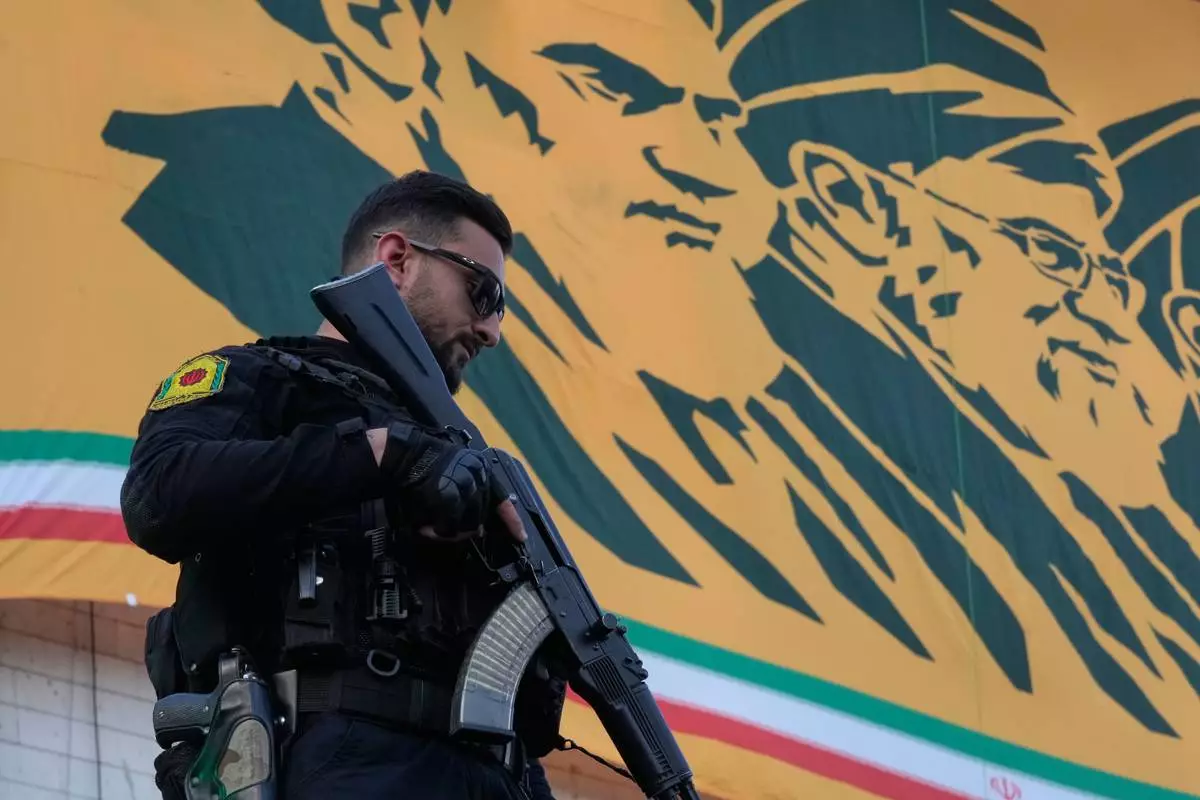
A police officer stands guard in front of a banner with portraits of the late Iranian revolutionary founder Ayatollah Khomeini, left, and late Supreme Leader Ayatollah Ali Khamenei in a state-organised rally celebrating the birthday of Imam Reza, the 8th Shiite Muslims' Imam, and supporting the supreme leader, in Tehran, Iran, Wednesday, April 29, 2026. (AP Photo/Vahid Salemi)

A police officer stands guard in front of a banner with portraits of the late Iranian revolutionary founder Ayatollah Khomeini, left, and late Supreme Leader Ayatollah Ali Khamenei in a state-organised rally celebrating the birthday of Imam Reza, the 8th Shiite Muslims' Imam, and supporting the supreme leader, in Tehran, Iran, Wednesday, April 29, 2026. (AP Photo/Vahid Salemi)

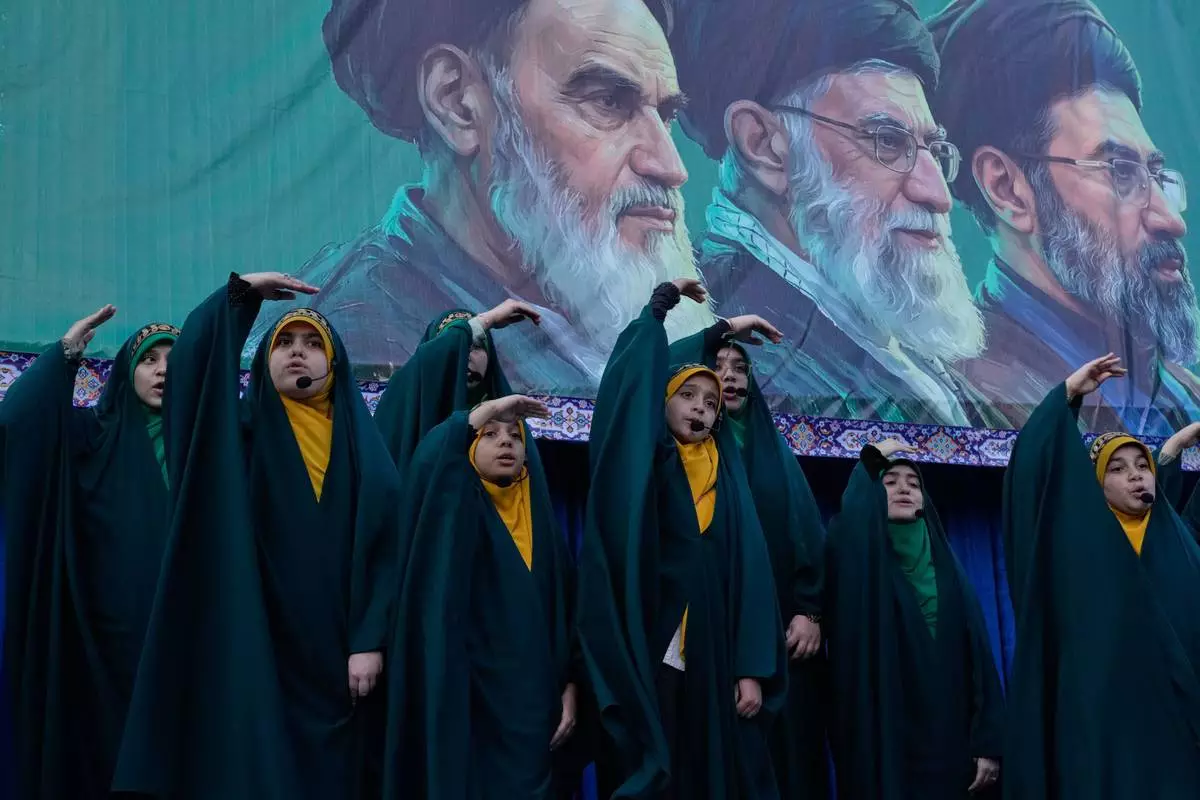
Girls sing a song as they show the movement of missiles with their hands next to the portraits of the late Iranian revolutionary founder Ayatollah Khomeini, left, late Supreme Leader Ayatollah Ali Khamenei, center, and Supreme Leader Ayatollah Mojtaba Khamenei, in a state-organised rally celebrating the birthday of Imam Reza, the 8th Shiite Muslims' Imam, and supporting the supreme leader, in Tehran, Iran, Wednesday, April 29, 2026. (AP Photo/Vahid Salemi)

Girls sing a song as they show the movement of missiles with their hands next to the portraits of the late Iranian revolutionary founder Ayatollah Khomeini, left, late Supreme Leader Ayatollah Ali Khamenei, center, and Supreme Leader Ayatollah Mojtaba Khamenei, in a state-organised rally celebrating the birthday of Imam Reza, the 8th Shiite Muslims' Imam, and supporting the supreme leader, in Tehran, Iran, Wednesday, April 29, 2026. (AP Photo/Vahid Salemi)

Recommended Articles