Once declared "uninhabitable" by the United Nations, the Xihaigu region in northwest China's Ningxia Hui Autonomous Region has been transformed through a mass resettlement campaign that moved poverty-stricken families to new settlements, where the Yellow River water sustains thriving vineyards, while the abandoned homeland has been restored with forests.
Not so long ago, Xihaigu, was one of China's most impoverished areas, with over 80 percent of people living under the poverty line during the early stage of reform and opening up in 1978.
In the water-starved Xihaigu area, the per capita water resources accounted for less than 8 percent of the national average level. It was declared as "uninhabitable" by the United Nations in 1972.
During drought years, residents would rely on aid. But relief was merely a bandage, not a cure. So the government made a bold decision: relocate the population over 400 kilometers north, where the land is flat and the capital, Yinchuan, is nearby. There was just one problem - the destination was a desert.
Liu Zuoxin, appointed Communist Party Secretary of Funing Community in Minning Town, Yongning County in 1994, recalled that when the first settlers arrived, they found the environment harsh. Still, he endured the tough conditions alongside the earliest residents.
"When we went to sleep at night, the door was intact. But when we woke up the next morning, our doors were half buried in sand," Liu said.
In the beginning, life here was even harder than in their former homeland. People lived off the flour and potatoes they had brought with them. Some gave up and went back. But more chose to stay.
"They have chosen to stay on because the Yellow River flows nearby. At least they no longer have to rely on rain to water their crops. So they've stayed on with persistence and dream," Liu said.
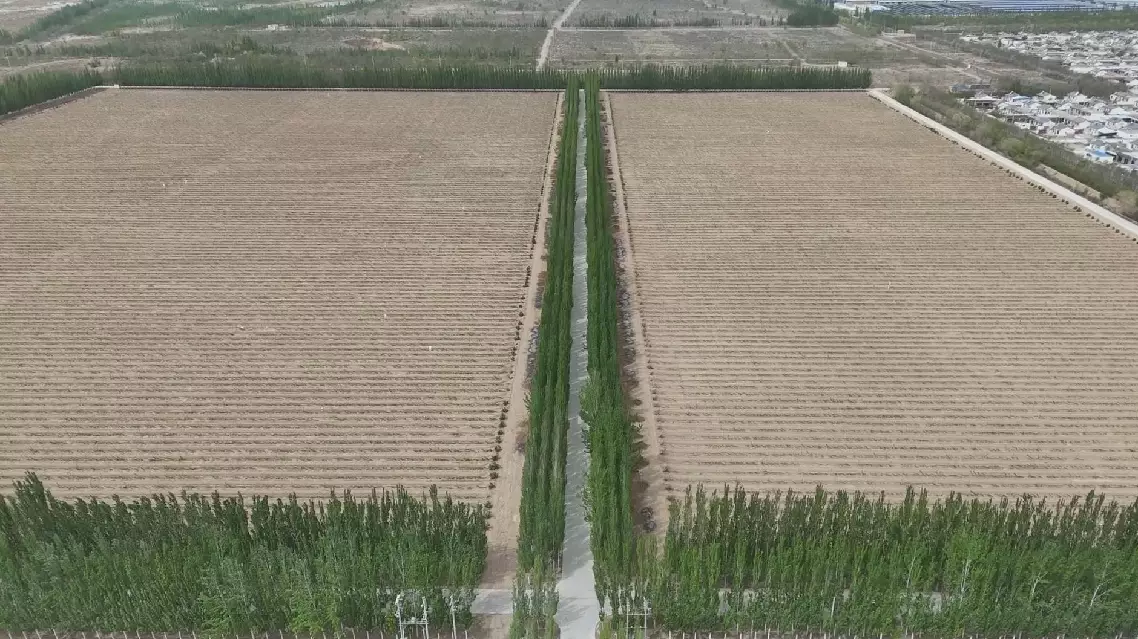
Thirty kilometers to the east flows the Yellow River, widely regarded as the cradle of Chinese civilization. The water it carries provided the essential foundation for all subsequent development. The government constructed irrigation channels, while settlers transformed sand into housing, planted trees, and plowed fields. From this sandy soil emerged an unexpected industry - wine brewery.
Notably, northern Ningxia lies on the same latitude as France's Bordeaux region and the U.S. state of California. The flourishing vineyards have created numerous jobs, which in turn has transformed the lives of migrants such as Liu Li.
"When living in our former homeland, we would be making a living by planting potatoes and corn. Now I plant grapes and make wine. I never could have dreamed of this," said Liu Li, cellar manager of Lilan Winery.
Liu still remembers the first time she tasted wine, back when she worked as a cleaner in the cellar.
Ten years later, Liu now holds a certificate in wine brewery, and bottles from her cellar are winning awards in Europe. When asked what her life might have been had she never left, she focused on her children.
"If we had stayed on in our former homeland, by now my children would be doing manual jobs. My daughter would likely be working as a dish washer. My son would be working at some kind of a barbecue joint," Liu said.
In reality, her daughter has earned a bachelor's degree in oenology and now works at the same winery. Her son is in college, studying to become a doctor. Back in their former village, Liu's daughter had to walk for hours just to get to school. Today, the children no longer have to cross mountains.
The new settlement is not the only place that has been transformed. Settlers also demolished their old houses, planted trees, prepared the soil, and allowed the land to recover. The land that once could not sustain its people now hosts these plant residents.
"These are all spruce trees. They lose less water through evaporation, so they survive more easily on such land," said Ma Wensi, deputy director of the Xiji County Rural Revitalization Service Center.
The increase in tree coverage has changed the local climate, and the area has seen more rainfall in recent years. Vegetable farming and tourism have now become pillars of the local economy.
"In the past, I was reluctant to say 'I'm from Xihaigu' because it was backward. Now when people ask, 'Where are you from?' I immediately say, 'Xihaigu.' They will say, 'It is a good place for a summer vacation'," Ma said.
Mass resettlement campaign improves lives, restores land in northwest China's Ningxia