Construction is progressing smoothly for the green energy-powered water elevators along the Pinglu Canal, a landmark mega-infrastructure project in the south China's Guangxi Zhuang Autonomous Region that is expected to be operational later this year.
The gateway, Qingnian Shipping Hub, or Youth Shipping Hub, is one of three critical shipping hubs along the 134-kilometer canal, connecting Guangxi's inner waterways with the Beibu Gulf in the northwest of South China Sea.
Once put into operation, it will open up the shortest, most economical, and most convenient waterway from Guangxi and Southwest China to the ASEAN region.
At the gateway, a massive lock chamber, covering an area equivalent to 1.5 standard soccer fields, serves as the primary functional area for navigation. It is designed to accommodate six 5,000-tonne vessels simultaneously, a capacity that will significantly boost the canal's transportation efficiency.
To navigate the elevation drop of 65 meters, the gateway utilizes a sophisticated water filling and emptying system.
"The water conveyance corridors of the ship lock operate on the fundamental physics principle of communicating vessels. When a vessel moves upstream, the culverts fill the lock chamber with water," said Zhong Guangda, a section engineer with Guangxi Pinglu Canal Construction Co.
Beyond the water conveyance system, the safe and reliable operation of the ship lock also depends on another engineering element: the giant miter gates that regulate access to the lock chamber.
"Once the water level inside aligns with the upstream level, we open the miter gates to allow the vessel to proceed smoothly. Conversely, for downstream traffic, we release the water from the chamber through the culverts to lower the vessel safely," Zhong said.
Functioning as the "doors" of the water elevator, the gates feature a distinctive herringbone design when closed, a structural choice rooted in advanced engineering logic to withstand immense water pressure.
"When the miter gates are closed to hold back water, they form a herringbone shape with the lock walls on both sides. This design allows the massive water pressure to be transferred directly to the load-bearing lock walls," the engineer explained.
A short distance from the miter gates sits another critical safety component: the maintenance gate, purpose-built for use during lock inspection and repair works.
Unlike the rotating miter gates, the maintenance gate adopts a modular, stacked design with removable sections. This structure allows for easy installation and dismantling, as the gate is only deployed during maintenance periods to block water flow and create a dry, secure working environment for construction and maintenance crews.
Beyond its core navigation function, the Youth Shipping Hub also serves dual critical roles as a safety barrier for the entire waterway and a source of clean, renewable energy.
The hub is fitted with a dedicated flood discharge gate, which is designed to release excess water and regulate water levels during flood seasons, ensuring the safety of the canal and surrounding areas.
Adjacent to the flood gate, a supporting hydropower station generates electricity by harnessing the canal's water level drop, maximizing the project's comprehensive resource utilization efficiency.
To further safeguard the project's long-term operational safety, engineers have installed reinforced concrete protective grids on the steep slopes surrounding the hub. These structures prevent landslides and erosion from water flow, firmly stabilizing the embankments and protecting the entire shipping complex.
Construction on the Pinglu Canal began in August, 2022, and the project is now in its final stage, ready to open for navigation within the year.
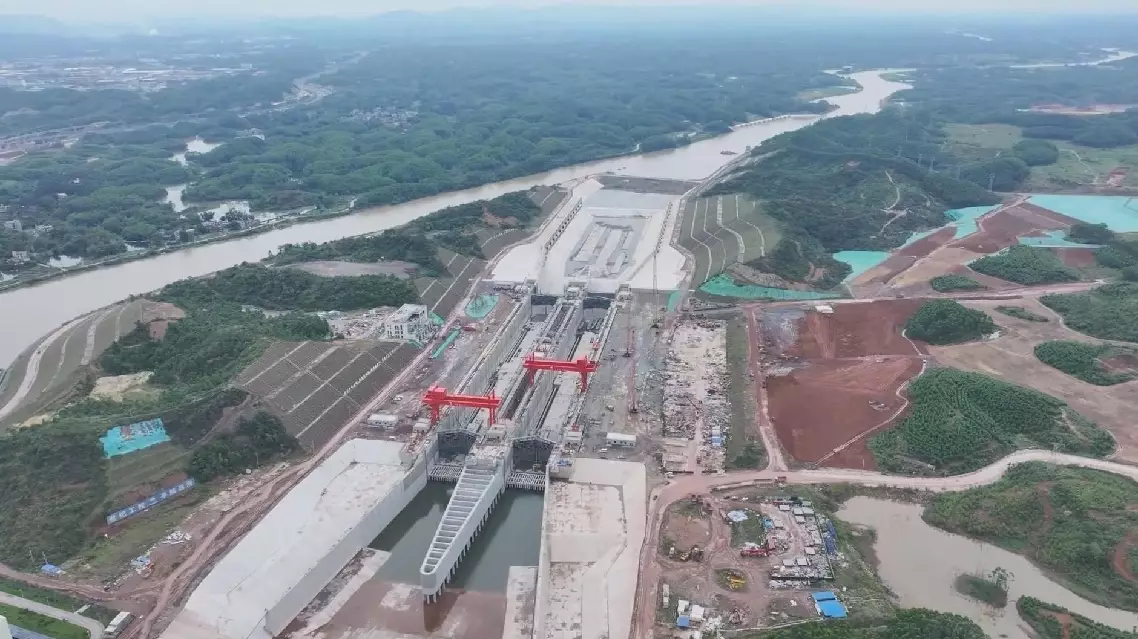
Ship-lifting water elevators along Pinglu Canal near completion