From tech-driven interactions to coastal and mountain hiking and in-depth sightseeing, Hong Kong tourism is being revitalized with fresh ideas during the five-day May Day holiday.
The May Day holiday, running from May 1 to 5, is typically one of the busiest travel periods of the year. During this time, millions of Chinese travelers hit the road to visit family, explore domestic destinations, or venture abroad.
The Immigration Department of the Hong Kong Special Administrative Region (HKSAR) government estimated that about 980,000 mainland tourists will visit Hong Kong during the holiday, a year-on-year increase of around 7 percent.
During the five-day holiday, many shopping malls in Hong Kong offer special promotions. A mall in Sha Tin has transformed its pop-up store into an immersive "coffee farm," gathering lifestyle goods and creative items in one place, with long queues forming at the entrance. Tsim Sha Tsui and Causeway Bay are equally bustling, with jewelry shops and trendy brand stores seeing long lines of customers.
A full slate of concerts and exhibitions displays Hong Kong's position as a bridge between Eastern and Western cultures.
At the former Yau Ma Tei police station, tourists pose for photos. The ongoing "Yau Ma Tei Police Station: A Cinematic Journey" exhibition allows visitors to step inside the historical building and relive classic scenes from Hong Kong police dramas.
New experiences such as hiking, seaside trips and self-driving tours are rapidly broadening Hong Kong's tourism appeal. According to industry observers, more people are focusing on Hong Kong's unique natural scenery and geological features, doubling the scale of eco-tourism from last year.
On the first day of the May Day holiday, direct buses from the Liantang Port/Heung Yuen Wai boundary control point at Hong Kong-Shenzhen boundary to the start of Hong Kong's MacLehose Trail were nearly full. The Agriculture, Fisheries and Conservation Department of the HKSAR government reported heavy crowds at the east dam of High Island Reservoir.
The rise of eco-tourism has boosted surrounding businesses. Seafood restaurants near a pier in Sai Kung are packed, and their holiday turnover is expected to rise by 30 percent from normal days.
With Hong Kong's Southbound Travel for Guangdong Vehicles scheme, self-driving tours from Guangdong have gained popularity. A drive from Guangzhou to downtown Hong Kong now takes only about 90 minutes.
Meanwhile, according to a proposal from a member of the HKSAR Legislative Council, the city is expected to further improve cross-border transport connections, introducing Guangdong-Hong Kong-Macao Greater Bay Area travel passes, and jointly promote tourism with neighboring cities to enhance the overall appeal of regional tourism.
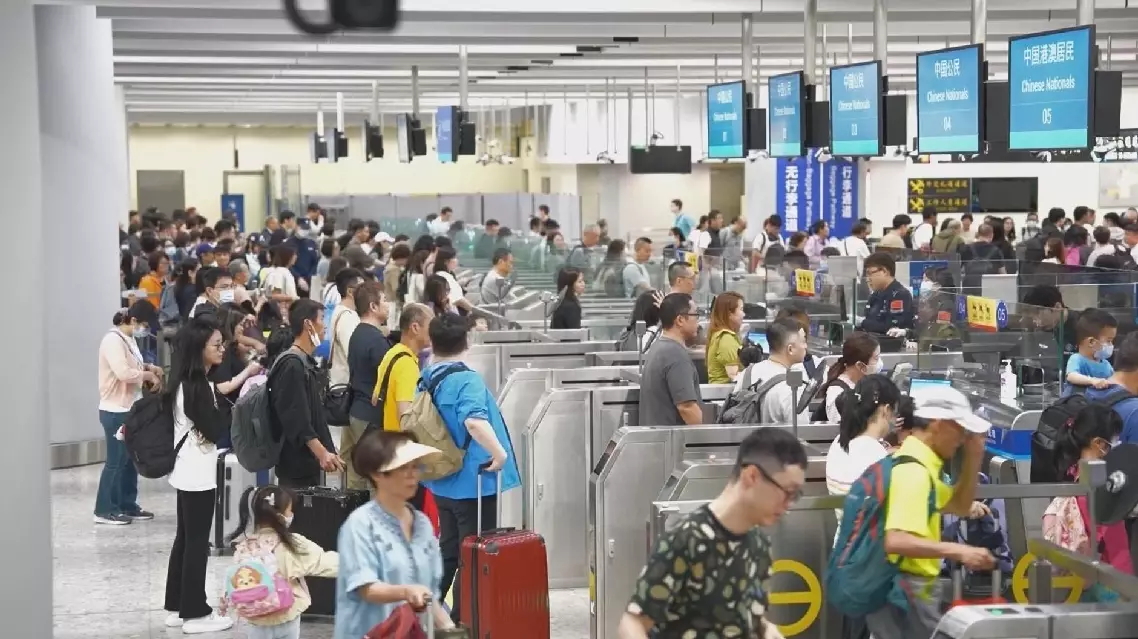
Hong Kong receives influx of inland holidaymakers
Eighteen sets of precious archival materials related to David Nelson Sutton, a U.S. assistant prosecutor at the Tokyo Trials and one of the earliest international prosecutors to investigate the Nanjing Massacre, were officially donated on Wednesday to the Memorial Hall of the Victims in Nanjing Massacre by Japanese Invaders.
Sunday marks the 80th anniversary of the opening of the International Military Tribunal for the Far East (IMTFE, also known as the Tokyo Trials). To commemorate the milestone, six diaries written by Sutton between 1946 and 1948, when he was conducting investigations for the tribunal, were donated together with a series of reports titled Reports from China.
"It is necessary to let more Chinese, even people all over the world, to see these archival materials. Let all the world know why the Tokyo Trials 80 years ago were described as a trial of justice, and how the Nanjing Massacre nearly 90 years ago was unprecedentedly brutal and tragic beyond compare," said Zou Dehuai, the donor.
From May 3, 1946 to Nov 12, 1948, the International Military Tribunal for the Far East was held in Tokyo by 11 countries, including the United States, China, Britain and the Soviet Union, to try Japan's Class-A war criminals after World War II.
"Why do we say the Tokyo Trials were a trial of justice? It was a trial witnessed by the world, with judges from 11 countries. Major war criminals, such as Iwane Matsui, a crime culprit for the Nanjing Massacre, and Hideki Tojo, all ultimately received the punishment they deserved. That is why the Tokyo Trials are called a trial of justice. These archives are of immense importance," Zou said.
Sutton came to China with the International Prosecution Section in 1946 and was tasked with investigating Japanese war crimes in China, with a particular focus on collecting evidence related to the Nanjing Massacre.
The six diaries recorded many details of Sutton's work during the Tokyo Trials. In one entry, dated March 9, he wrote that he had received formal orders to go to Shanghai, Nanking (Nanjing), Peiping (Beijing) and other sites in the China theater to investigate war crimes and gather evidence. Another entry recorded his arrival in Nanjing at 11:20 on April 2. On May 3, the day the trial opened, he described the defendants as looking like "insignificant beaten men."
The donated materials also include Sutton's "Reports from China," which further exposed Japanese wartime atrocities in China, including mass killings, violence against civilians, germ warfare and the coercion of Chinese people into opium cultivation.
Zou is a collector born in the 1990s who has long searched for wartime historical evidence. He first found the Sutton materials in November 2025 on a U.S.-based auction website specialized in military artifacts. After confirming Sutton's identity and reviewing preview images that indicated the items were original archival materials, Zou placed a bid for the collection and later, ultimately paying a price nearly 100,000 U.S. dollars, far more than his original budget. And he arranged for its return to China, with assistance from others.
At the donation ceremony, Zou received a donation certificate. He said the Sutton archives were the most expensive items he had acquired in a decade of collecting. "These archives, these ironclad evidences, expose the crimes committed by the invading Japanese army in China and serve as a warning to all humanity. When you look at these documents, you cannot imagine that a human army could commit such massive and horrible atrocities. I believe that any Japanese person with conscience, after reading the Sutton archives, would firmly recognize what kind of a massacre took place in Nanjing. For the young people of future China, Japan and the United States, we must tell them the truth of history, and why we must cherish the hard-won peace, and how heavy the cost of peace truly was," Zou said.
Tokyo Trials prosecutor's diaries donated to Nanjing Massacre memorial hall