
Willie Simon stood outside the Memphis motel where Rev. Martin Luther King, Jr. was assassinated in 1968, now a museum dedicated to the Civil Rights Movement.
Days after the U.S. Supreme Court gutted a key provision of the Voting Rights Act, Simon feared what the decision would mean not just for Black Americans like himself but an entire country where the political guardrails seem to be coming apart.
Simon, who leads the Shelby County Democratic Party in Tennessee, said the court's conservative majority set a precedent that if you're “not in the in-crowd group, they can just erase us.”
By weakening a requirement that states draw congressional districts in a way that gives minorities an opportunity to control their own fate, the court escalated the nationwide redistricting war that has seen Democrats and Republicans casting aside decades of tradition in hopes of gaining an edge over the competition. New sessions are scheduled to begin this week in two Republican-controlled states to eliminate U.S. House districts represented by Democrats, and there's more on the horizon.
It's the latest example of how the American democratic experiment has been pushed to the breaking point in the decade since Donald Trump rose to power. Extreme rhetoric has become commonplace. There's been a spike in political violence and a rash of assassinations. Five years after the Jan. 6 attack on the U.S. Capitol, Trump's allies are trying to harness the same falsehoods about voter fraud to reshape elections.
The rules and norms that once helped smooth over an unruly country's vast differences have given way to a race for power at all costs.
“I’ve never subscribed to the idea we’re in a civil war, but the gerrymandering wars and the recent decision from the Supreme Court do not make the United States more united,” said Matt Dallek, a political scientist at George Washington University. “It speeds up the hyperpartisan force and atmosphere that people feel on both sides.”
Trump ignited the conflict over redistricting last year by urging Republicans to redraw congressional maps to reduce the likelihood that his party loses the U.S. House in the November midterm elections.
It was an unusual step, since redistricting normally only takes place after the once-a-decade census to accommodate population shifts. But in 2019 the Supreme Court ruled federal courts cannot prevent partisan gerrymandering, and Trump saw a chance to push the limits.
Once Republican-led states like Texas started shifting district lines, Democratic-led states like California countered. The fight was heading for a draw until the Supreme Court's conservative majority issued its long-awaited decision in Louisiana v. Callais.
The court weakened the last remaining national impediment to gerrymandering — the Voting Rights Act's requirement that, in places where white people and outnumbered racial minorities vote differently, districts be drawn to give those minorities a chance to elect representatives they prefer.
The ruling opened a new set of political floodgates.
Republicans in Tennessee plan to erase the only Democratic congressional district, which is majority Black and centered in Memphis, by splitting it up among more conservative suburban and rural white communities. More than a dozen other majority-minority districts, mainly in the South, could face the same fate.
Louisiana moved to postpone its congressional primaries, set for May 16, to have a chance to redraw two majority-Black Democratic seats it was required to maintain before the recent ruling. Alabama is trying to get the Supreme Court to let it redraw its two majority-Black seats.
"We should demand that State Legislatures do what the Supreme Court says must be done,” Trump wrote on social media on Sunday. “That is more important than administrative convenience.”
He said Republicans could gain 20 seats through redistricting.
Democrats have threatened to retaliate by splitting up conservative bastions in states like New York and Illinois, which would reallocate Republican voters to more liberal, urban districts.
With fewer limits — either legal or self-imposed — people expect the issue to become a perpetual race to squeeze every possible advantage out of legislative maps.
“It’s hard to know where it ends,” said Rick Hasen, a law professor at UCLA.
Partisans gleefully shared color-coded maps of California with all 54 House seats drawn for Democrats, or southern states with only a couple of blue districts. Most agreed that eventually it will be very hard for Democrats to get elected to the House in any Republican-run state, even if there are large swaths of blue-leaning terrain, and vice versa for Republicans in Democratic-run states.
That seems un-American, said Jonathan Cervas, a political scientist at Carnegie Mellon who’s redrawn maps on behalf of judges reviewing redistricting litigation. The country's system, he said, “was founded on this idea that it’s majority rule with minority rights.”
“There is no more rule of law in redistricting,” Cervas said. “There have to be some constraints, somewhere. Otherwise we don’t really have elections.”
The arcane art of drawing legislative lines is the most powerful tool that politicians have for gaming elections. They can make districts an almost guaranteed win for their side by drawing lines that scoop up a majority of their voters and just enough of the opposition's supporters to ensure the other party cannot win that seat or the one next door, either.
Lawmakers have used the trick since the country's founding. Democratic gerrymanders helped the party hold onto the House through the Reagan revolution. After the 2010 midterms, Republican majorities in state legislatures allowed the GOP to draw districts to lock up control of the House even during President Barack Obama's reelection two years later.
However, that didn't prevent the “blue wave” in 2018, during Trump's first term, when Democrats retook the House. It was a reminder that even the most partisan gerrymanders may stifle shifts in public opinion but eventually crack as political tides turn.
“When you try to get every last ounce of blood from the stone you can end up shooting yourself in the foot,” said Michael Li of the liberal Brennan Center for Justice in New York.
Political coalitions also change, and voters that a party thinks will be reliable can switch sides. That's what's happened in the Trump era, as Democrats have expanded their support among wealthier and suburban voters and Republicans among Blacks and Latinos.
Although Republicans won't be able to exploit the full force of the Supreme Court ruling until after the November midterms, it will be challenging for Democrats to find enough seats to counter those gains.
Sean Trende, a political analyst who has drawn maps for Republicans, agreed that the court decision is likely to lead to partisan gerrymandering run amok. He said it's been hard to find neutral arbiters to rein in politicians who draw lines to benefit themselves.
The coming storm, Trende said, will be more of a symptom of polarization than its root cause.
“All our institutions are broken. We don't speak a common political language,” Trende said. “This is what you get.”
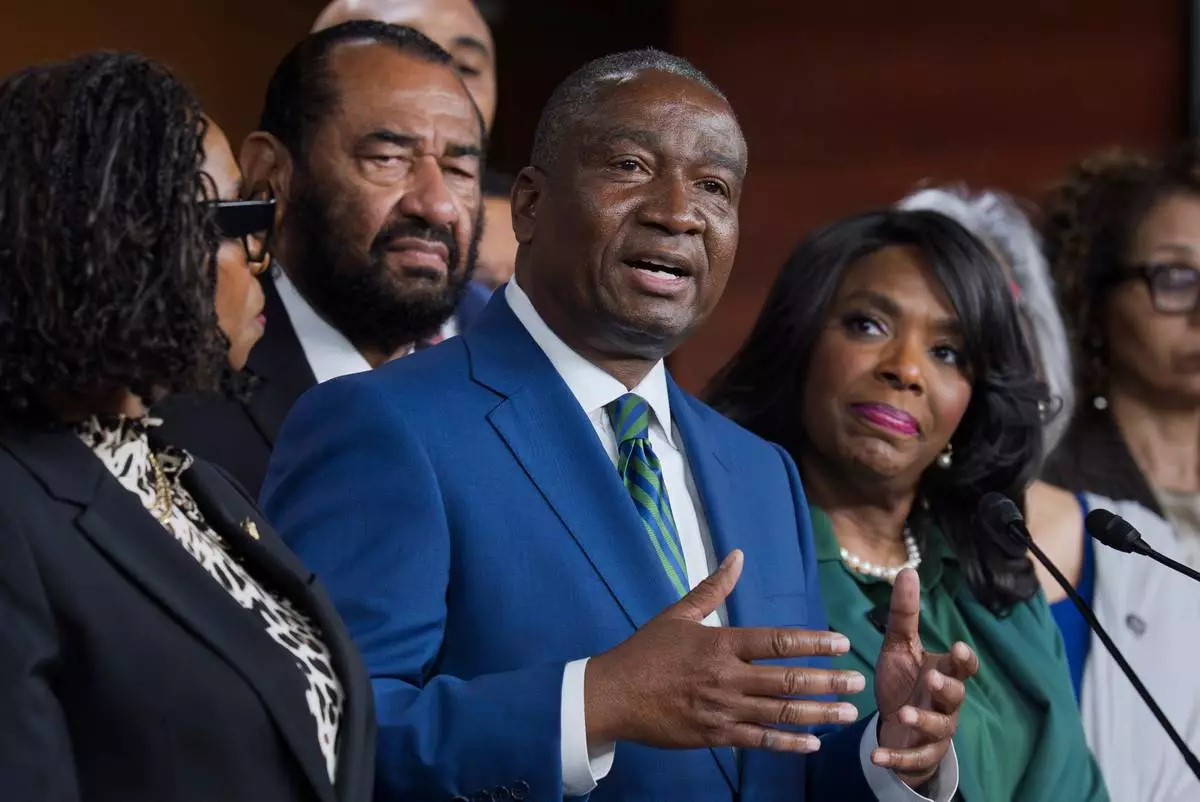
Rep. Cleo Fields, D-La., center, who represents Louisiana's 6th congressional district, is joined by members of the Congressional Black Caucus as they speak to reporters in the wake of the Supreme Court ruling to strike down his majority Black congressional district in Louisiana, at the Capitol in Washington, Wednesday, April 29, 2026. (AP Photo/J. Scott Applewhite)

House Minority Leader Hakeem Jeffries, D-N.Y., speaks about Virginia's redistricting vote, at the Democratic National Committee headquarters in Washington, Wednesday, April 22, 2026. (AP Photo/Cliff Owen)

President Donald Trump walks from Marine One to board Air Force One at Ocala International Airport, in Ocala Fla., Friday, May 1, 2026, after speaking at an event in The Villages, Fla. (AP Photo/Matt Rourke)