Displaced residents in Gaza are relying on tents equipped with solar panels to provide them a lifeline to the outside world, with these makeshift charging stations helping people keep their phones topped up and stay connected amid frequent power outages.
With the Israel-Hamas conflict that erupted in 2023 having wiped out nearly all infrastructure in the Gaza Strip, power supply shortages remain a serious issue in the war-torn region, with many areas relying on only a limited supply or going completely without electricity altogether.
An unassuming tent which has popped up in Gaza City is now viewed as an important outlet for residents facing power cuts. Fitted with solar panels on its roof, this facility provides just enough juice for people to charge their mobile phones.
The tent's owner, Mohammed Sarsawi, initially bought just one solar panel for his own personal use. But as neighbors began coming by and asking him to charge their phones, he added an additional panel and expanded the space inside to provide this much-needed service to locals.
"This is a place that provides charging services. Gaza has been without power for nearly three years. Even now, our area is completely without electricity. People are forced to find alternatives. Currently, the only feasible option is solar panels. There is an extremely big demand for this service, because everyone needs a mobile phone and access to the internet," said Mohammed.
In Gaza, mobile phones are seen as an essential tool for survival. From obtaining rescue information and contacting relatives to handling medical procedures and arranging transportation, every aspect of life depends on them.
Mohammed's tent is also proving critical for many facing emergency situations, including Abu Urba, who traveled to Gaza City to seek medical treatment for his son. After searching everywhere for a place to power his phone after his battery went dead, he was relieved to finally find this solution. "I came from out of town this morning, but my phone was dead. I tried to charge it at the hospital, but there were no such facilities. I had to search everywhere for a place to charge my phone, and finally I managed to find this charging point. I'm very grateful. We can't live without our phones, whether in the hospital or on the road," he said.
Due to the high demand and the slow speed of charging, people often have to wait two to three hours to get their phones back fully charged. But given the lack of other options, this tent has become the only means for residents to maintain contact with the outside world.
However, keeping the tent operational is also proving a challenge for Mohammed, with concerns over soaring costs meaning he is hoping his current equipment can stay reliable for as long as possible.
"My biggest problem right now is that once the solar panels break, I can't find replacements. A few months ago, a solar panel cost about 1,000 U.S. dollars, but now the price for the same product has risen to 3,000 or even 4,000 U.S. dollars. It's also hard to find replacements for broken batteries," said Mohammed.
The situation here is just a microcosm of the broader survival crisis in Gaza, with the severe electricity shortages not only affecting mobile phone charging but also disrupting all facets of daily life, with homes, hospitals, and water stations all without power, leaving the future uncertain.
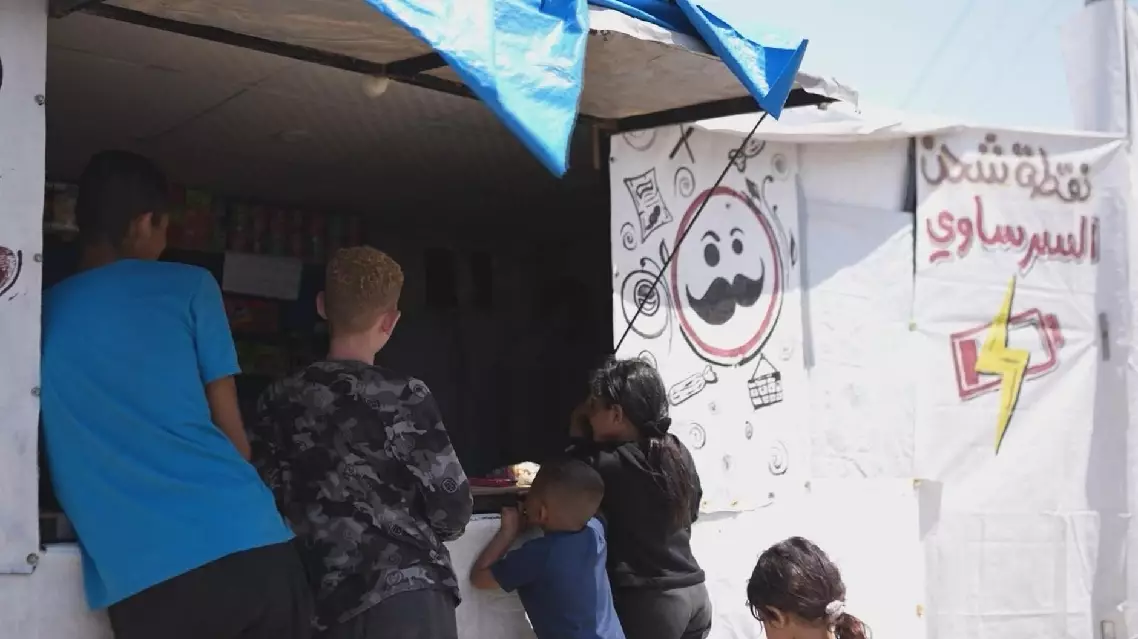
Tent fitted with solar panels provides lifeline to Gaza residents amid power outages