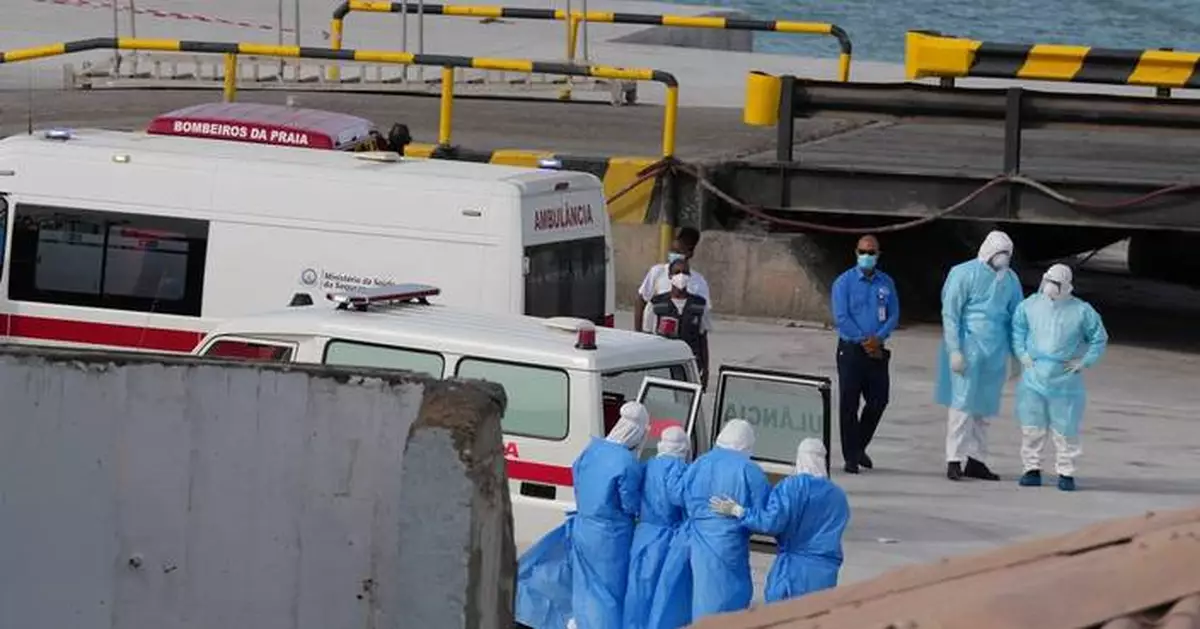
NEW YORK (AP) — Hantaviruses do not spread easily between people, which makes health officials confident the recent outbreak on a cruise ship that has killed three people will not turn into an epidemic.
But, still, they need to make sure. So health officials in several countries are contact tracing: trying to identify and follow people who may have come in contact with passengers who got sick or died.
Hantaviruses usually spread when people inhale contaminated residue of rodent droppings. While human cases are rare, small outbreaks have been documented around the world. But the Andes virus implicated in the cruise ship outbreak may be able to spread between people in rare cases. And viruses can change.
Scientists are trying to learn more about the virus as fast as they can, including whether it has mutated and how exactly it spreads.
The goal of contact tracing is to alert people who might have been exposed, keep tabs on them in case they come down with symptoms, and prevent them from spreading it to others.
The process isn’t easy because people are social and mobile creatures who spend time with others, visit crowded places and travel.
In the cruise ship outbreak, fewer than a dozen people are thought to have shown any symptoms, and there have been only five confirmed cases, but many more may have been exposed.
About 140 people remain on the cruise ship headed for the Canary Islands, where they will disembark, and none has been reported to be sick.
But authorities are trying to reach the dozens of people who left the ship about two weeks after a passenger died, but before authorities knew a hantavirus was the culprit. They were from at least 12 different countries, including from several states in the U.S. — including Arizona, California, Georgia and Texas, according to infectious disease experts and state public health officials.
Authorities in St. Helena — the remote, volcanic British territory in the South Atlantic where passengers got off — said they were monitoring a small number of people considered “higher-risk contacts.” They were being told to isolate for 45 days, the St. Helena government said.
British health officials say two people who were passengers aboard the ship but flew home midway through the journey are self-isolating but do not have symptoms. The U.K. Health Security Agency said “a small number” of contacts of the two are also self-isolating but not showing symptoms.
Singaporean health authorities said they were monitoring two men who disembarked at St. Helena and flew to South Africa and then home. The two men, who arrived in Singapore at different times, were being tested for hantavirus and were isolated at the country’s National Center for Infectious Diseases, officials said.
The U.S. government has released few details about its work on any contact tracing.
Texas officials on Thursday said public health workers there have reached the two people who left the ship April 24, who say they are not experiencing symptoms and did not have contact with a sick person while aboard. They promised to monitor themselves with daily temperature checks and contact public health officials at any sign of possible illness, officials said.
Arizona officials said they too are following a person who disembarked April 24. They said they don’t know exactly when the person arrived in Arizona. The U.S. Centers for Disease Control and Prevention notified the state health agency on May 5, state officials said. That's when monitoring began and it will continue for 42 days.
Two Canadians who disembarked are in Ontario and have been advised to self-isolate since they returned home, the province’s health minister says.
Apart from tracking people, scientists are also trying to understand the germ. The Andes virus, a member of the hantavirus family found in South America, may be one of the rare hantaviruses that can spread between people. Officials in Argentina believe the first cases may have been contracted on a birdwatching trip in the southern city of Ushuaia.
Argentina’s Health Ministry has yet to dispatch the team, but scientists from the state-funded Malbrán Institute planned to travel to Ushuaia “in the coming days,” the ministry told The Associated Press.
Scientists are analyzing the virus's genetics to see whether it has changed in a way to make it more transmissible.
AP journalists Isabel Debre in Buenos Aires, Argentina; Gerald Imray in Cape Town, South Africa; Rob Gillies in Toronto; Jill Lawless in London; Suman Naishadham in Madrid; Susan Montoya Bryan in Albuquerque, New Mexico; and Jamie Stengle in Dallas contributed.
The Associated Press Health and Science Department receives support from the Howard Hughes Medical Institute’s Department of Science Education and the Robert Wood Johnson Foundation. The AP is solely responsible for all content.
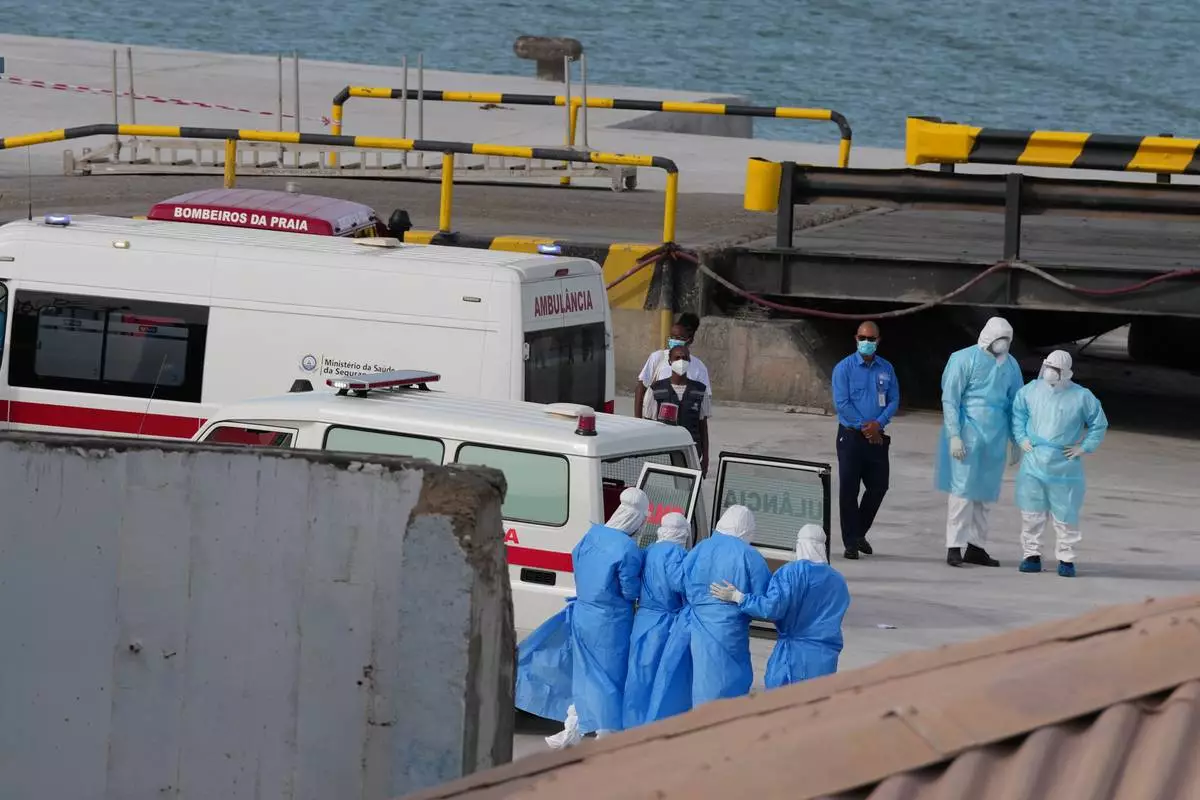
Health workers in protective gear evacuate patients from the MV Hondius cruise ship at a port in Praia, Cape Verde, Wednesday, May 6, 2026. (AP Photo/Misper Apawu)
The NCAA Tournament is getting a supersized makeover, a long-expected expansion that many basketball fans should notice and pay attention to beginning next season.
The sanctioning body increased the fields for its men’s and women’s March Madness tournaments to 76 teams apiece on Thursday. That means there will be eight more games — 12 total involving 24 teams — squeezed into the highly popular bracket without substantially changing the overall format.
NCAA coaches and administers have lobbied for more access to the lucrative, postseason showcase for years. The biggest questions always revolved around how many teams would get in and what would the new setup look like.
The first expansion of the tournaments in 15 years, since adding increasing the field from 64 to 68 teams, will turn what has been known as the First Four into a bigger affair that will now be called the March Madness Opening Round.
The 12 winners will move into the main 64-team bracket that will begin, as usual, on Thursday for the men and Friday for the women.
Money seems like the primary reason, though some will argue it's about providing more spots for deserving teams.
The change comes at a time when conferences and universities are desperately looking for ways to add revenue. Some schools are strapped for cash while having to share revenue with top athletes and are trying to better position themselves for the next iteration of the ever-changing landscape of college sports. With schools now allowed to spend more than $20 million on their athletes, the race to stay competitive is frenetic.
The NCAA said it will distribute more than $131 million in new revenue to schools that make the tournament. That money will come from expanded TV advertising opportunities for alcohol, the likes of which were previously restricted. It said the value of the rights agreement will increase $50 million each year on average over the course of the six years remaining on existing broadcast agreements with CBS and others.
Most of the eight new slots are expected to go to teams from the four power conferences — Atlantic Coast, Big Ten, Big 12 and Southeastern — that were already commanding the bulk of the entries in the bracket.
Keith Gill, the chairman of the Division I men’s basketball committee, called the expansion “a nice way to create some access but make sure we have the bracket we all love when we start Thursday at noon.”
Although no mid-major program advanced past the first weekend of either tournament the last two seasons, there still will be a chance for someone to make a run to the Sweet 16 or maybe even the Final Four.
Leaders in the power conferences acknowledge that smaller programs – most recently Saint Peter’s in 2022, Loyola Chicago in 2018 and George Mason in 2006 — help make March Madness what it is.
Those sorts of teams will have a path, even if revenue sharing and name, image and likeness payments have it increasingly more difficult for mid-major programs to keep talent beyond one year. And remember, there was actually concern last season that a Miami (Ohio) team with a 31-1 record would be left out.
On the men’s side, Auburn, Cincinnati, Indiana, Oklahoma and San Diego State surely would have slipped into the field and landed a spot in the opening round. Those schools surely would have drawn more attention – and more TV ratings — than many of the teams in the First Four: Howard, Lehigh, Miami (Ohio), Prairie View, SMU and UMBC.
On the women’s side, BYU, Cal, Texas A&M and Utah likely would have made the field and gotten more eyeballs than games including Missouri State, Samford, Southern and Stephen F. Austin.
Most brackets excluded the First Four and began with first-round games played Thursday (men) and Friday (women).
Having eight more teams playing in the opening round could change that – and make it more difficult for someone – or artificial intelligence – to land that elusive perfect bracket.
The late DePaul mathematics professor Jeffrey Bergen calculated the odds of picking a perfect bracket at 1 in 9.2 quintillion, assuming every game is a 50-50 proposition, or about 46 million times the number of stars in our galaxy. Adding eight games to the mix won't make it any easier.
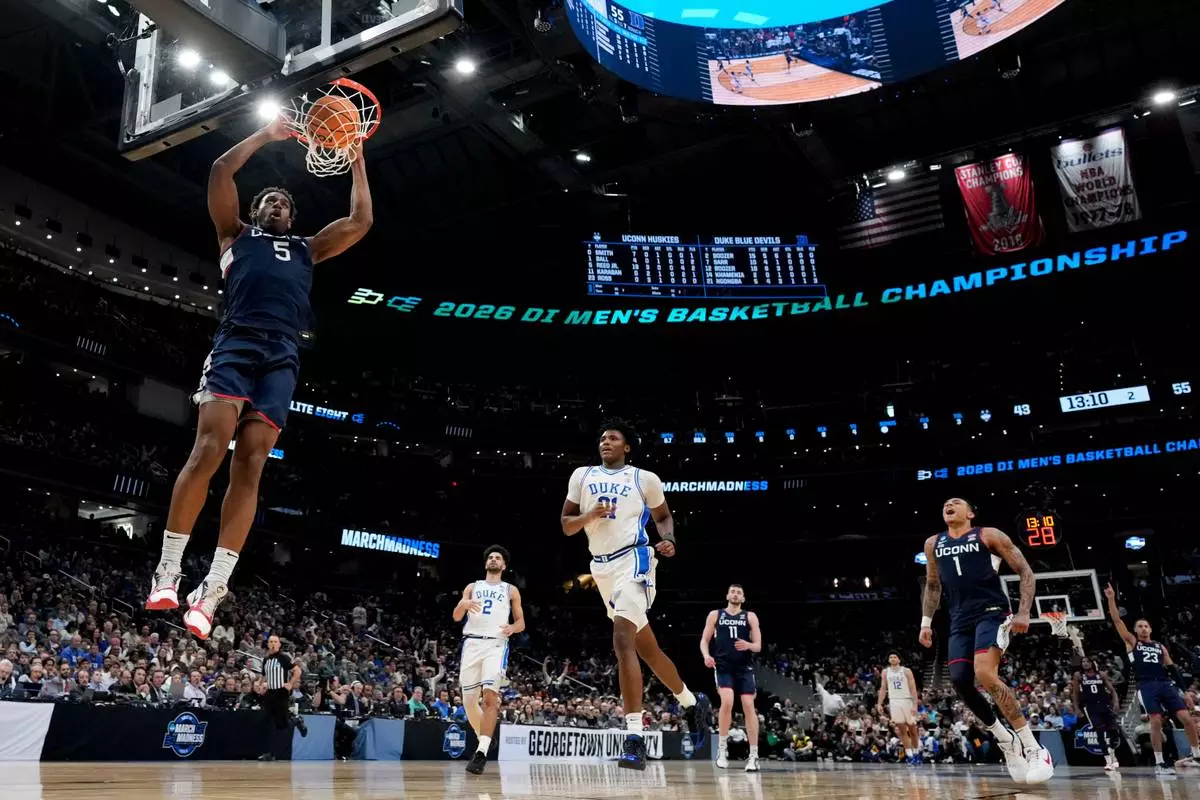
FILE - UConn forward Tarris Reed Jr. (5) dunks against Duke during the second half in the Elite Eight of the NCAA college basketball tournament on March 29, 2026, in Washington. (AP Photo/Stephanie Scarbrough, File)

FILE - UCLA head coach Cori Close celebrates after cutting down the net after UCLA defeated South Carolina in the women's National Championship Final Four NCAA college basketball tournament game, April 5, 2026, in Phoenix. (AP Photo/Ross D. Franklin, File)
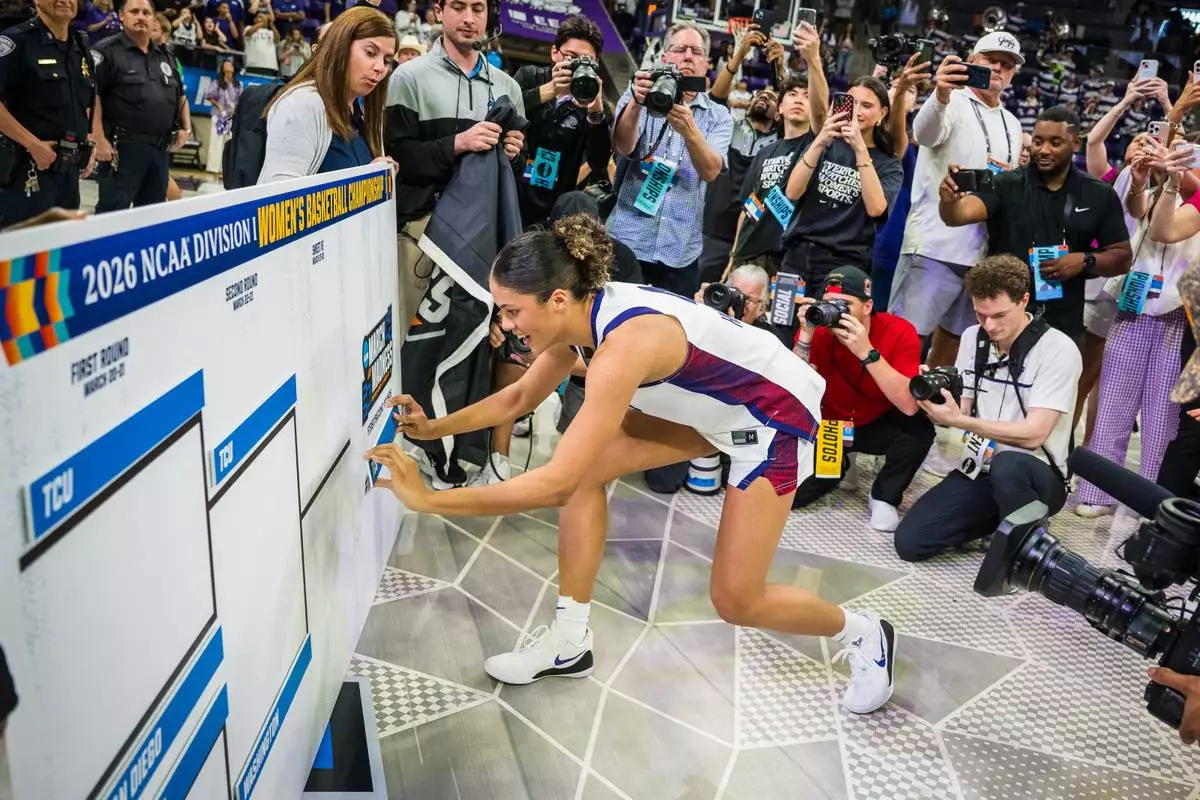
FILE - TCU guard Donovyn Hunter (4) places the team placard on the bracket board after the second round of the NCAA college basketball tournament March 22, 2026, Fort Worth, Texas. (AP Photo/Jessica Tobias, File)

FILE - The Miami (Ohio) swim team attempts to distract SMU forward Corey Washington (3) from taking a free throw during a First Four college basketball game in the NCAA Tournament in Dayton, Ohio, March 18, 2026. (AP Photo/Jeff Dean, File)
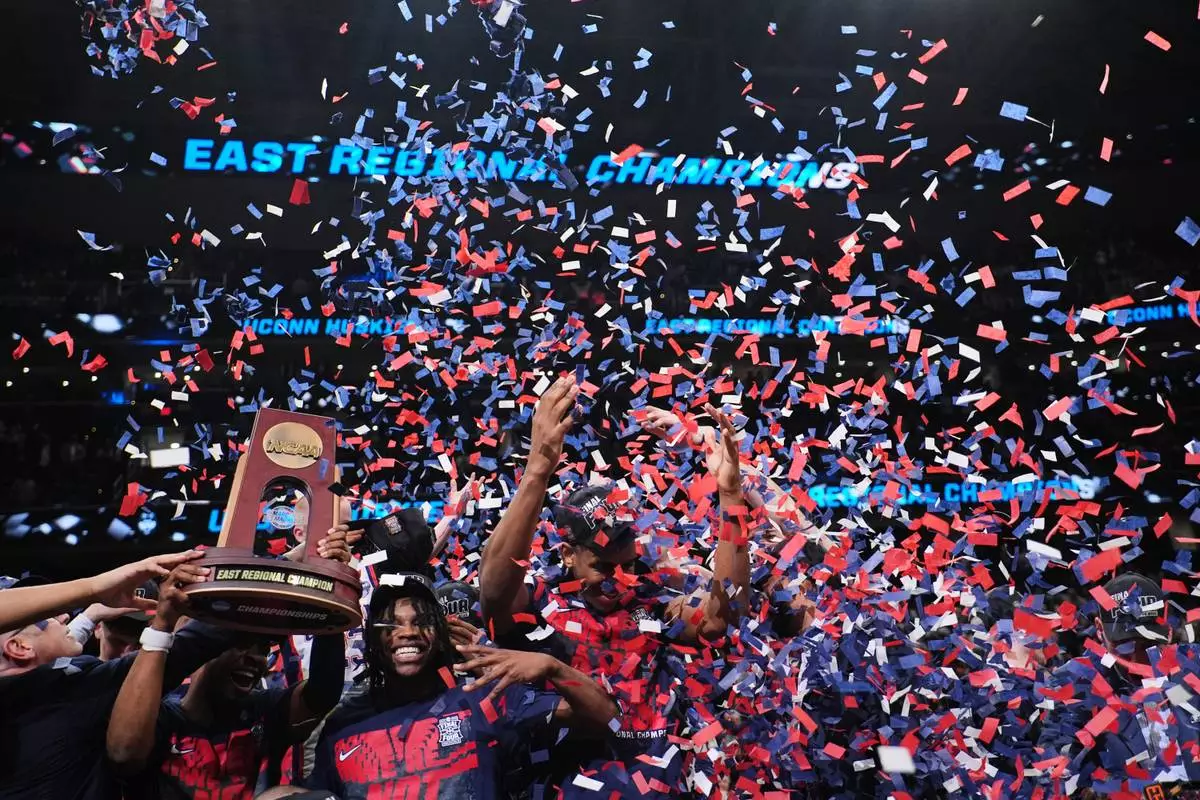
FILE - UConn players celebrate after their win against Duke in the Elite Eight of the NCAA college basketball tournament March 29, 2026, in Washington. (AP Photo/Abbie Parr, File)