Serbian and Chinese officials, along with local people, gathered in Belgrade on Thursday to commemorate Chinese journalists killed in the NATO bombing of the Chinese embassy in the former Federal Republic of Yugoslavia in 1999.
Attending the event were Chinese Ambassador Li Ming, Serbian Minister of Labor, Employment, Veteran and Social Affairs Milica Djurdjevic Stamenkovski, staff members of the Chinese embassy in Serbia, representatives of Chinese media outlets, Chinese-funded institutions, Chinese students and teachers, and overseas Chinese in Serbia.
Addressing the event, Li said that that NATO's atrocity 27 years ago seriously violated China's sovereignty and grossly trampled on international law and the basic norms governing international relations. Today, 27 years later, hegemonism and power politics are still eroding the foundation of the international order and threatening world peace.
Remembering history is aimed at better defending peace and safeguarding justice, he said. China is willing to work with Serbia to carry forward friendship, strengthen mutual trust, firmly uphold the UN-centered international system, and take concrete actions to build a community with a shared future for humanity, Li said.
Stamenkovski said that 27 years ago, NATO launched a barbaric aggression against the Federal Republic of Yugoslavia, seriously violating the UN Charter and international law. The peoples of Serbia and China firmly defended their national dignity, and forged an ironclad friendship that proves true in adversity with blood and lives, she said.
Serbia is willing to continue deepening its traditional friendship with China and to work together toward the noble cause of peace and development, she added.
Ranko Spalevic, a local resident who attended the event, said the tragedy China and Serbia shared 27 years ago brought their peoples closer together, adding that Serbians have always sincerely commemorated that period of history and treasured their friendship with China.
"We thank our brothers who stood by us in our darkest hour and remain with us to this day. No one can break the ironclad bond of friendship forged in the blood of World War II. Let us remember this forever," he said.
NATO missiles struck the Chinese embassy on May 7, 1999, killing three Chinese journalists: Shao Yunhuan of Xinhua News Agency, Xu Xinghu and Zhu Ying of Guangming Daily, and injuring dozens of others.

Serbia holds memorial event to honor Chinese journalists killed in NATO bombing
The Iranian Ministry of Foreign Affairs on Friday strongly condemned U.S. attacks on Iranian oil tankers and several locations along the coast of the Strait of Hormuz.
In a statement, the ministry emphasized that Iranian forces are determined to defend the country's territorial integrity, independence, and national sovereignty against any aggression.
It also said the ministry had called on the United Nations Security Council and the UN Secretary-General to uphold international peace and security in accordance with the UN Charter.
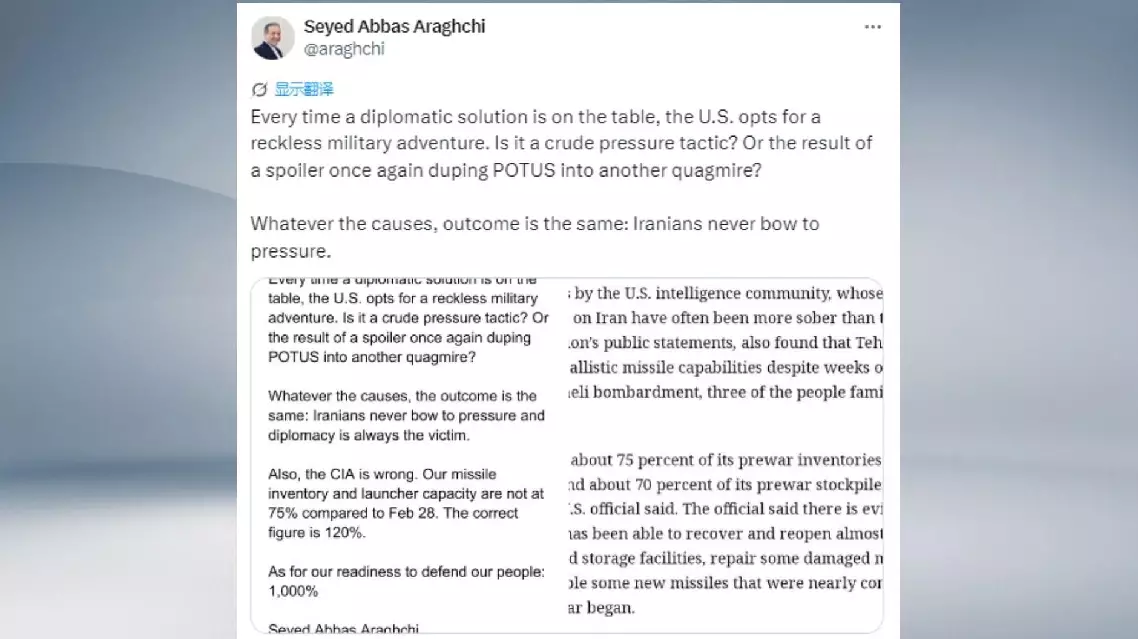
Meanwhile, Iranian Foreign Minister Seyed Abbas Araghchi on Friday slammed the U.S. for once again choosing what he called a "reckless military adventure" when "a diplomatic solution is on the table" again.
Writing on social media platform X, Araghchi said Iranians "never bow to pressure" and "diplomacy is always the victim."
He also dismissed the U.S. intelligence assessment, saying Iran's missile inventory and launch capacity were not at 75 percent of their February 28 levels, but had reached 120 percent. Iran's readiness to defend its people, he added, stood at "1,000 percent."
U.S. forces on Friday struck and disabled two more Iranian-flagged empty oil tankers before they entered an Iranian port on the Gulf of Oman amid rising tensions in the Strait of Hormuz, U.S. Central Command (CENTCOM) said.
In a post on X, CENTCOM said it had "enforced blockade measures against two Iranian-flagged empty oil tankers attempting to pull into an Iranian port on the Gulf of Oman."
A U.S. Navy F/A-18 Super Hornet from the USS George H.W. Bush disabled both tankers by firing precision munitions into their smokestacks, the command said.
On Wednesday, U.S. forces disabled another unladen Iranian-flagged oil tanker, the Hasna, as it attempted to sail to an Iranian port on the Gulf of Oman. An F/A-18 Super Hornet from the USS Abraham Lincoln fired several rounds from a 20mm cannon to disable the ship's rudder.
"All three vessels are no longer transiting to Iran," the command said.
CENTCOM commander Brad Cooper said U.S. forces would continue to fully enforce blockade measures against vessels entering and leaving Iran.
There are currently more than 70 oil tankers that U.S. forces are preventing from entering or leaving Iranian ports, CENTCOM said in another post, noting these commercial ships have the capacity to transport over 166 million barrels of Iranian oil worth an estimated 13 billion-plus U.S. dollars.
U.S. and Iranian forces traded fire on Thursday when three U.S. Navy destroyers were transiting out of the Strait of Hormuz.
CENTCOM said it was a "self-defense" action while Tehran accused Washington of violating a ceasefire which took effect on April 8.
Iran condemns U.S. attacks on tankers