The Iranian Ministry of Foreign Affairs on Friday strongly condemned U.S. attacks on Iranian oil tankers and several locations along the coast of the Strait of Hormuz.
In a statement, the ministry emphasized that Iranian forces are determined to defend the country's territorial integrity, independence, and national sovereignty against any aggression.
It also said the ministry had called on the United Nations Security Council and the UN Secretary-General to uphold international peace and security in accordance with the UN Charter.
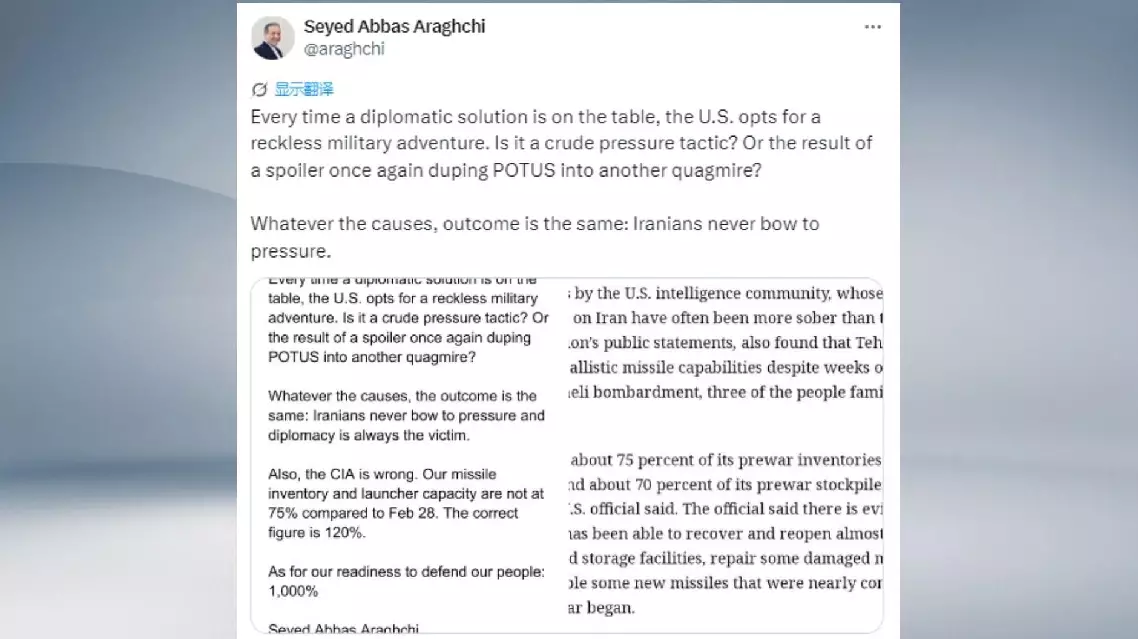
Meanwhile, Iranian Foreign Minister Seyed Abbas Araghchi on Friday slammed the U.S. for once again choosing what he called a "reckless military adventure" when "a diplomatic solution is on the table" again.
Writing on social media platform X, Araghchi said Iranians "never bow to pressure" and "diplomacy is always the victim."
He also dismissed the U.S. intelligence assessment, saying Iran's missile inventory and launch capacity were not at 75 percent of their February 28 levels, but had reached 120 percent. Iran's readiness to defend its people, he added, stood at "1,000 percent."
U.S. forces on Friday struck and disabled two more Iranian-flagged empty oil tankers before they entered an Iranian port on the Gulf of Oman amid rising tensions in the Strait of Hormuz, U.S. Central Command (CENTCOM) said.
In a post on X, CENTCOM said it had "enforced blockade measures against two Iranian-flagged empty oil tankers attempting to pull into an Iranian port on the Gulf of Oman."
A U.S. Navy F/A-18 Super Hornet from the USS George H.W. Bush disabled both tankers by firing precision munitions into their smokestacks, the command said.
On Wednesday, U.S. forces disabled another unladen Iranian-flagged oil tanker, the Hasna, as it attempted to sail to an Iranian port on the Gulf of Oman. An F/A-18 Super Hornet from the USS Abraham Lincoln fired several rounds from a 20mm cannon to disable the ship's rudder.
"All three vessels are no longer transiting to Iran," the command said.
CENTCOM commander Brad Cooper said U.S. forces would continue to fully enforce blockade measures against vessels entering and leaving Iran.
There are currently more than 70 oil tankers that U.S. forces are preventing from entering or leaving Iranian ports, CENTCOM said in another post, noting these commercial ships have the capacity to transport over 166 million barrels of Iranian oil worth an estimated 13 billion-plus U.S. dollars.
U.S. and Iranian forces traded fire on Thursday when three U.S. Navy destroyers were transiting out of the Strait of Hormuz.
CENTCOM said it was a "self-defense" action while Tehran accused Washington of violating a ceasefire which took effect on April 8.
Iran condemns U.S. attacks on tankers
The prolonged power outages in northern Cameroon have triggered an economic and social crisis, where halted commercial activity and soaring household expenses are compounding daily losses for both residents and businesses.
For Sabo Sani, a tailor and garment maker at the Yelwa market in Garoua, life has changed dramatically over the past few months. Due to recurring power cuts, he can no longer work properly, and customer orders have gone undelivered.
"I have a tailor workshop, but it's not up and running at the moment. Why isn't it working? Because we need electricity, but we don't have any. We only get electricity for maybe three or four hours a day," he said.
It is a harsh reality shared by all traders in this market and the surrounding areas.
"What the customer needs is very difficult, very difficult -- because you cannot do everything. You cannot wash the head, you cannot use the hair dryer, because there's no light. And we don't know how to do again, because this situation has been going on now around three months. With what is going on now, I cannot even work again. My business is stopped, and I have to check and look for another way to try to satisfy my customers," said Tatania Zouatom, a hairdresser.
"All our products are damaged. Just look at the state of the fish -- they're no longer presentable. Under these circumstances, we're losing a great deal. Some products simply become unsellable. There are goods that we're forced to set aside, a situation that has been going on for nearly three months. We're really disappo," said July Nzatssa, a local fishmonger.
Despite the presence of the Lagdo Dam -- a key power generation facility in the region -- the situation has failed to improve.
Standing 40 meters tall and 297 meters long, the dam was built between 1978 and 1984 with an installed capacity of 82 megawatts. It has long supplied electricity to three regions in northern Cameroon, while also providing flood control and irrigation.
But in recent years, it has fallen short of 80 percent of its targets. According to ENEO Cameroon, a state-owned power company in Cameroon, which has cited the issue for years, the problem lies in low water levels.
"During 2021 and 2022, we first experienced the most critical deficit from this site. So actually, what we are facing is load shedding -- it is just because the Lagdo, due to water, cannot generate power at a high level. The level of water is too low, and we are managing to avoid a crack within this month of May," said Ahmadou Bivoung, a power station director at the company.
Experts said the dam can no longer maintain normal water levels, and that is affecting power generation.
"Admittedly, the power station is over 40 years old, but I would like to reassure you that all four turbines are operational and capable of generating power at their rated capacity. Maintenance work is carried out on a regular basis. However, what is currently limiting production is the low water level," said Steve Ndanga, an official of the Lagdo Dam.
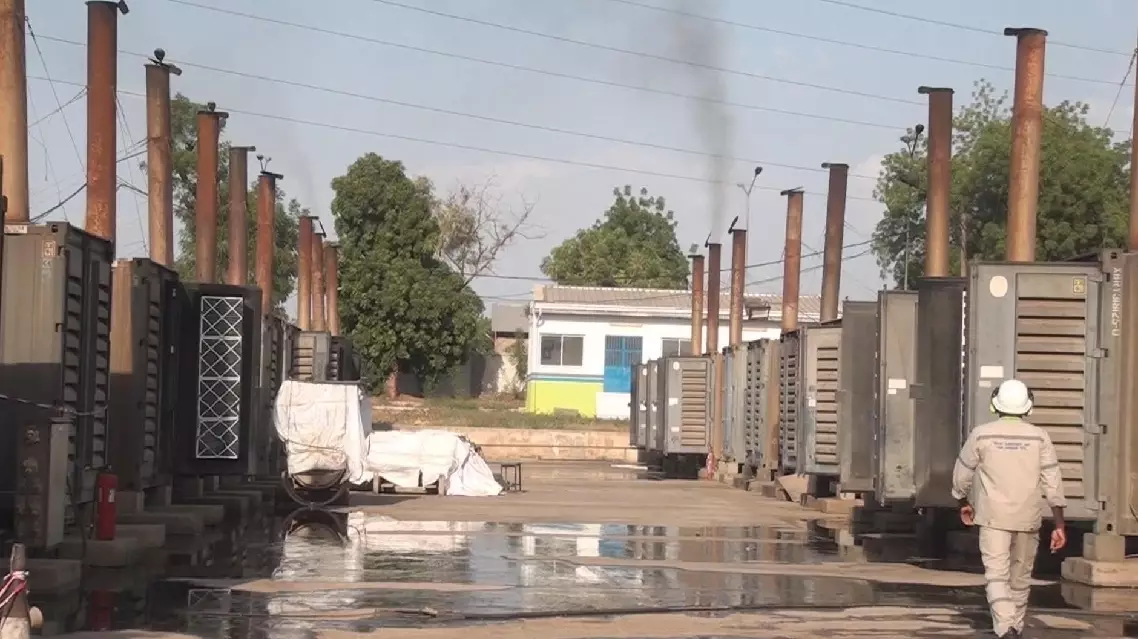
As a stopgap measure, ENEO Cameroon has built a diesel-powered plant in Garoua, with plans to supply electricity to the three northern regions for a few months. Unfortunately, those plans remain far from sufficient. Industry experts are now recommending solar power -- an energy source that Garoua enjoys for nine months of the year.
For now, Cameroonian authorities have moved to fully take over the major power provider, while communities continue to call for diversification of the electricity supply to end chronic blackouts.
Frequent blackouts in northern Cameroon plunge local communities, businesses into crisis