China's foreign trade demonstrated robust resilience and vitality in April, driven by strong export momentum in high-value-added products such as new energy vehicles (NEVs) and consumer electronics.
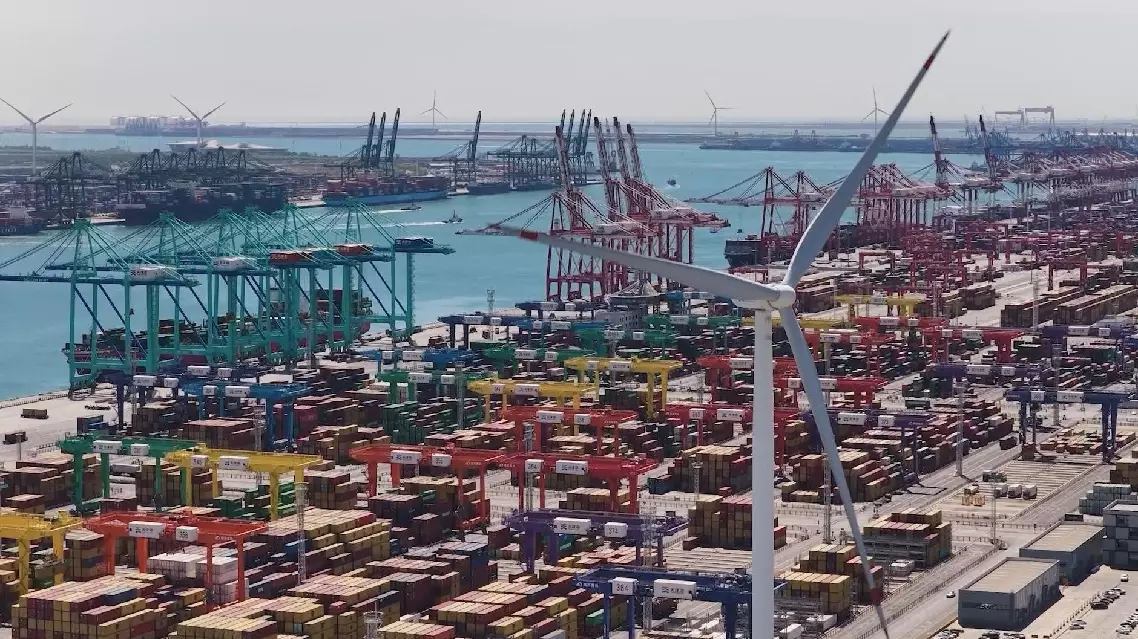
Port activity continued to improve nationwide in April, with equipment utilization rates rising 7.65 percentage points year on year and 1.61 percentage points month on month.
Among the 10 provincial-level administrative regions with the busiest port operations, five coastal regions -- Tianjin, Zhejiang, Shandong, Fujian and Guangxi -- achieved robust container throughput, leveraging their traditional advantages as major port hubs.
And five inland provincial-level regions -- Beijing, Ningxia, Shaanxi, Guizhou and Sichuan -- emerged as new engines of foreign trade growth, driven by rapid development of the new western land-sea corridor, China-Europe freight train services, and bonded zone and port logistics.
"Port equipment utilization has formed a pattern of growth spreading across coastal and inland regions. Foreign trade is shifting from a coastal-only model to a new landscape of coordinated growth nationwide. Cross-border supply chain resilience continues to strengthen," said Shen Chunfeng, a big data expert at iRootech, a pioneer industrial Internet of Things digital platform supplier.
Data from the State Information Center showed sustained improvement in goods exports. In April, the cargo tonnage of cargo vessels departing from major ports increased by 42.1 percent year on year, representing a sharp acceleration of 41.7 percentage points from the growth rate in March.
Daily international cargo flights also grew 2.2 percent month on month in April, reflecting improved export performance for high-value products, particularly consumer electronics, the data showed.
Despite a complex external environment, China's foreign trade has displayed remarkable resilience and vitality. The strong performance of high-value-added exports, experts say, reflects both robust international demand for Chinese goods and the country's increasingly prominent industrial and supply chain advantages, reinforced by a series of supportive policies.
"Overall, driven by policies already adopted and new ones, the momentum of improved domestic and international demand was solid in April. Market expectations remained stable, while the cultivation of new quality productive forces was quickened. China's economy showed a positive trend characterized by optimized structure, renewed business models and stable expectations," said Xing Yuguan, an associate researcher of the Big Data Development Department under the National Information Center of the National Development and Reform Commission.
High-value exports surge boosts foreign trade resilience in April