Russia and Ukraine on Sunday accused each other of violating a declared three-day ceasefire.
The Russian Defense Ministry said Sunday that Ukrainian forces committed 16,071 violations of the ceasefire regime in the past 24 hours.
Russian forces responded to the ceasefire violations in kind, launching retaliatory strikes against multiple launch rocket system, artillery, and mortar positions, as well as command posts and drone launch sites of the Ukraine forces, the ministry said.
On Saturday, the ministry also reported 8,970 ceasefire violations in multiple regions.
Ukrainian authorities said Sunday that at least one person was killed, and 15 others were injured in Russian attacks across Ukraine despite the ceasefire.
The General Staff of the Ukrainian Armed Forces said in a statement that Russian forces attacked Ukrainian positions 60 times on Sunday.
Russia and Ukraine on Friday agreed to a three-day ceasefire from Saturday to Monday.
Ukrainian President Volodymyr Zelensky said Sunday that Ukraine has submitted to the Russian side a list of 1,000 detainees for the planned prisoner exchange, according to the presidential press service.
"The prisoner exchange, 1,000 for 1,000, is being prepared and must take place. The Americans assumed responsibility for these guarantees," Zelensky said in his evening address.
The U.S. President Donald Trump announced the ceasefire and the exchange of prisoners in a social media post on May 8, which was later confirmed by the two countries.

Russia, Ukraine accuse each other of violating 3-day ceasefire
A gold buying craze is sweeping China, with consumers piling into the precious metal to preserve and grow value as prices hover at record highs.
According to data from the China Gold Association, the country's gold consumption exceeded 303 tonnes in the first quarter of this year, up 4.41 percent year on year.
Behind this slight overall increase lies a significant divergence in the structure of gold consumption: While gold jewelry sales continued to face pressure, consumption of investment-grade gold products such as gold bars and coins surged by 46.4 percent year on year.
At the Shuibei market, a gold jewelry manufacturing and trading hub in the southern metropolis of Shenzhen, investment-grade gold products and gold recycling services are showing clear signs of growth.
"Investment gold has risen quite a bit recently. Buying some might help preserve value. Plus, seeing that the central bank is also buying gold now, I figured setting up a regular investment plan probably won't go wrong,'' said a buyer.
In addition to the popularity of investment-grade gold products, gold recycling volumes have remained at high levels since the start of the year.
Merchants at the Shuibei market said that gold recycling volumes have been climbing steadily, with monthly volumes reaching over 500 grams.
In Beijing, sales of gold bars through banks have also surged sharply this year, while subscriptions for gold-related wealth management products and funds have notably increased.
This year, the number of gold investment clients and the scale of transactions have grown markedly at many bank branches in Beijing.
"(Regarding household asset allocation) 30 percent should be invested in gold. I believe gold offers better risk resistance and is more stable," said an investor.
Driven by falling interest rates, some investors have also shifted their funds toward purchasing gold or gold-related investments.
"Subscriptions for wealth management products and funds linked to gold are seven times higher than the same period last year, and the number of clients is nearly four times higher. Conservative investors prefer 'fixed income plus' structured wealth management products, while experienced investors favor products such as gold ETF (exchange traded fund) or FOF (fund of funds)," said Yu Wei, deputy general manager of the Operations Department at China Everbright Bank's Beijing Branch.
This year, gold prices have fluctuated sharply, with spot gold price once peaking at nearly 5,600 U.S. dollars per ounce and bottoming out at about 4,098 U.S. dollars per ounce.
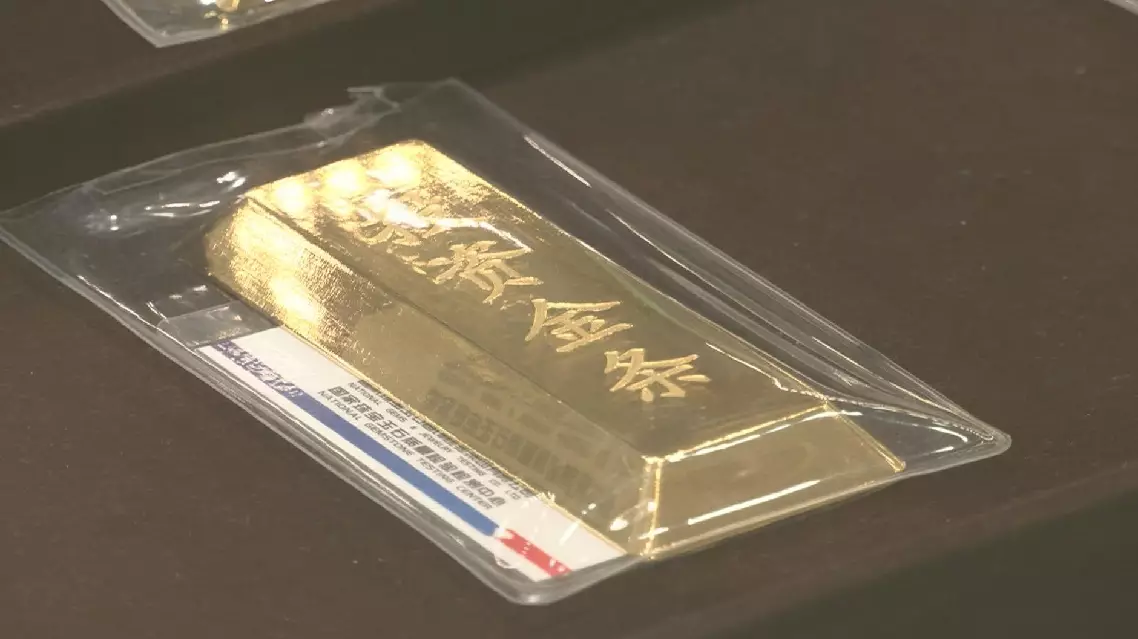
High prices drive up demand for gold purchases in China