Thailand's energy crisis, sparked by Middle East tensions, has rapidly turned solar power from a green option into an economic necessity.
As electricity costs surge, homes and businesses are rushing to install rooftop panels, with demand outpacing supply and installers struggling to keep up.
Heavily reliant on imported energy, Thailand is vulnerable to global shocks.
Despite abundant sunshine, renewables still make up only about 10 percent of its power mix.
To accelerate adoption, the Thai government has recently introduced tax incentives for residential solar.
Homeowners can now sell excess power back to the grid, with guaranteed rates.
"Actually, we've been looking into this for a while, and we only just made the decision now because electricity prices keep going up," said Kriangkai Kajondetpisan, a resident whose family is among a growing number of Thai households turning to solar.
Energy experts said the timing is critical.
Thailand relies heavily on imported liquefied natural gas (LNG) to power its electricity grid, making the country highly vulnerable to global energy price volatility.
"Import LNG is especially dense from the area in the Arab Gulf, and that is a straight impact to the electricity vulnerability of Thailand. So the government is really concerned about the shortage of this energy. We have studied that every 2,000 megawatts of installation of solar rooftop, around maybe 300,000 households, we can reduce the LNG import by five to seven percent," said Chalie Charoenlarpnopparut, associate professor at Sirindhorn International Institute of Technology (SIIT) under Thammasat University.
That policy push is now translating into real demand.
Solar companies said business has surged in recent months, as households rush to lock in long-term savings.
"This year, it's clear that the increase has been huge, a percentage increase of over 100 percent. And that's not even counting the projects where we're out of stock and can't install, or have to wait for availability," said Bamrung Thanapornphibalchon, managing director of the V-Techs Advance Solution Co., Ltd.
The rapid expansion has been made possible by the availability of cost-effective equipment. Affordable and widely available Chinese panels are driving much of this boom, helping scale up installations during a time of global supply strain, backed by a supply chain built for speed and scale.
What began as a crisis-driven necessity is now accelerating Thailand's long-awaited energy transition.
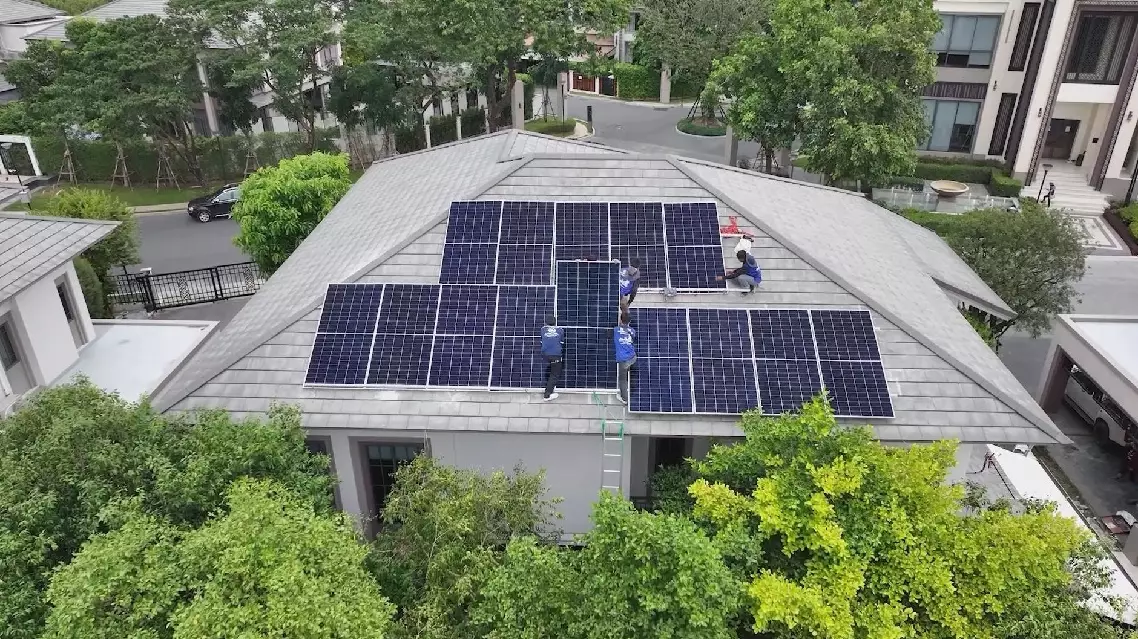
Thailand turns solar power from green option to economic necessity amid ongoing Mideast conflict

A gold buying craze is sweeping China, with consumers piling into the precious metal to preserve and grow value as prices hover at record highs.
According to data from the China Gold Association, the country's gold consumption exceeded 303 tonnes in the first quarter of this year, up 4.41 percent year on year.
Behind this slight overall increase lies a significant divergence in the structure of gold consumption: While gold jewelry sales continued to face pressure, consumption of investment-grade gold products such as gold bars and coins surged by 46.4 percent year on year.
At the Shuibei market, a gold jewelry manufacturing and trading hub in the southern metropolis of Shenzhen, investment-grade gold products and gold recycling services are showing clear signs of growth.
"Investment gold has risen quite a bit recently. Buying some might help preserve value. Plus, seeing that the central bank is also buying gold now, I figured setting up a regular investment plan probably won't go wrong,'' said a buyer.
In addition to the popularity of investment-grade gold products, gold recycling volumes have remained at high levels since the start of the year.
Merchants at the Shuibei market said that gold recycling volumes have been climbing steadily, with monthly volumes reaching over 500 grams.
In Beijing, sales of gold bars through banks have also surged sharply this year, while subscriptions for gold-related wealth management products and funds have notably increased.
This year, the number of gold investment clients and the scale of transactions have grown markedly at many bank branches in Beijing.
"(Regarding household asset allocation) 30 percent should be invested in gold. I believe gold offers better risk resistance and is more stable," said an investor.
Driven by falling interest rates, some investors have also shifted their funds toward purchasing gold or gold-related investments.
"Subscriptions for wealth management products and funds linked to gold are seven times higher than the same period last year, and the number of clients is nearly four times higher. Conservative investors prefer 'fixed income plus' structured wealth management products, while experienced investors favor products such as gold ETF (exchange traded fund) or FOF (fund of funds)," said Yu Wei, deputy general manager of the Operations Department at China Everbright Bank's Beijing Branch.
This year, gold prices have fluctuated sharply, with spot gold price once peaking at nearly 5,600 U.S. dollars per ounce and bottoming out at about 4,098 U.S. dollars per ounce.
High prices drive up demand for gold purchases in China