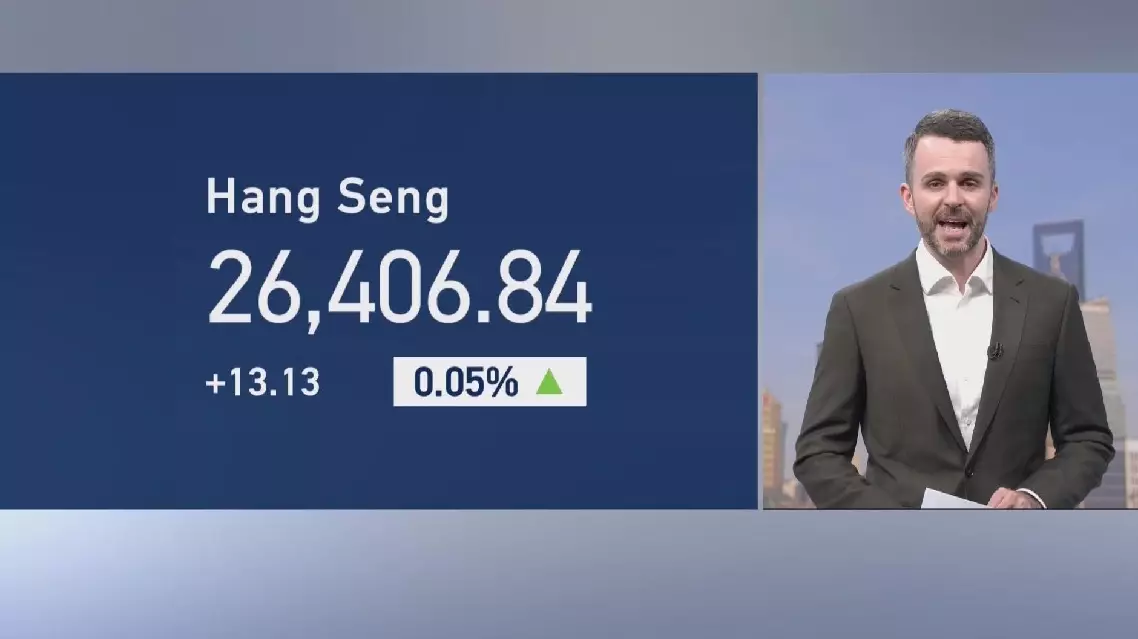
The Hong Kong stock market drifted lower for most of Monday's session before staging a comeback to wipe out all losses by the end of the day, while Tokyo's Nikkei benchmark experienced a slight decline as the continuing tensions between the U.S. and Iran continued to cast a cloud over investor confidence.
Hong Kong's stock market ended higher Monday with the benchmark Hang Seng Index up 0.05 percent to close at 26,406.84 points.
The Hang Seng China Enterprises Index dipped 0.05 percent to end at 8,884.20 points, while the Hang Seng Tech Index edged up 0.07 percent to end at 5,106.40 points.
Recapping on the day's developments, Timothy Pope, a market analyst for the China Global Television Network (CGTN), noted that the uncertainties surrounding the situation in the Middle East continued to weigh on investor sentiment across the Asian markets.
"Around the region, attention really did turn to President Trump's blunt rejection of Iran's counter-proposal to the White House's one-page peace plan -- that leaves the conflict to drag on, and shipping in the region remains at a standstill. The Hang Seng spent most of the session lower. It did actually claw back all of those losses and closed pretty much flat. Resources, travel and tech stocks were among the biggest drags on the Hang Seng today," he said.
Despite this, Pope noted a surprising rally in the Chinese property market, with the state-owned China Poly Property Group Corporation seeing a jump after it posted encouraging sales figures for last month, as well as a strong debut showing for a newly-listed Chinese robotics firm.
"We don't get much good news from Chinese property developers these days, but over the last couple of sessions they have been doing a little bit better and a few of them have been reporting growth in property sales. Poly Property is the latest to release that kind of data with contracted sales amounting to 4.2 billion yuan in April. Now that's a huge jump and its stocks added about 5.5 percent today as a result. The big winner in Hong Kong though was robot maker Shenzhen Ldrobot, one that is brand new to the market. It debuted today and shot up more than 150 percent at one stage and still ended the day slightly off that but 127 percent higher," said Pope.
Japan's Nikkei Stock Average slipped 295.77 points, or 0.47 percent, to close at 62,417.88 on Monday.
"The Nikkei 225 went into retreat after some early gains took it to new record highs. But the Iran situation is weighing on investors minds there and the index closed 0.5 percent lower. The latest U.S. economic data has also raised some concerns about consumer sentiment there. And really that is fallout from the conflict that could hurt Japanese exporters too. As I've already said, though, nobody's worried about demand for AI going away, and that sector was doing okay in Tokyo," said Pope.
There was big disappointment for the Japanese video game giant Nintendo after its move to hike up the price of its games console was met with a poor reception on the markets, Pope said.
"The big drag actually came from the games company Nintendo. It slumped 8.4 percent today after increasing the price of its flagship 'Switch 2' console in the face of what's been growing market concerns that that video games console isn't attracting enough top-quality, high-profile video games coming out at the moment and they've just increased the price, so that didn't go down too well," said the analyst.
Hong Kong stocks rally, Tokyo slips amid Middle East turbulence

Major breakthroughs by Chinese scientists have laid the foundation for a future where space-based solar power stations are capable of wirelessly transmitting energy to Earth and spacecraft, though significant engineering problems remain.
A research team from Xidian University in northwest China's Shaanxi Province has made significant progress on the Sun Chasing project, or "Zhuri" in Chinese. The team has developed a ground-based test system for wireless power transmission that can charge multiple moving targets at the same time.
In recent tests, the system achieved a wireless power transmission efficiency of 20.8 percent from direct current to direct current over a distance of 100 meters. It delivered 1,180 watts of power. The team has also built a wireless charging system for drones. In a test, a drone flying at 30 kilometers per hour was able to receive 143 watts of stable power from 30 meters away.
A space solar power station works exactly as its name suggests: a huge array of solar panels placed in orbit. It would collect sunlight in space, where the sun always shines, and then convert that energy into microwaves or lasers to beam down to Earth or directly to satellites and spacecraft. This could address two significant issues: supplying uninterrupted power for space missions and alleviating energy shortages on the ground.
"The construction of space solar power stations could become a major undertaking in the future. One potential benefit is access to a virtually unlimited power supply. Because energy can be collected continuously in space 24 hours a day, electricity could be supplied on an uninterrupted basis," said Fan Guanheng, an associate professor at the School of Mechano-Electronic Engineering at Xidian University.
"Secondly, it could reduce our dependence on fossil fuels, thereby lowering carbon emissions and helping protect the environment. Thirdly, it could support the development of charging infrastructure in space and enable wireless microwave charging for spacecraft, changing the way power is supplied to space vehicles," the professor added.
In 2018, the research team launched the first phase of the Sun Chasing project to build a ground test system. By June 2022, they had completed the world's first full-link, full-system ground validation system for a space solar power station. Now, the team has moved to phase two. The goal now is to solve the challenges of generating high power in space and transmitting it efficiently over long distances.
According to Duan Baoyan, an expert at Xidian University and an academician of the Chinese Academy of Engineering, recent breakthroughs include improving the efficiency of solar energy collection and conversion, increasing the precision of microwave beam control to reduce energy loss, and making the transmitting and receiving antennas smaller and lighter, which is critical for space application.
The team has also solved the problem of how to power multiple moving targets at once using a single transmitter. This means that in the future, one space power station could potentially supply electricity to several satellites or ground vehicles at the same time, Duan said.
Despite the advances in ground-based validation, a series of technical challenges must still be overcome before the technology can be deployed in space.
"The first issue that needs to be addressed is the adaptability of components to the space environment, as conditions in space are completely different from those on Earth, including radiation exposure and extreme temperatures. Another challenge involves the deployment and retraction design of transmitting and receiving antennas. We also need to develop thermal management systems to cope with extreme temperatures and temperature fluctuations in space. These are all areas where further breakthroughs are needed," said Qian Sihao, an associate professor at the School of Mechano-Electronic Engineering at Xidian University.
"We have now completed the development and validation of a ground-based test system, and our next step is to carry out in-orbit wireless microwave power transmission," Fan said.
With ground validation complete, the team now turns its attention to overcoming the harsh realities of space, aiming to demonstrate in-orbit wireless power transmission and bring the vision of orbital solar energy closer to reality.
Space-to-earth solar power moves closer to reality although hurdles remain: scientists