HONOLULU (AP) — Two states could try a new way to reduce the influence of corporations and hard-to-track “dark money” groups that have been able to spend unlimited amounts on politics since the Supreme Court's 2010 Citizens United v. Federal Election Commission ruling.
Hawaii lawmakers on Friday sent a bill to the governor that would redefine corporations in a way that precludes spending on elections. A volunteer group in Montana is gathering signatures in hopes of putting a similar issue to voters in November.
Supporters say voters dislike corporate and dark money in elections and this effort meets a need. Detractors say states can't pass laws to skirt Supreme Court decisions they don't like.
Similar legislation has been introduced in at least 14 states besides Hawaii, but none of those bills have gotten very far.
Citizens United, a conservative group, wanted to run TV commercials promoting its anti-Hillary Clinton movie when she was running for president in 2008. The high court's ruling in its case two years later effectively struck down a ban on corporate and union election spending as long as they don’t donate directly to any campaigns.
The ruling has benefitted Democrats and Republicans. The campaign finance watchdog group OpenSecrets tracked more than $4 billion in outside political spending in the 2024 federal elections — almost 12 times as much as in 2008.
Some of that came from dark money groups that aren’t required to disclose donors, and the Brennan Center for Justice tallied a record $1.9 billion in that type of spending in 2024. Dark money has also played a part in some state-level races.
Justin Levitt, a professor at Loyola Law School who studies campaign finance law, said keeping companies from spending on elections might not make a big difference in how political spending works, noting that far more is spent by wealthy people such as Elon Musk.
Americans want to undo the Citizens United ruling, according to Tom Moore, a former Federal Elections Commission lawyer who is now a senior fellow at the Center for American Progress. The think-tank in Washington, D.C. is pushing to redefine corporations to ban spending on campaigns but allow them to lobby lawmakers.
The prohibition would also include the nonprofit organizations involved in dark money spending.
“This is a genuinely new approach to getting Citizens United out of America's politics that is based on absolutely foundational corporation law,” he said.
If just one state adopts it, Moore said, it would be tested in court.
Hawaii Gov. Josh Green, a Democrat, hasn't said whether he'll sign the bill. He has to say by June 30 if he intends to veto it.
“This is an instance where a small state has a chance to make big waves on the national scene,” said state Sen. Karl Rhoads, a Democrat, who introduced the legislation. “I think we should take advantage of it.”
The office of Hawaii Attorney General Anne Lopez, a Democrat, opposed the bill, arguing in part that will be difficult and costly to defend in court.
Separately, volunteers are gathering signatures hoping to put the corporate redefinition idea — branded as The Montana Plan — before voters in that state in November.
Montana's Supreme Court ruled in April that the effort could proceed even after Republican state Attorney General Austin Knudsen said it violates the requirement that ballot initiatives stick to one subject.
“It really resonates with citizens," said Jeff Mangan, a former Montana state commissioner of political practices who’s leading the ballot effort. "They probably see it because they live it."
Bradley Smith, a Republican former member of the Federal Election Commission, says Moore’s idea is not likely to pass muster in court.
“The mistake I think supporters of this are making is thinking you can ignore the substance of a Supreme Court ruling by semantic lawyerly tricks,” he said.
Lower courts likely won't approve a measure that aims to circumvent a Supreme Court ruling and would probably reject any law that ties the provision of general government services to the behaviors of the recipients, Smith said.
If the measures take effect, he said, companies might withdraw from states rather than curtail their political spending.
Loyola’s Levitt says he’s not sure whether the effort would work, but he knows who would decide.
“The one thing I am absolutely sure of is if it got the signatures and is passed by the Montana public and is approved by the Montana courts, that the Supreme Court will want a crack at it,” he said. “There are a lot of steps between here and there.”
Mulvihill reported from Haddonfield, New Jersey.
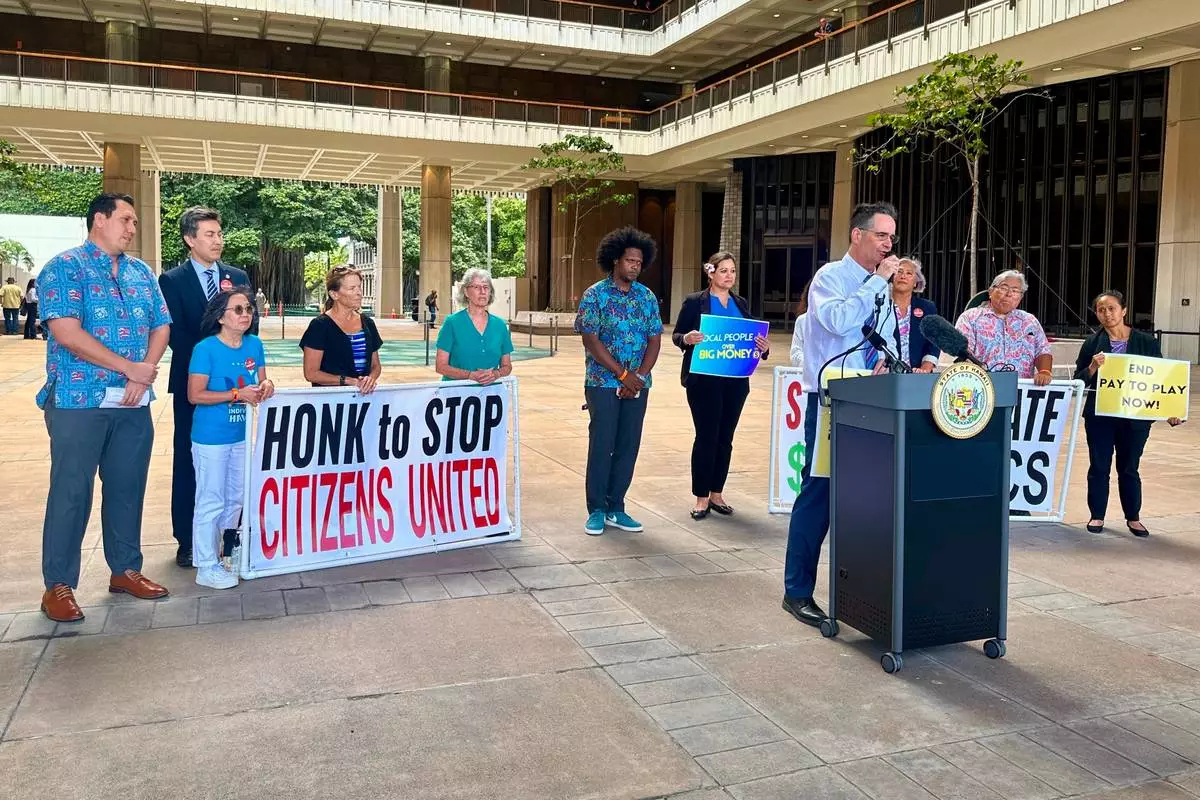
Hawaii Sen. Karl Rhoads speaks at a news conference about a bill that seeks to limit corporate money in politics in Honolulu on Thursday, April 23, 2026 (AP Photo/Jennifer Sinco Kelleher)
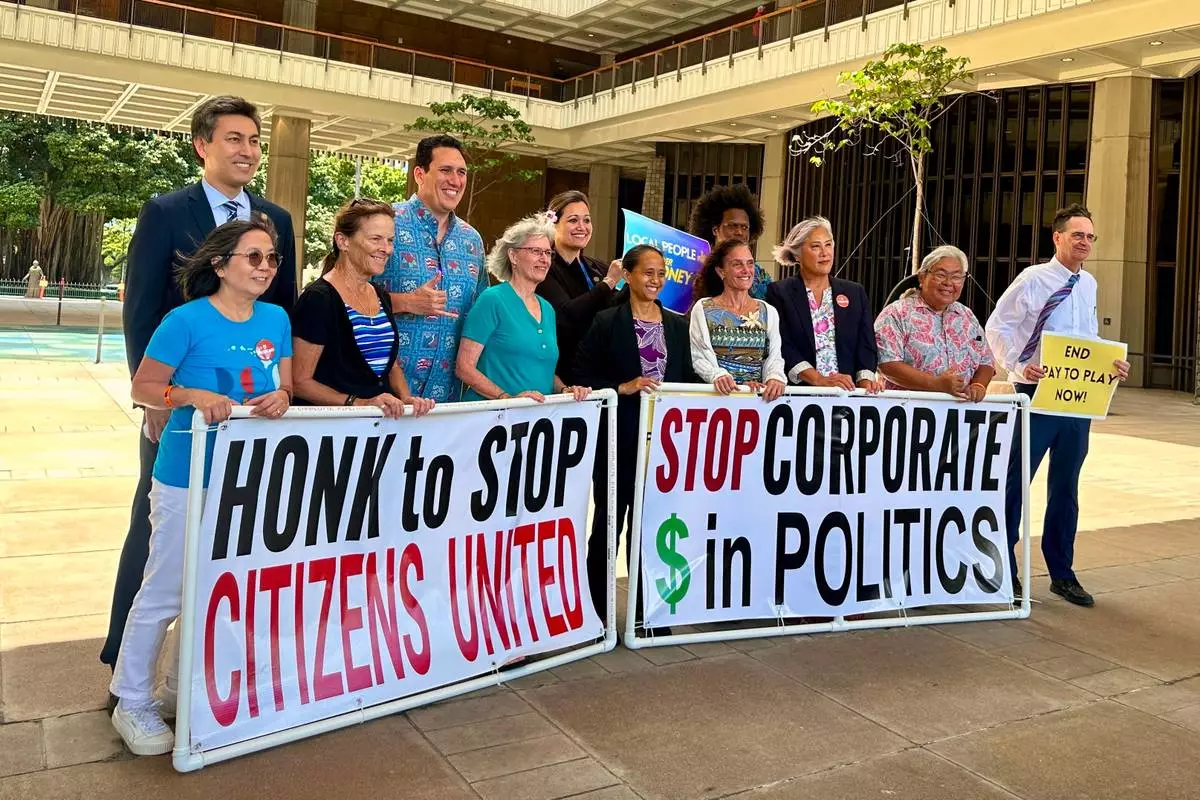
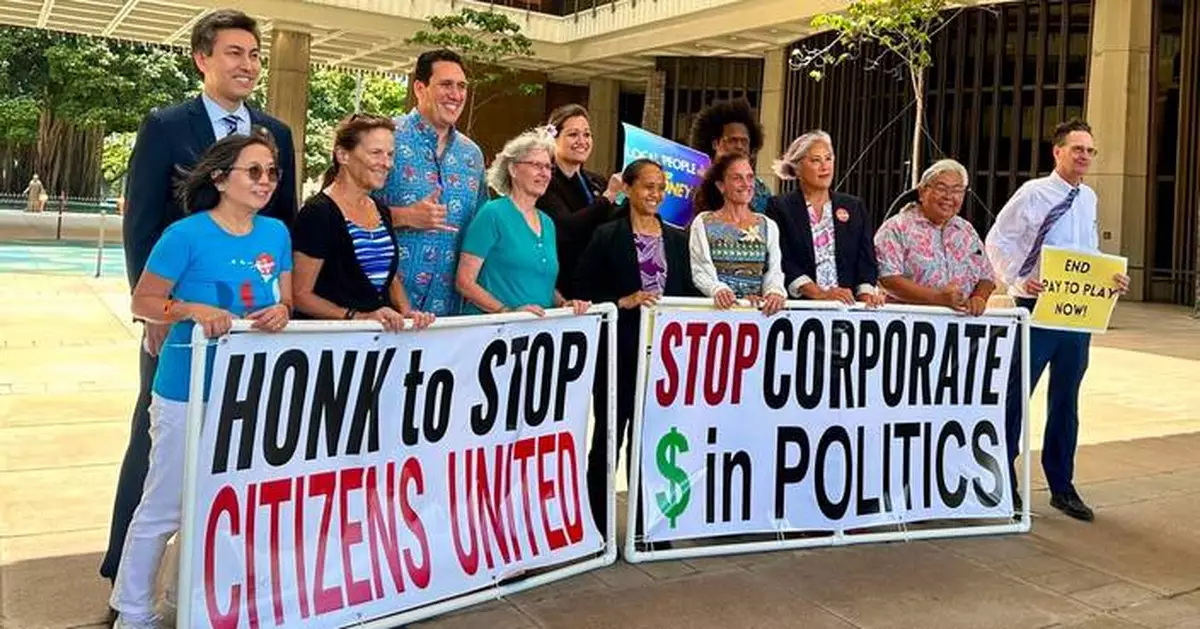
Hawaii lawmakers and activists pose for a photo after discussing a bill that seeks to limit corporate money in politics in Honolulu on Thursday, April 23, 2026. (AP Photo/Jennifer Sinco Kelleher)
OMAHA, Neb. (AP) — The fate of Nebraska's “blue dot” — a small, but significant factor in presidential politics — will take center stage Tuesday as Democratic voters select a congressional nominee in the state's high-profile 2nd District.
The Omaha-area district, where Republican U.S. Rep. Don Bacon is retiring, is one of the Democratic Party's biggest targets this midterm season. It's also a national focus every four years in presidential contests because Nebraska is one of just two states that splits its electoral votes. The 2nd District has gone to Democratic presidential candidates three out of five times since 2008 — a “blue dot” in an otherwise sea of red.
Three Democrats are seen as the top contenders in Tuesday's primary: state Sen. John Cavanaugh, political activist Denise Powell and district court clerk Crystal Rhoades. Republican Brinker Harding, an Omaha City Council member endorsed by President Donald Trump, is running unopposed on the GOP side.
Cavanaugh, more than anyone else on Tuesday's ballot, has been under attack from both parties.
Some Democratic opponents argue that a primary victory for Cavanaugh would jeopardize the district's “blue dot” status because he'd be leaving his valuable state legislative seat, making it easier for Republicans in the Nebraska Legislature to change the law that allows the state to split its electoral votes.
The issue has defined the primary contest perhaps more than any other.
The Democratic argument against Cavanaugh has little to do with his politics or policies.
His opponents and groups backing them have flooded mailboxes, airwaves and social media warning that if he wins the congressional primary, Nebraska's Republican governor would appoint a conservative Republican to replace him in the Legislature.
That move, they say, could give state Republicans enough votes to enact a conservative wish list that includes stricter limitations on abortion and transgender rights.
It could also empower Republicans to enact midcycle redistricting or change the state's unusual system of splitting presidential electoral votes, some Democrats argue. Republicans failed in 2024 to pass a bill that would have made Nebraska the 49th state to award its Electoral College votes on a winner-take-all basis.
“Our Blue Dot. We fought hard for it. But if John Cavanaugh goes to Congress, it could all fall down,” cautions one TV ad by the super PAC New Democrat Majority.
EMILY’s List, a national group that supports women running for office, has put its reach and money behind Powell, calling Cavanaugh’s candidacy “a gift to MAGA Republicans.”
Republican groups have sent out mailers and social media posts claiming Cavanaugh “is in agreement with President Donald Trump” and showing a photo of Cavanaugh overlaid on a photo of the president, making it appear as if the two are standing together.
“Clearly, the Republicans know that I’m the strongest general election candidate,” Cavanaugh said. “And so they’re trying to hurt me.”
The attacks on Cavanaugh show Democrats and Republicans believe he has the best chance of winning the general election, said Paul Landow, a former Nebraska Democratic Party executive director.
He called the “blue dot” attacks disingenuous, noting Republicans already have a filibuster-proof majority in the Legislature but have still failed to pass key elements of their agenda because it is unpopular even among GOP lawmakers. The argument that a Cavanaugh win could weaken the state’s “blue dot” also assumes Democrats won’t pick up additional legislative seats this year, he said.
“There’s so many things that have to fall into place for this alleged danger to the ‘blue dot,’” Landow said. “It’s just wild speculation.”
While all the Democratic contenders cite affordability and opposition to Trump administration policies — from immigration and healthcare to military actions — the top three contenders began attacking one another more aggressively in the days leading up to the primary.
Candidates and allied groups have spent more than $2.6 million on TV and digital advertising since Jan. 1, according to the advertising tracking company AdImpact. Nearly all of that has been by or on behalf of Cavanaugh and Powell.
Cavanaugh has spent about $375,000. Powell's campaign has spent almost as much — $345,000 — but with the help of groups backing her, campaign advertising has been overwhelmingly pro-Powell.
Powell co-founded Women Who Run Nebraska, a political action committee that supports progressive female candidates, and she has a decade of Democratic political activism. She's never held office but said her deep connections have helped her with independents and third-party voters who make up nearly 30% of the district's electorate.
“My name recognition has increased dramatically,” Powell said, adding that "people are really connecting with my message.”
Rhoades carries her own name recognition after 20 years in public service and running a slew of successful local Democratic elections — including that of Omaha Mayor John Ewing, who unseated a longtime Republican last year. Rhoades has raised a fraction of what Cavanaugh and Powell have amassed, but said she's intentionally eschewing campaign ads and instead blanketing the city with door-knocking and personal contact with voters.
Both Powell and Rhoades have leaned heavily into the concern that Democrats' influence in the district will erode if Cavanaugh is elected to Congress.
The winner of Tuesday's primary will head to a highly competitive general election. Trump won the district in 2016, and the retiring Bacon, who has clashed with Trump, has held the House seat for five terms.
Also on Tuesday's ballot is the race for U.S. Senate, where Republican incumbent Pete Ricketts is seeking a full term, following his 2023 appointment and 2024 special election victory to replace Republican Ben Sasse.
Ricketts faces four Republican primary challengers, but he’s already looking ahead to an expected general election contest against independent candidate Dan Osborn, an industrial mechanic and military veteran who came within 7 points of defeating Republican U.S. Sen. Deb Fischer in her 2024 reelection bid. Running in the Democratic primary are William Forbes and Cindy Burbank.
In the race for governor, incumbent Republican Gov. Jim Pillen faces five primary challengers, while former state Sen. Lynne Walz and frequent candidate Larry Marvin compete for the Democratic nomination. Marvin previously ran for U.S. Senate four times since 2012.
Peoples reported from New York.
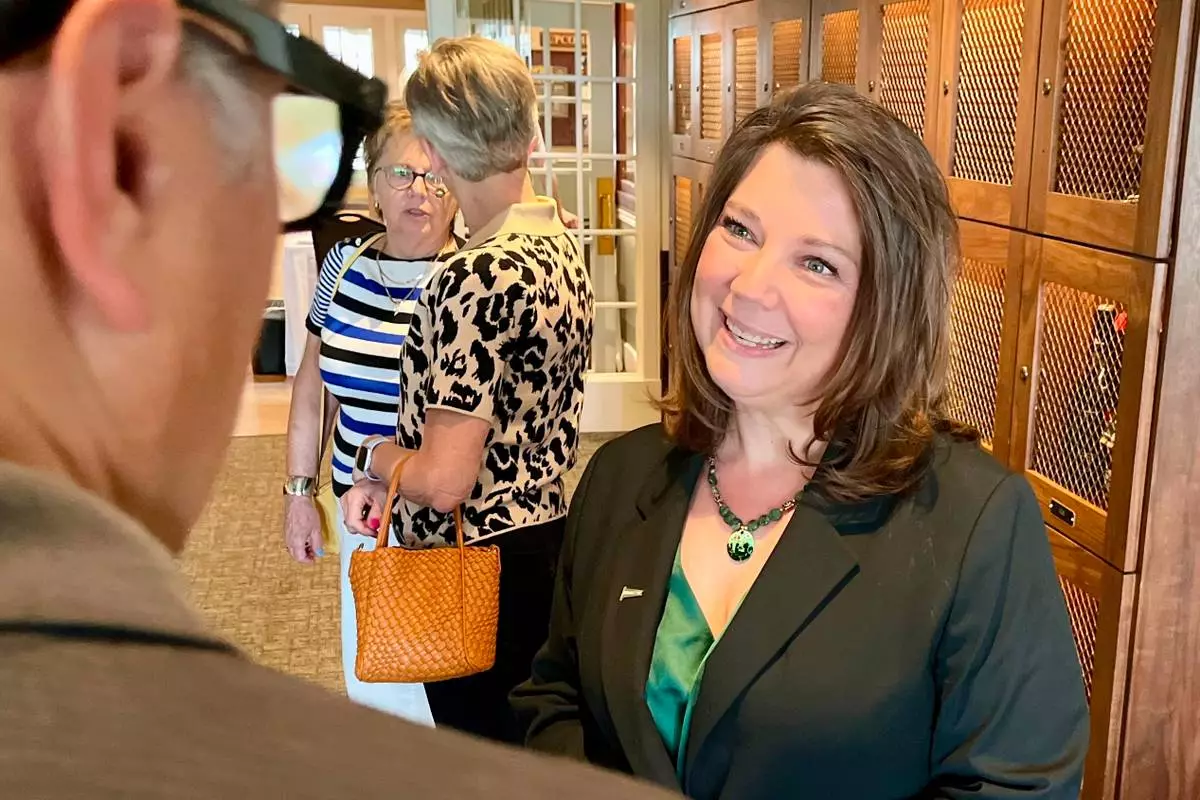
District county clerk Crystal Rhoades speaks at a fundraising event Thursday, April 16, 2026, in Omaha, Neb. (AP Photo/Margery A. Beck)
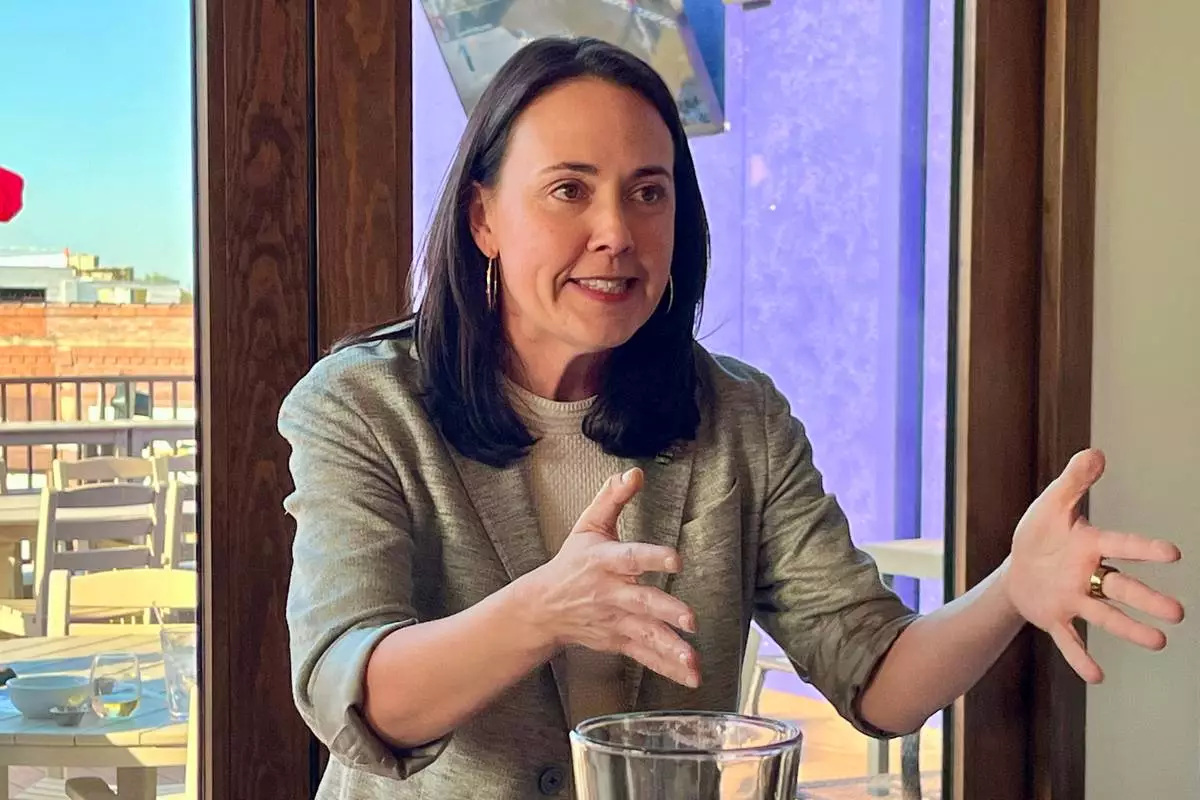
Political activist Denise Powell speaks at a fundraising event Thursday, April 16, 2026, in Omaha, Neb. (AP Photo/Margery A. Beck)
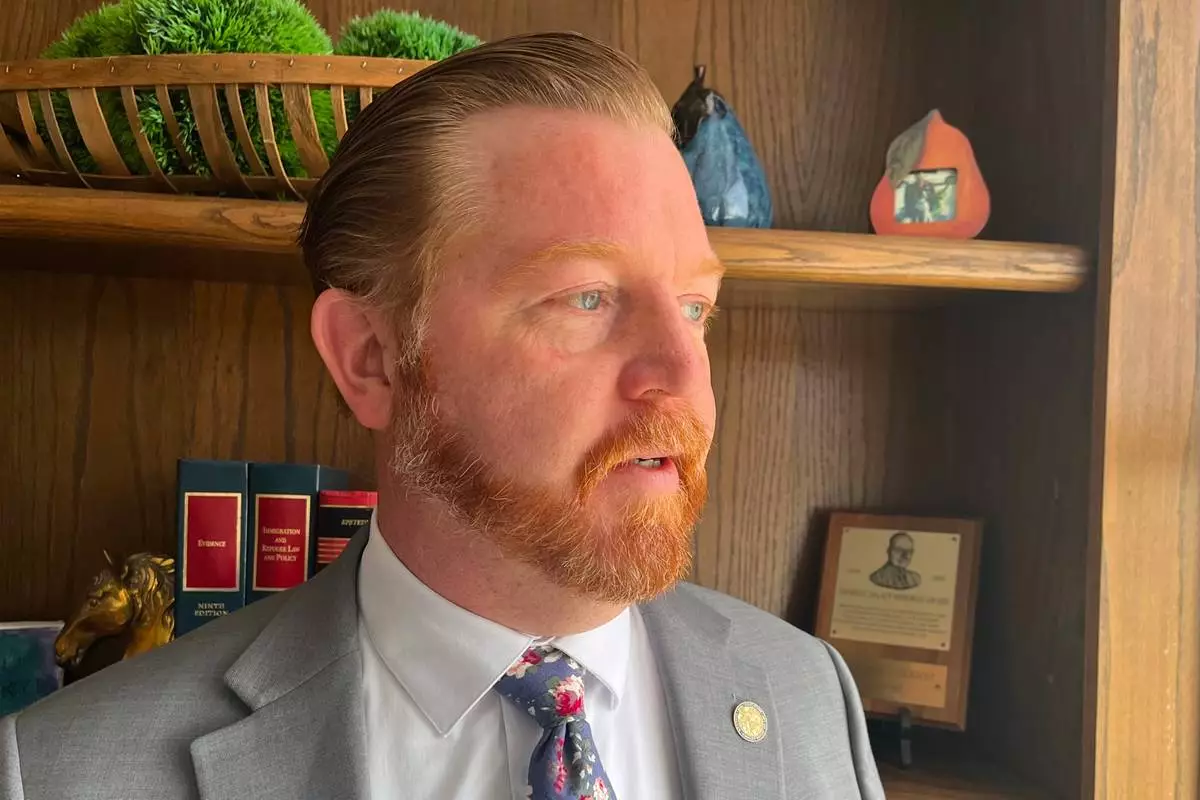
State Sen. John Cavanaugh speaks at an office in Lincoln, Neb., Friday, April 10, 2026. (AP Photo/Margery A. Beck)