Chinese robotics company Unitree has unveiled its latest sci-like creation on Tuesday as it debuted the world's first mass-produced transformable humanoid mechanical suit designed for civilian transportation.
An official demo video shows off the impressive abilities of the mecha suit, which the company has dubbed the 'GD01,' bringing the once far-fetched science-fiction notions of the 'Transformers' franchise to life.
The newly-released demonstration video shows Unitree's founder and CEO Wang Xingxing climbing aboard and strapping himself into the mecha suit, which when standing upright is almost twice the size of an average human.
It is seen striding forward at speed and can instantly transform into a four-legged "steel beast" to traverse rugged terrain with a human occupant sitting inside as a pilot, fulfilling a mecha dream. The video clip even shows the high-tech device being able to punch through a brick wall.
Billed as the world's first production ready manned mecha, the GD01 is equipped with a 500-kg-class dynamic balance control system, allowing seamless switching between bipedal and quadrupedal modes, according to Unitree.
The bipedal mode is suitable for walking and turning on urban streets, while the quadrupedal mode can climb stairs, slopes and other complex terrains.
In recent years, China's robotics sector has been continuously advancing, from quadruped robot dogs to humanoid robots, with manned mechas now appearing to be the next stage in the ongoing development of this highly futuristic sector.
The groundbreaking launch of the GD01 has significantly moved up the timeline for the potential commercialization of such manned mechas.
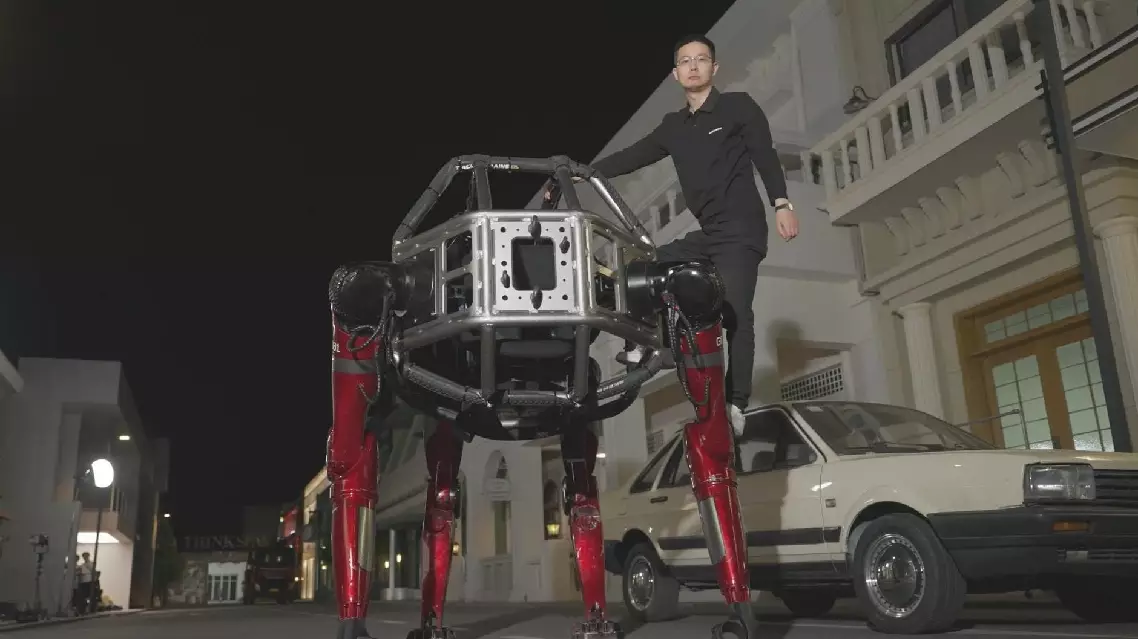
Unitree brings transformers to life with world's first manned mecha suit
Micro-dramas born in China are now taking the U.S. market by storm, and according to a popular American actor, the U.S. film and television industry is looking to copy China's playbook to replicate the commercial success of its vertical-screen short dramas.
Matt William Knowles is the first non-Asian to graduate in acting from the Beijing Film Academy and has starred in multiple hit Chinese TV dramas, including "Red Sorghum" and "Eastern Battlefield". Now, as he has become the face of America's vertical micro-drama boom, he said the experience feels nothing short of surreal.
"I didn't expect that the vertical series would be a thing several years ago, and now they've popped up and grown so fast," said Knowles.
In his view, vertical micro-dramas have long ceased to be a niche phenomenon. In the U.S., they've already built a huge and fast-growing audience.
"I think a couple of years ago, there was a smaller market or type of person who was watching this series, and now there are more and more people who are watching. I had a friend who said he was on a construction site recently, and there were a bunch of construction workers, and they were all watching a vertical series together," he said.
As an insider, Knowles has observed a notable shift in the U.S. film and television industry in recent years: a growing trend of looking to China for inspiration. Backed by hard market data, the once-supreme Hollywood is now filled with professionals eager to decode the business secrets behind China's micro-drama success.
"Several years ago, China was usually bringing over talent from Hollywood to China to learn from them. But now you have this interesting thing that's happening with vertical series, where vertical series started in China. And now people in America are trying to figure out: how can we copy this thing and make money off it? I think a lot of people are studying what's going on in China," he said.
Hollywood taking notes from China's micro-drama playbook: U.S. actor