KUALA LUMPUR, Malaysia (AP) — Norway's foreign ministry affirmed Friday it has revoked export licenses tied to a naval missile system for Malaysia, saying sales of its most sensitive defense technologies are now restricted to allies and closest partners.
The move blocked delivery of the Naval Strike Missile system and launcher components intended for Malaysia’s littoral combat ship program, prompting sharp protests from Kuala Lumpur. Malaysian Prime Minister Anwar Ibrahim warned it could damage confidence in European defense suppliers.
Norway's foreign ministry said in reply to Associated Press queries that the government has strengthened oversight on defense technology in response to major shifts in the security landscape in Europe and globally in recent years.
“Exports of some of the most sensitive Norwegian-developed defense technologies will be limited to our allies and closest partners,” it said. “It is regrettable that this affects Malaysia.”
Malaysia inked a deal for the NSM anti-ship missile system in 2018 with Norway's Kongsberg Defense & Aerospace AS. The missiles were intended to arm Malaysia’s new class of littoral combat ships under a broader naval modernization program.
Anwar said Thursday he raised Malaysia’s strong protest during a phone call with Norwegian Prime Minister Jonas Gahr Støre. He said Oslo’s move would hurt Malaysia’s operational readiness and cast doubt on the reliability of European defense partners if signed agreements could be reversed unilaterally.
Contracts are “not confetti to be scattered in so capricious a manner,” Anwar said. “If European defense suppliers reserve the right to renege with impunity, their value as strategic partners flies out the window.”
The Norway foreign ministry said Store had explained Norway's decision to Anwar during their call. Despite the curbs, it said Norway “greatly values its relationship with Malaysia” and looked forward to continued cooperation and constructive dialogue with Malaysian authorities.
Malaysia has already paid 95% of the contract value and is now examining legal options and possible compensation claims over the canceled delivery.
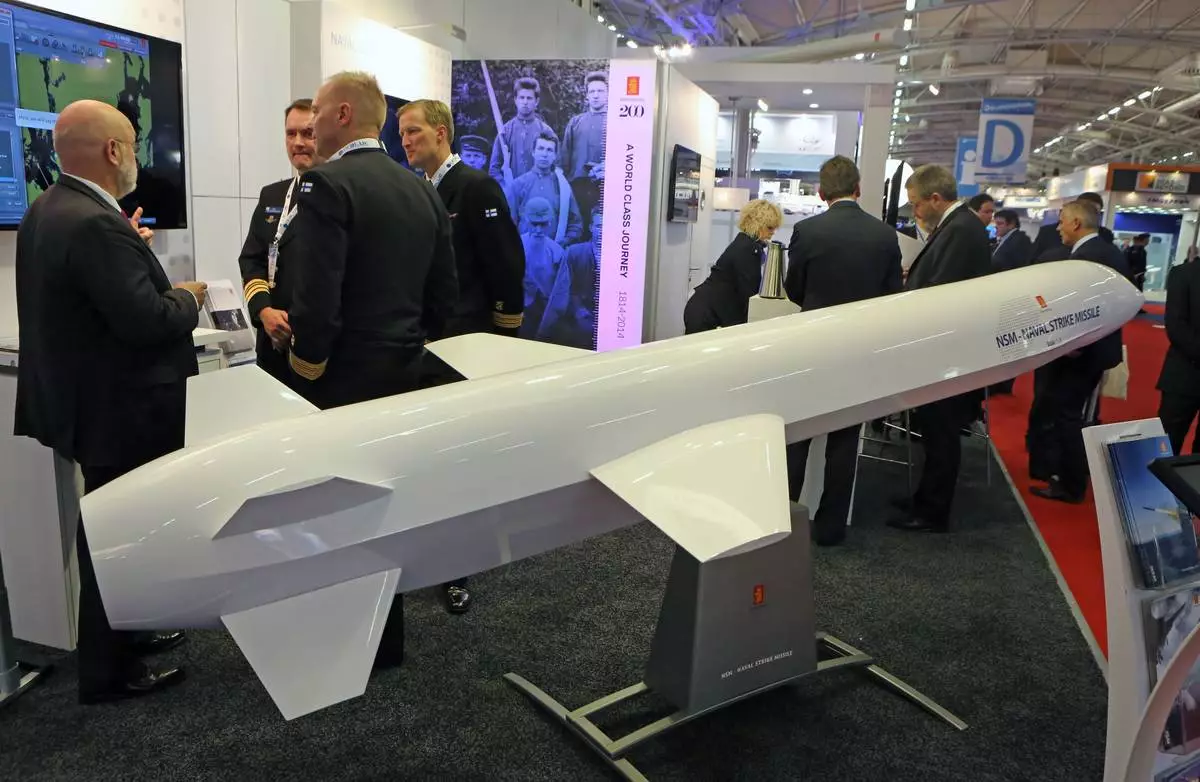
Visitors are gathered next to a display of an NSM Naval Strike Missile made by Norwegian company Kongsberg, presented at the Euronaval show, in Le Bourget, North of Paris, France, Wednesday Oct. 29, 2014. (AP Photo/Remy de la Mauviniere)
NEW YORK (AP) — The U.S. stock market is falling from its records Friday and joining a worldwide drop for stocks, as higher oil prices send a shiver through the bond market. Stocks that had been caught up in the euphoria around artificial-intelligence technology led the way lower.
The S&P 500 fell 1.1% from its all-time high set the day before. The Dow Jones Industrial Average was down 408 points, or 0.8%, as of 9:35 a.m. Eastern time, and the Nasdaq composite was down 1.6% from its own record.
Technology stocks tumbled in a sharp turnaround from their meteoric rises for much of the year, which had carried markets worldwide to records but also raised criticism that they had gone too far.
Nvidia, the stock that quickly became the face of the AI revolution, dropped 3.6% and was the heaviest weight on the S&P 500. It had come into the day with a gain of more than 26% for the year so far.
“To us, it looks like markets have pushed into overbought territory,” according to Brian Jacobsen, chief economic strategist at Annex Wealth Management. He said the strong corporate profits and durable U.S. economy that launched U.S. stocks to records remain intact, but “the path is unlikely to be smooth. Periods like this call for discipline more than hope.”
In the meantime, rising oil prices are raising the pressure after already sending inflation higher than economists had feared. The war with Iran is continuing, and the Strait of Hormuz remains shut to oil tankers, which is preventing them from delivering crude to customers worldwide and driving up oil’s price.
The price for a barrel of Brent crude oil, the international standard, rose 2.1% to $107.97 and is well above its level of roughly $70 from before the war.
Many big U.S. companies have been saying their customers have been able to keep spending on their products and services despite having to pay higher prices for gasoline. But U.S. households have also been telling surveys they’re feeling discouraged about the economy and the pressures building not only because of the war but also because of tariffs.
The worries were most clear Friday in the bond market, where Treasury yields climbed. The yield on the 10-year Treasury rose to 4.56% from 4.47% late Thursday. That’s a notable move for the bond market, and it’s well above its 3.97% level from before the war. The yield on the 30-year Treasury is close to its highest level since 2023 after breaking above 5%.
Higher yields can make mortgages and other kinds of loans going to U.S. households and businesses more expensive, which slows the economy. They also tend to push downward on prices for stocks and all kinds of other investments.
Yields have been climbing since the war on worries about higher inflation and how it may tie the Federal Reserve’s hands when it comes to short-term interest rates. Not only have traders abandoned virtually all expectations that the Fed will resume its cuts to interest rates this year, they’ve been building some bets that it may even hike rates in 2026, according to data from CME Group.
In stock markets abroad, indexes fell sharply across Europe and Asia.
South Korea’s Kospi dropped 6.1% for one of the sharpest moves. It had been reaching records this year because of the influence of AI beneficiaries like SK Hynix. But it quickly reversed momentum Friday after briefly topping the 8.000 level for the first time.
Some on Wall Street have been warning about a possible break in momentum for tech stocks in general and AI winners in particular.
“If nothing else this should be a ‘shot across the bow’ for how volatility works both ways,” according to Jonathan Krinsky, chief market technician at BTIG.
AP Business Writer Chan Ho-him contributed.
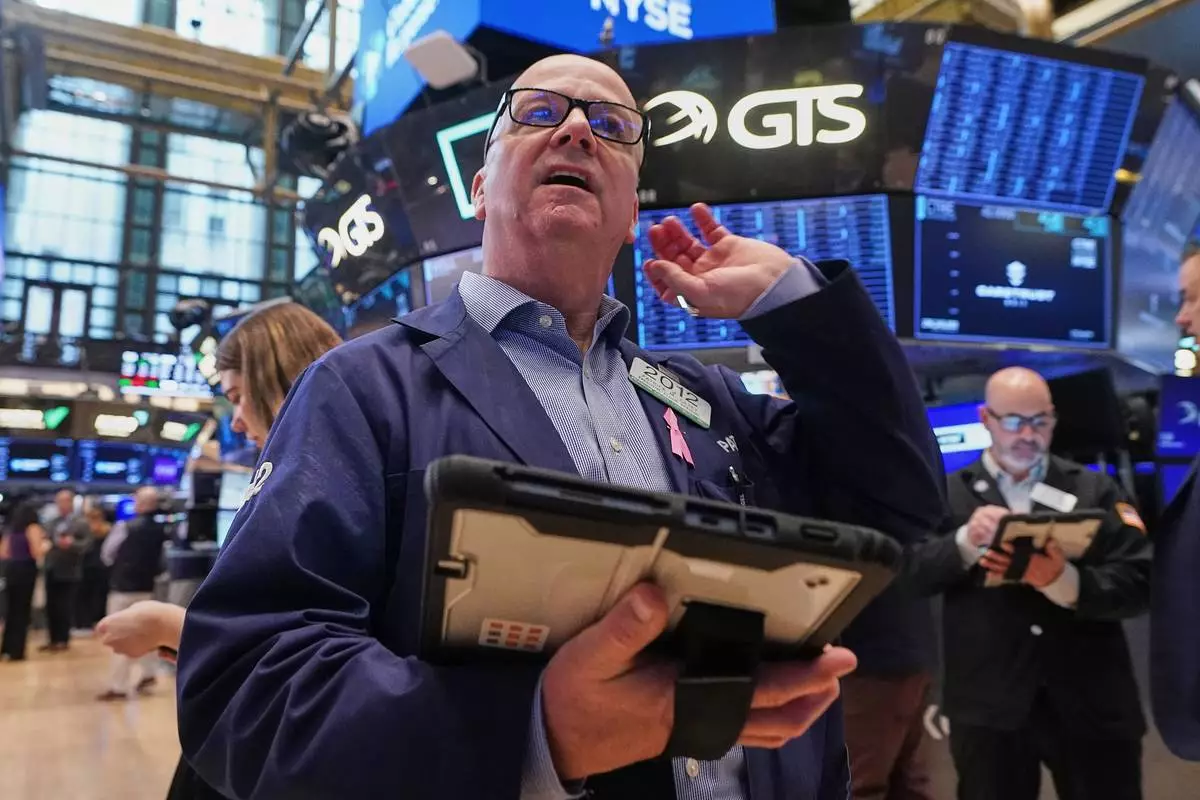
Trader Patrick Casey works on the floor of the New York Stock Exchange, Wednesday, May 13, 2026. (AP Photo/Richard Drew)
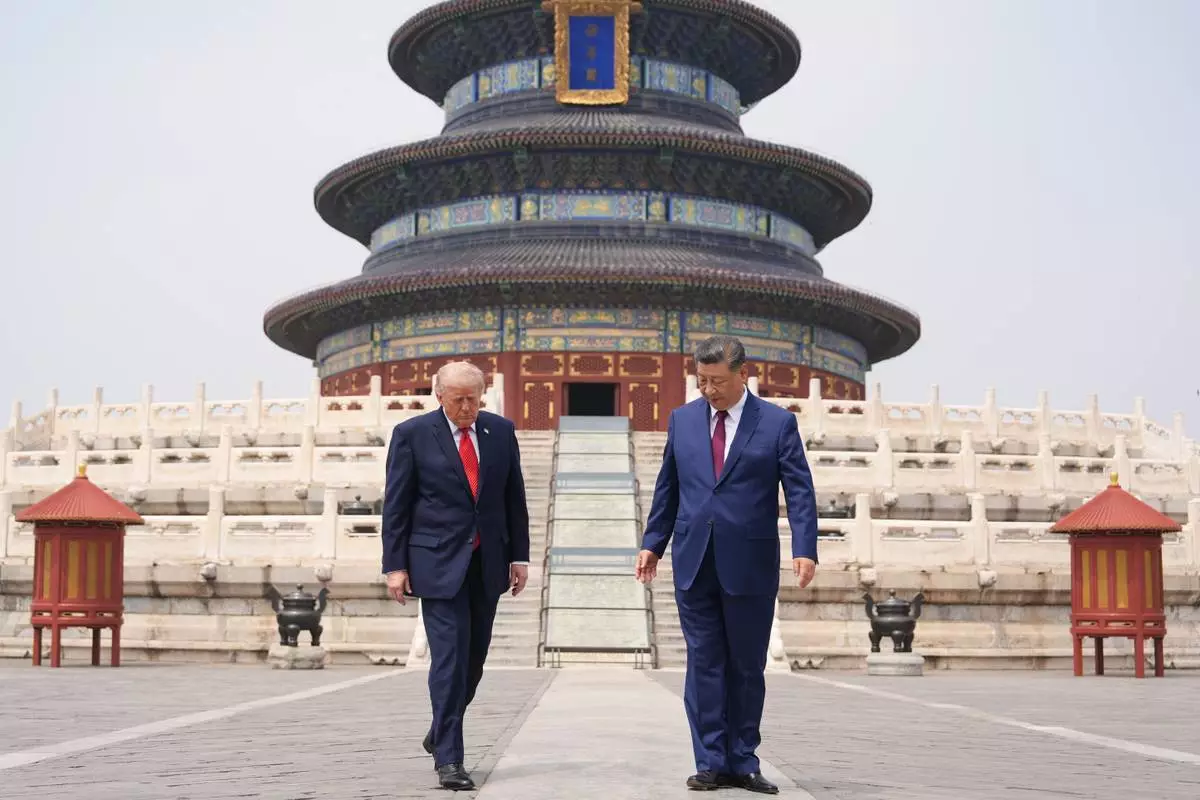
President Donald Trump, left, walks with Chinese President Xi Jinping at the Temple of Heaven on Thursday May 14, 2026, in Beijing. (AP Photo/Mark Schiefelbein)
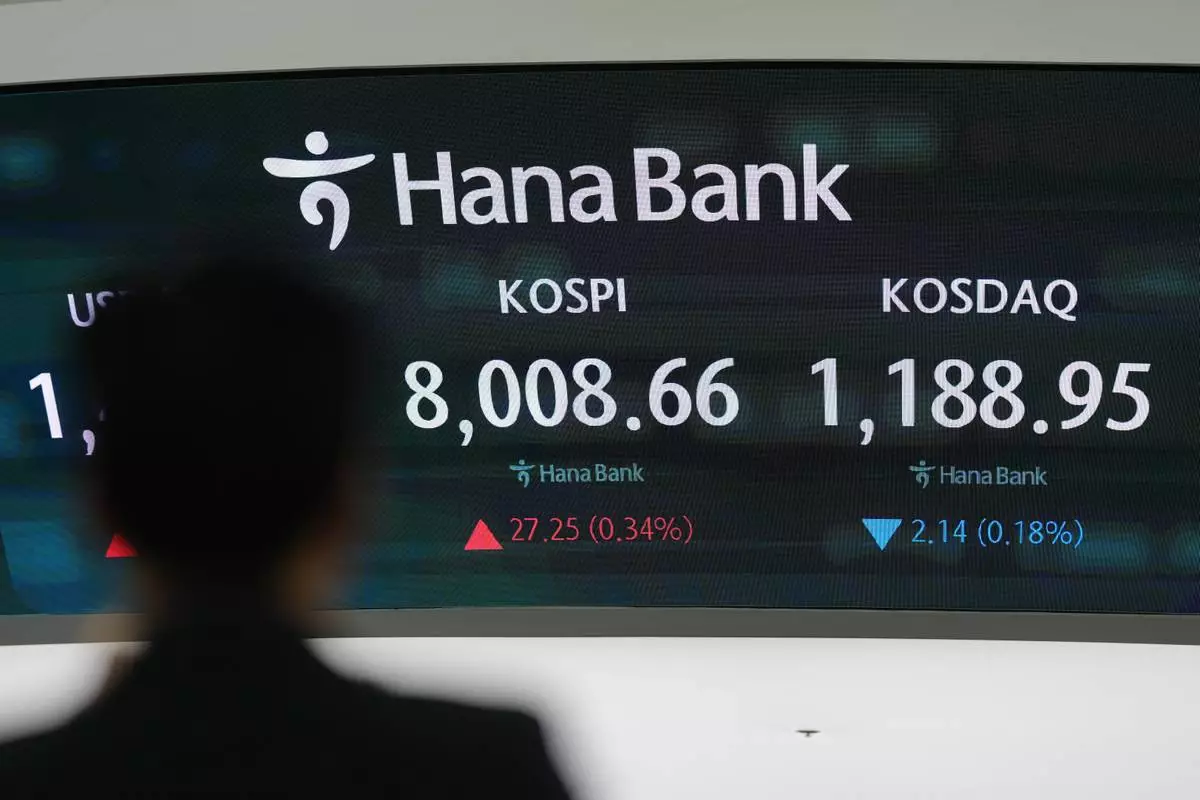
A dealer stands near the screens showing the Korea Composite Stock Price Index (KOSPI), and the Korean Securities Dealers Automated Quotations (KOSDAQ) at a dealing room of Hana Bank in Seoul, South Korea, Friday, May 15, 2026. (AP Photo/Lee Jin-man)

Employees of Hana Bank celebrate in a photo-op to mark the Korea Composite Stock Price Index (KOSPI) of over 8,000 points at a dealing room of Hana Bank in Seoul, South Korea, Friday, May 15, 2026. (AP Photo/Lee Jin-man)