DAKAR, Senegal (AP) — The Trump administration has deported 15 Latin Americans to the Democratic Republic of Congo, sending them to an unfamiliar country thousands of miles from home — many despite U.S. court orders protecting them from deportation to their homelands.
The Associated Press spoke by phone with a 29-year-old Colombian woman about her experience. She spoke on condition of anonymity for fear of reprisals.
Here are takeaways from AP's story.
All the deportees had received legal orders from U.S. judges shielding them from removal to their home countries, according to U.S. attorney Alma David, one of their lawyers. The Colombian woman was granted protection under the U.N. Convention Against Torture in May 2025, after a federal judge ruled she could not safely be returned to Colombia, where she had faced threats from armed groups and abuse by a former partner in government.
She was nonetheless detained at a routine U.S. Immigration and Customs Enforcement check-in earlier this year and told a third country had been found for her. Less than three weeks later, she was on a plane — hands and feet restrained during a nearly 24-hour charter flight. She learned she was going to Congo the day before departure.
A recent U.S. court ruling found the government likely broke the law by deporting a fellow Colombian to Congo. What that means for the others remains unclear.
The Trump administration has struck deals with at least eight African countries to accept deportees who are not their own nationals — people whose home countries won’t take them back or who have court protections preventing their return. Legal experts say the arrangements function as an effective loophole in U.S. immigration law.
The terms of Congo’s deal are unclear. Unlike other participating countries, which have received millions of dollars, Congolese President Félix Tshisekedi has called it an “act of goodwill,” with no financial compensation. The deal comes as Washington has pressured neighboring Rwanda over its support for the M23 rebel group in eastern Congo — a dynamic analysts say may help explain Kinshasa’s cooperation.
The Department of Homeland Security did not respond to questions about the Colombian woman’s case but has asserted the agreements “ensure due process under the U.S. Constitution.” The Trump administration says they are needed to “remove criminal illegal aliens.”
The International Organization for Migration, a U.N.-affiliated body, plays a central role in managing the deportees’ lives in Kinshasa. They stay in bungalows at a hotel near the airport, with costs covered by Congo’s government, according to the IOM. The gates are locked and security does not let them leave alone, the Colombian woman said.
Deportees may go out roughly once a week, accompanied by IOM staff, with about 30 minutes to shop or withdraw money. “They choose where we go and what we buy,” the woman said.
The IOM has also presented deportees with their options: return to their home countries — where many face the persecution they fled — with IOM assistance, or remain in Congo with no support. Her attorney, Alma David, called them “impossible choices,” saying the deportations violated due process rights, U.S. immigration law, and international treaty obligations.
The deportees arrived on three-month Congolese visas. What happens when those expire is unclear. They have been told they can apply for asylum in Congo — an option none have taken.
The woman says she doesn’t feel safe there. The food has made several of them sick. French and Lingala are as foreign as the surroundings. She spends most of her time in her room, making late-night calls to her 10-year-old daughter back in Colombia.
Congolese human rights groups have called the arrangement a violation of international refugee law. The Congo-based Institute for Human Rights Research described it as “arbitrary detention by proxy for the United States.”
The woman, who managed a dessert shop in Colombia before fleeing, says she committed no crime, and just fled to the United States for safety. Instead she is stranded in a country she had never heard of, with no timeline and no plan.
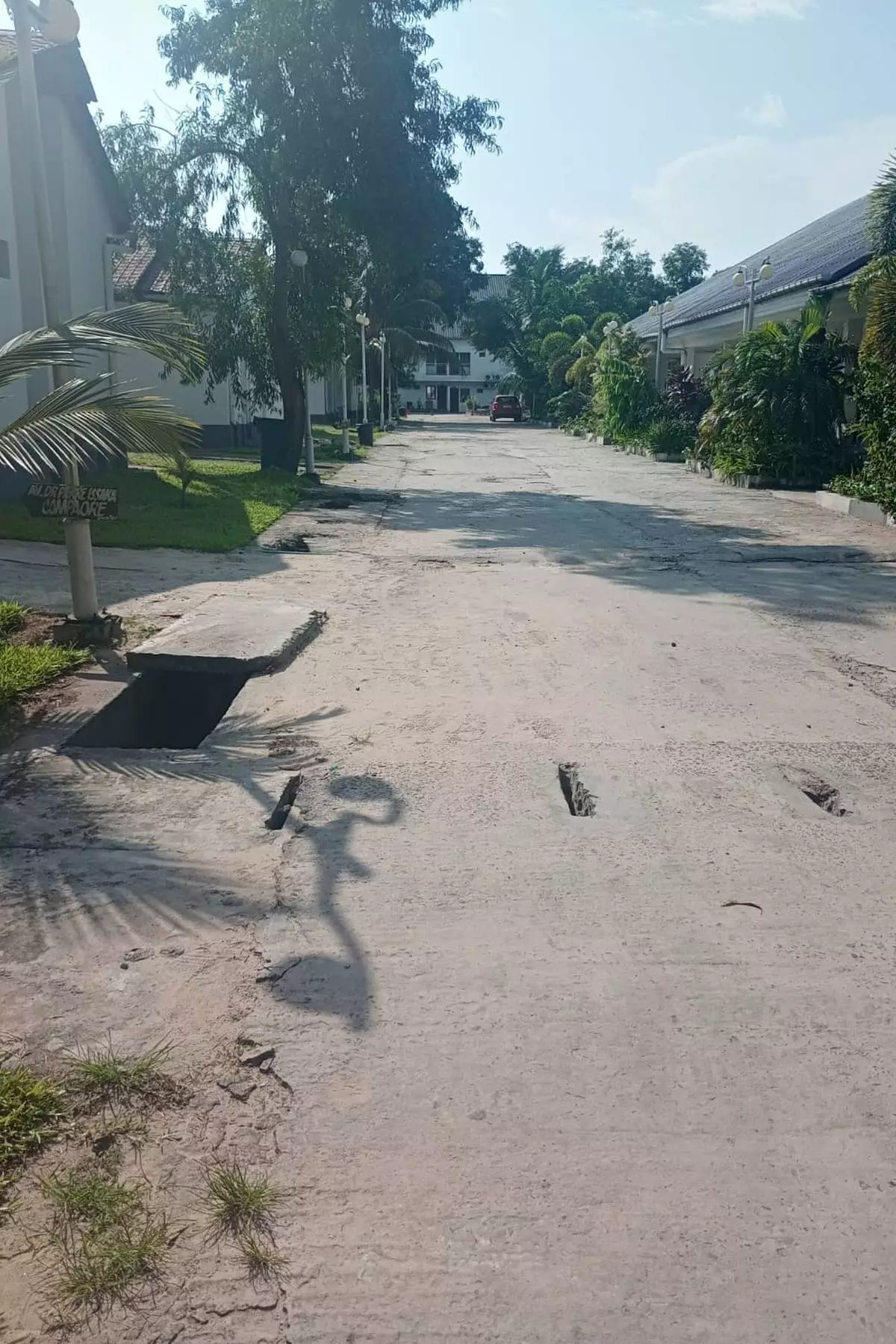
An exterior view of a hotel where a Colombian woman was deported to from the United States, in Kinshasa, Congo, Saturday, May 10, 2026. (UGC via AP)

FILE - Pedestrians slalom between traffic to cross the road in Kinshasa, Congo, Tuesday Jan. 8, 2019. (AP Photo/Jerome Delay, file)

A chair is seen outside a hotel room where a Colombian woman was deported to from the United States, in Kinshasa, Congo, Saturday, May 10, 2026. (UGC via AP)
NEW YORK (AP) — North America’s largest commuter rail system is facing a potential shutdown as a deadline nears to reach a deal with unionized workers to avert a strike.
The Long Island Rail Road that serves New York City’s eastern suburbs has been negotiating for months on a new contract with labor officials representing locomotive engineers, machinists, signalmen and other train workers.
A strike was temporarily averted in September when President Donald Trump’s administration agreed to help. Those efforts ended without a deal, giving both sides 60 days — ending 12:01 a.m. Saturday — to again try to resolve their differences before the union was legally allowed to go on strike or the agency could lock out workers.
Five labor unions representing about half the train system’s 7,000-person workforce warned this week that Saturday’s deadline was approaching.
The LIRR is the busiest commuter railroad in North America, carrying about 250,000 customers each weekday. LIRR workers last went on strike in 1994, for about two days. Workers nearly walked out in 2014 before then-Gov. Andrew Cuomo reached a deal with unions.
The Metropolitan Transportation Authority, which oversees the LIRR and other area transit systems, has said it will provide free but limited shuttle buses during the morning and afternoon rush hours. The agency says the shuttles will depart from designated LIRR train stations to subway stops in the New York City borough of Queens.
Gov. Kathy Hochul has urged LIRR riders to work from home, if possible, as the free shuttles are meant for essential workers and those who cannot telecommute. The Democrat, months earlier, slammed the LIRR unions for “greedy asks” that threaten to “destabilize the local economy.”
But there have been signs of progress in negotiations this week.
Months ago, the MTA had proposed to the unions a 9.5% wage increase over three years, in line with what the system’s other unionized workers have already agreed to. The unions, however, held out for another yearly salary increase of 6.5%, for a total raise of 16% over four years.
But following Wednesday’s closed door meetings, Gary Dellaverson, the MTA’s chief negotiator, said the agency offered the unions what it said would effectively amount to a 4.5% raise in the fourth year of the contract. That offer, he said, was in line with what federal officials had recommended and would come in the form of lump sum payments rather than wage increases, as the union sought.
“The difference between those two positions is not unbridgeable,” Dellaverson said in a news conference. “It is describable simply in terms of money. There are no longer any complexities involved with the parties.”
Kevin Sexton, a spokesperson for the unions, acknowledged Wednesday that there was “positive movement” toward a settlement but dismissed the notion that a deal was close as “far-fetched.”
“We would like to reach an agreement that reflects the rising cost of living,” he said. “Anything short of that amounts to a cut in real wages.”
Spokespersons for MTA didn’t immediately respond to emails seeking comment Thursday, but the union said the two sides were expected to continue talks later that night and reconvene Friday if there was still no deal.
Susanne Alberto, a personal trainer from Long Island, said she’s already made plans with her Manhattan clients to hold virtual sessions in the event of a shutdown.
She said the union likely has the upper hand, even if she believes raises should be based on job responsibilities and not made across the board.
“The MTA is going to cave, and they know that,” Alberto said. “Why don’t they just do it now instead of waiting until virtually millions of people get inconvenienced?”
Rob Udle, an electrician who takes the LIRR at least five days a week, said he’ll likely use his vacation days rather than navigate the “nightmare” of commuting into Manhattan if the rail service shuts down.
A union member, he sympathized with the unions’ affordability concerns, but said he didn’t agree with their strongarm tactics.
“I get it, the cost of living is going up and stuff like that,” Udle said while waiting at Penn Station for a train home. “But they shouldn’t hold everybody hostage to do it. There’s a better way. You’re affecting a lot of other people.”
The first reference to the rail system has been updated to correct to Long Island Rail Road, from Long Island Railroad.
Follow Philip Marcelo at https://x.com/philmarcelo
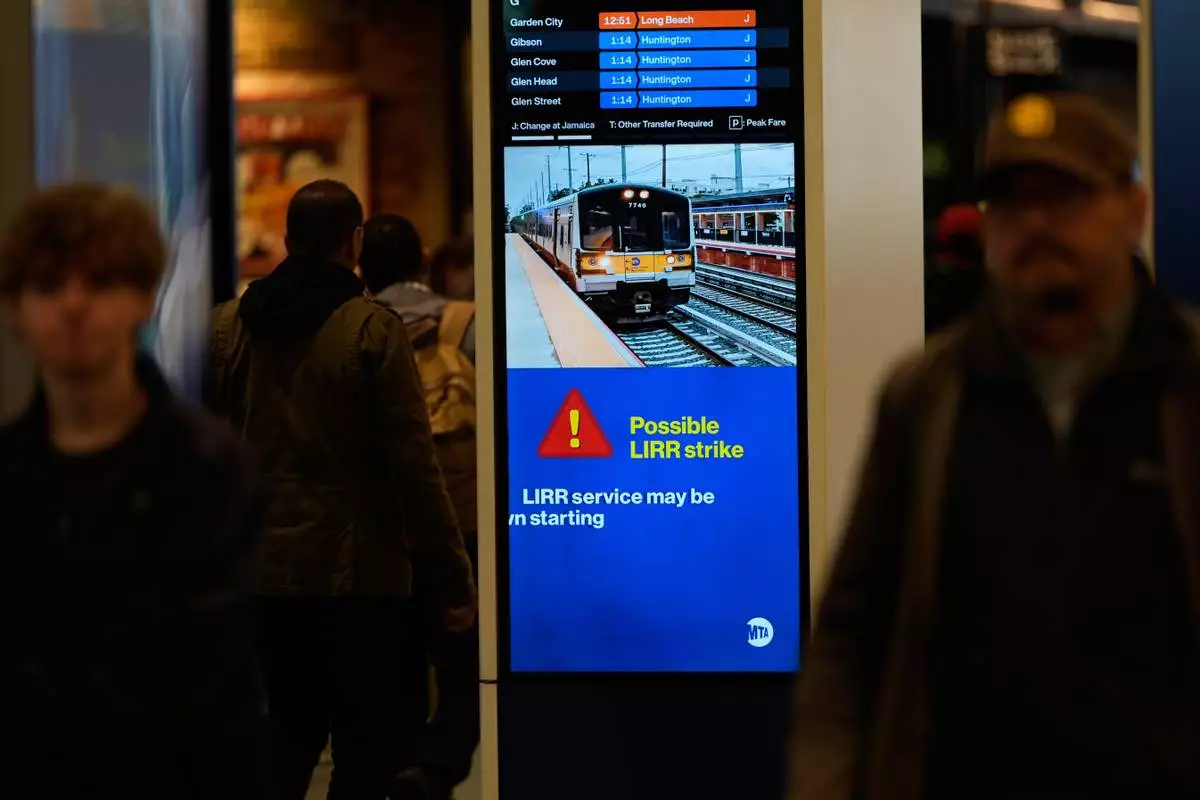
A sign warns commuters of a potential Long Island Rail Road strike at Penn Station in New York, Thursday, May 14, 2026. (AP Photo/Seth Wenig)
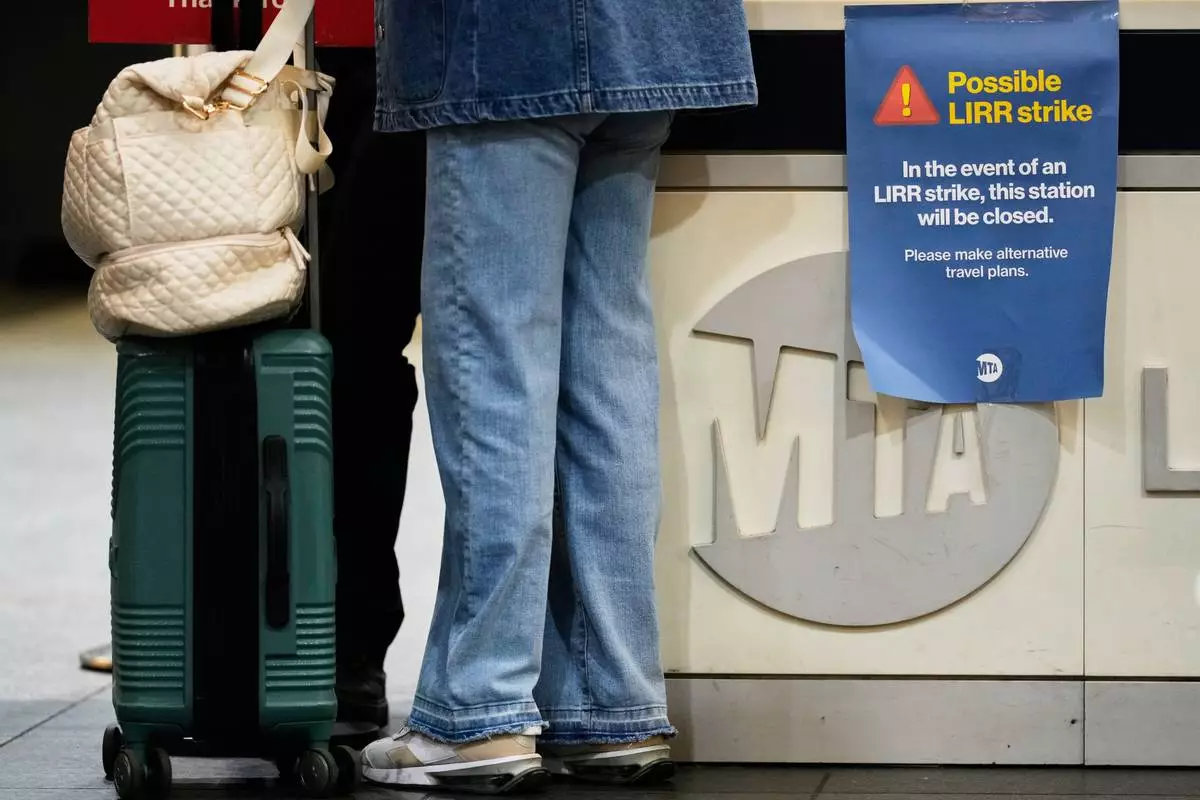
A sign warns commuters of a potential Long Island Rail Road strike at Penn Station in New York, Thursday, May 14, 2026. (AP Photo/Seth Wenig)
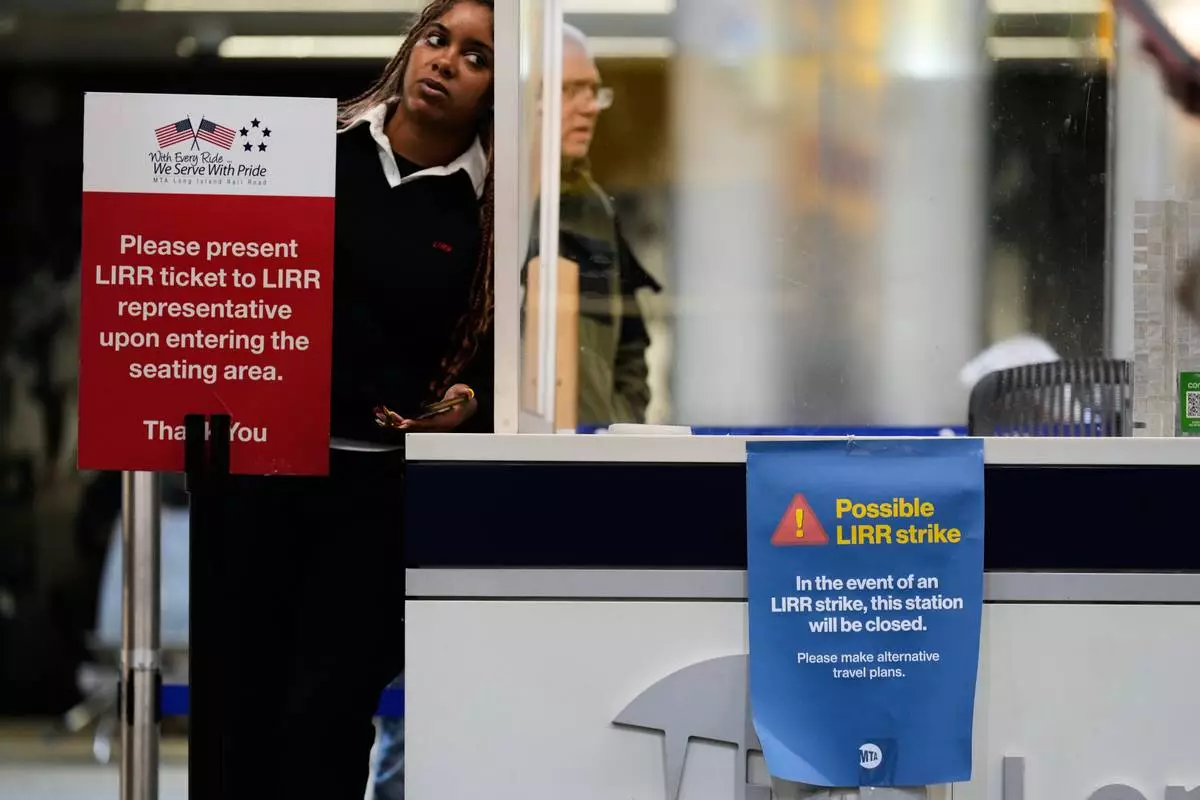
A sign warns commuters of a potential Long Island Rail Road strike at Penn Station in New York, Thursday, May 14, 2026. (AP Photo/Seth Wenig)
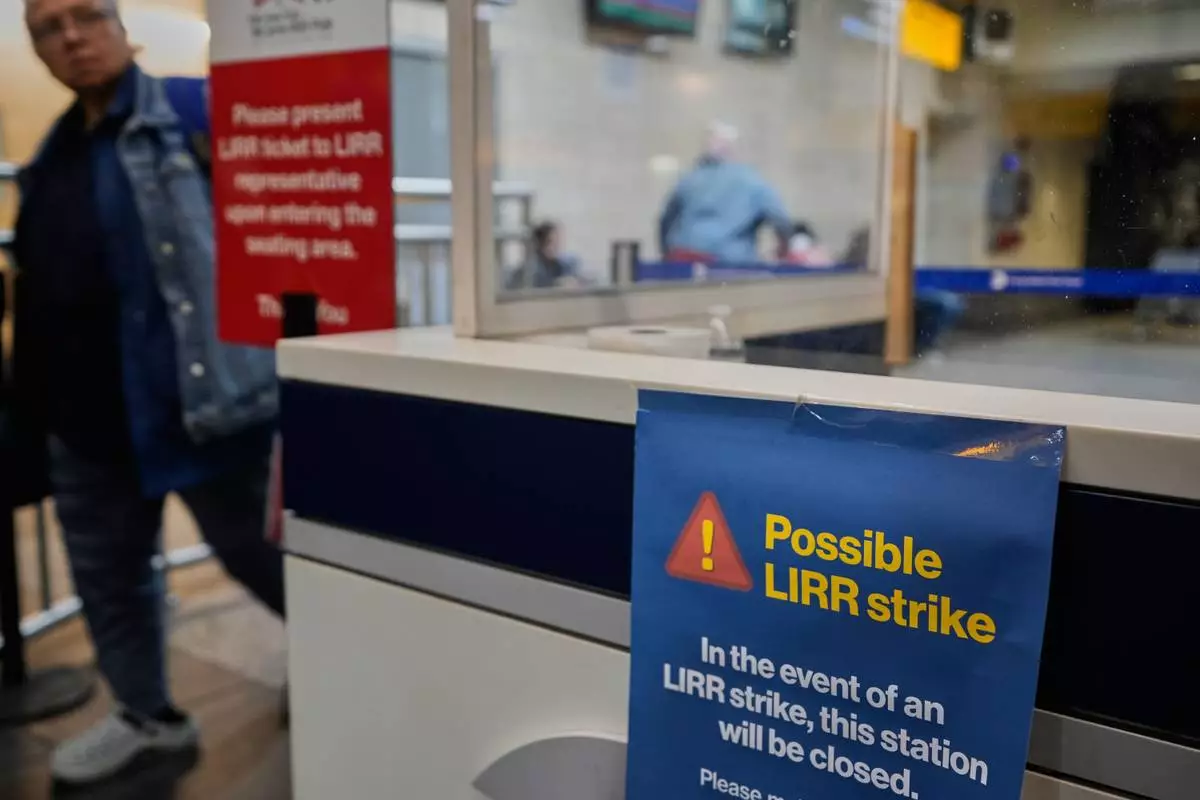
A sign warns commuters of a potential Long Island Rail Road strike at Penn Station in New York, Thursday, May 14, 2026. (AP Photo/Seth Wenig)