ANN ARBOR, Mich. (AP) — Growing up, Mikala Sposito dreamed of being a trailblazer.
“I always wanted to be the first female to do something,” she said.
Click to Gallery
Student Mikala Sposito welds at Washtenaw Community College on Friday, May 1, 2026, in Ann Arbor., Mich. (AP Photo/Mike Householder)
Student Mikala Sposito welds at Washtenaw Community College on Friday, May 1, 2026, in Ann Arbor., Mich. (AP Photo/Mike Householder)
Student Mikala Sposito welds at Washtenaw Community College on Friday, May 1, 2026, in Ann Arbor., Mich. (AP Photo/Mike Householder)
Student Mikala Sposito welds at Washtenaw Community College on Friday, May 1, 2026, in Ann Arbor., Mich. (AP Photo/Mike Householder)
That dream is about to be realized.
The 21-year-old from Dexter, Michigan, will be the first woman to represent the United States in welding at the WorldSkills Competition in China.
Sposito, a student at Washtenaw Community College, earned the coveted spot by winning the USA Weld Trials in Huntsville, Alabama, earlier this year.
“It was very, very close the whole time, but I was the one who made it to Shanghai,” Sposito said.
Described as the Olympics of the skilled trades, WorldSkills determines the globe’s best in technical disciplines that include construction, information technology, manufacturing and robotics.
And, of course, welding.
Sposito is the sixth Washtenaw Community College student to qualify in WorldSkills history. WCC has produced more WorldSkills welding alums than any other school in the United States, the Ann Arbor college said. One of them, Alex Pazkowski, who finished second in 2013, is Sposito’s instructor and mentor.
He accompanied her to the American championships in Alabama and also will be her coach at a series of competitions that will take them from Canada to Australia in the months leading up to WorldSkills in September.
Add to that 80 hours of welding practice per week at WCC, and Sposito has “a long, hard road” ahead of her, Pazkowski said.
“But at the end of the day, if you’re successful, it’s gonna open up all kinds of doors for you,” he said.
She will be evaluated on technical execution and craftsmanship under stiff time constraints and stringent international standards.
Sposito said she’s looking forward to putting up her skills against the world’s best. And traveling abroad, which she hasn’t done previously.
As for the “first” aspect, she said: “I don’t see the gender aspect of it.
“I mean, welding doesn’t take any brute strength or anything. It’s actually very fine and precise.”
But she does recognize that women are minority participants in a discipline she fell in love with at age 10. And if her world-class success joining together metals using heat and pressure helps pave the way for future welders, then all the better.
“Being the first female to do it is very cool,” said Sposito, whose near-term goal is to earn her bachelor’s degree in welding engineering at Wayne State University in Detroit. Long-term, she might like to follow in Pazkowski’s footsteps and teach at WCC.
Either way, she’s happy to be “inspirational for many women in the trades who have possibly struggled.”
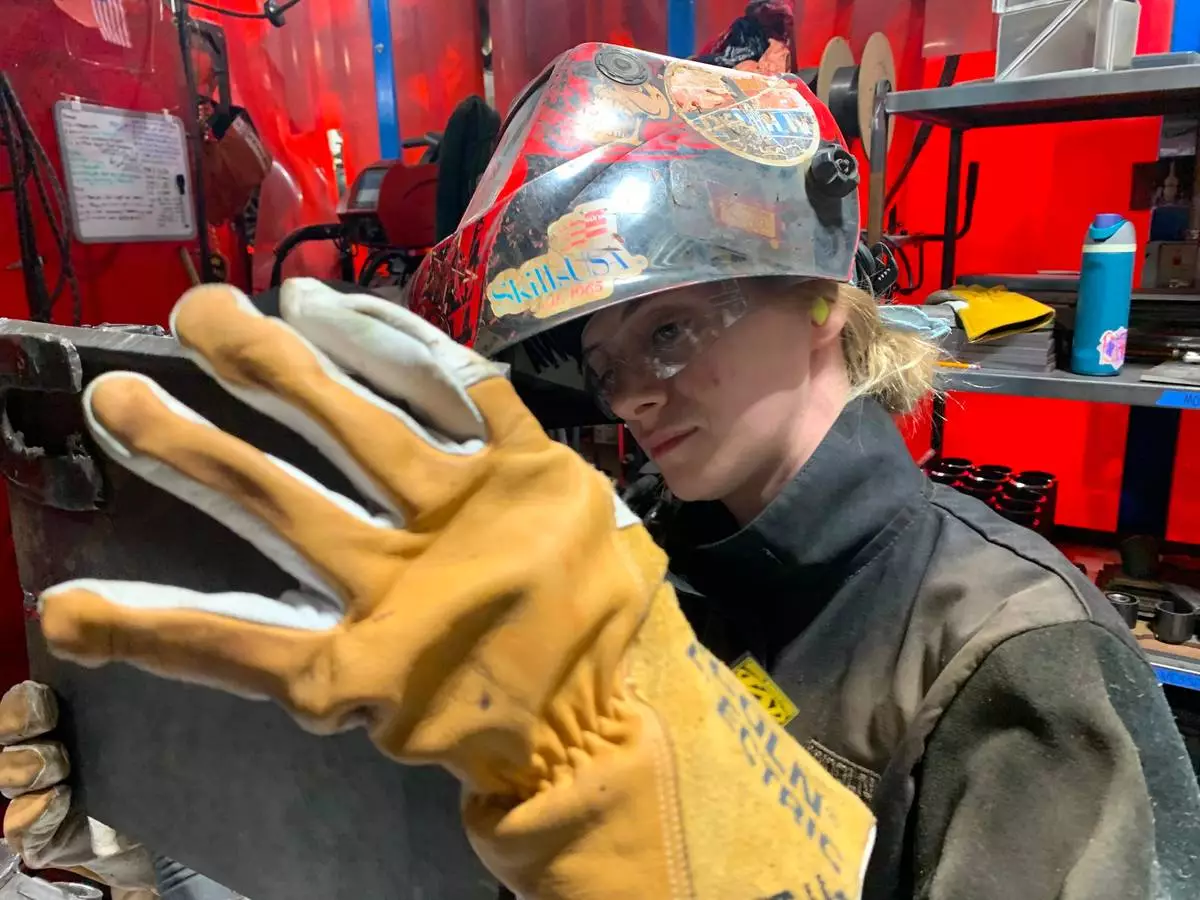
Student Mikala Sposito welds at Washtenaw Community College on Friday, May 1, 2026, in Ann Arbor., Mich. (AP Photo/Mike Householder)

Student Mikala Sposito welds at Washtenaw Community College on Friday, May 1, 2026, in Ann Arbor., Mich. (AP Photo/Mike Householder)

Student Mikala Sposito welds at Washtenaw Community College on Friday, May 1, 2026, in Ann Arbor., Mich. (AP Photo/Mike Householder)

Student Mikala Sposito welds at Washtenaw Community College on Friday, May 1, 2026, in Ann Arbor., Mich. (AP Photo/Mike Householder)
ROME (AP) — The researchers in Ireland looked at their computer screen, marveling at a medieval book tracked down in a Roman library. They flipped through its digitized pages and found their sought-after treasure: the oldest surviving English poem.
“We were extremely surprised. We were speechless. We couldn’t believe our eyes when we first saw that,” Elisabetta Magnanti, a visiting research fellow at Trinity College Dublin's school of English, told The Associated Press.
What's more, she said, the poem was within the main body of Latin text: "It was extraordinary.”
Composed in Old English by a Northumbrian agricultural worker in the 7th century, "Caedmon’s Hymn" appears within some copies of the “Ecclesiastical History of the English People,” written in Latin by a monk and saint known as the Venerable Bede. His history is one of the most widely reproduced texts from the Middle Ages, with almost 200 manuscripts, according to Magnanti's colleague Mark Faulkner, an associate professor of medieval literature at Trinity.
He considers Caedmon’s poem to be the start of English literature.
The manuscript he and Magnanti found is one of the oldest, dating from the 9th century. Two earlier copies contain the poem in Old English, but as afterthoughts — translated from Latin and scrawled into the margin by later scribes or appended but not within the text's main body, according to the researchers.
The discovery sheds light on the English language's wide diffusion, long before what was previously understood, Faulkner said in Rome, where the duo had traveled to view the text in person for the first time.
“Prior to the discovery of the Rome manuscript, the earliest one was from the early 12th century. So this is three centuries earlier than that. And so it attests to the importance that was already being attached to the English in the early 9th century,” Faulkner said.
And it's something of a miracle they uncovered it at all.
Caedmon is said to have composed the poem while working at Whitby Abbey in North Yorkshire, after guests at a feast began reciting poems, Faulkner said.
“Embarrassed that he didn’t know anything suitable, Caedmon left the feast and went to bed," he said. "A figure then appeared to him in his dreams telling him to sing about creation, which Caedmon miraculously did, producing the nine-line hymn."
Some 1,400 years later, this copy of his poem resurfaced in Rome’s main public library — but not before crossing the Atlantic Ocean at least twice and changing hands even more times.
Monks transcribed this copy of Bede's history in the scriptorium of the Benedictine abbey of Nonantola, one of the most important transcription centers during the Middle Ages, located near modern-day Modena in northern Italy, according to Valentina Longo, curator of medieval and modern manuscripts at Rome's National Central Library.
In the 17th century, as the abbey's importance declined, its vast collection of manuscripts was shifted to another abbey in Rome, then moved to the Vatican and finally on to a small church.
Along the way, some of the texts went missing, only to emerge in the early 19th century in the possession of famous international collectors, Longo said.
This copy of Bede's history went to renowned English antiquarian Thomas Phillipps. He fell on hard times, selling off bits and pieces of his collection, and Swiss bibliophile Martin Bodmer secured the book. From there, somehow, it arrived in New York City, in the trove of Austrian-born rare bookseller H.P. Kraus during the 20th century.
Italy's culture ministry was scouring the world for the Nonantola abbey's missing manuscripts, snapping them up in auctions and from collectors around the world. It bought the copy of Bede's history from Kraus in 1972, Longo said, and since then the illustrious text has remained in Rome's library — but received scant notice.
Enter Magnanti, who had spent over four years studying Bede’s history and was compiling a catalog of extant copies.
“I knew that the book was listed in the library’s catalog, so I was almost certain that the book was, in fact, still here," she said. “I realized that, because of the very complex history of this book, no big scholar had really looked at it. So it had been virtually unstudied."
She emailed the library, which confirmed the book was in its stacks. Three months later, she received digital images of the entire manuscript.
Nupue.
sciulun. herga. hefunricaes. puard. metudaes. maechti. and his.
mod geðanc. puerc. puldur. fadur. suæhepundragiaes
ecidrichtin or astalde. he aeristscoop eor dubearnū hefento
hrofe halig. sceppend. ða. middū. geard. moncinnes peard eci
drichtin. aefter. tia de. firū. on foldu. frea. allmechtig.
Now we must praise the guardian of the heavenly kingdom,
the might of the creator and his intention,
the work of the father of glory, in that he of each wonder,
eternal lord, established the beginning.
He first created the earth for men,
heaven as a roof, the holy creator,
then the middle earth, the guardian of mankind,
the eternal lord, afterwards created
for men on earth, the almighty lord.
The library has digitized the entire Nonantolan collection and it is freely accessible through the website, Longo said.
It's part of a massive project by the library to make thousands of rare books and manuscripts available to researchers around the world, according to Andrea Cappa, the library's head of manuscripts and the rare books reading room.
“The discovery made by the experts of Trinity College is just one starting point, a single manuscript that might pave the way for countless other discoveries, in countless other fields, through international cooperation like this,” Cappa said.
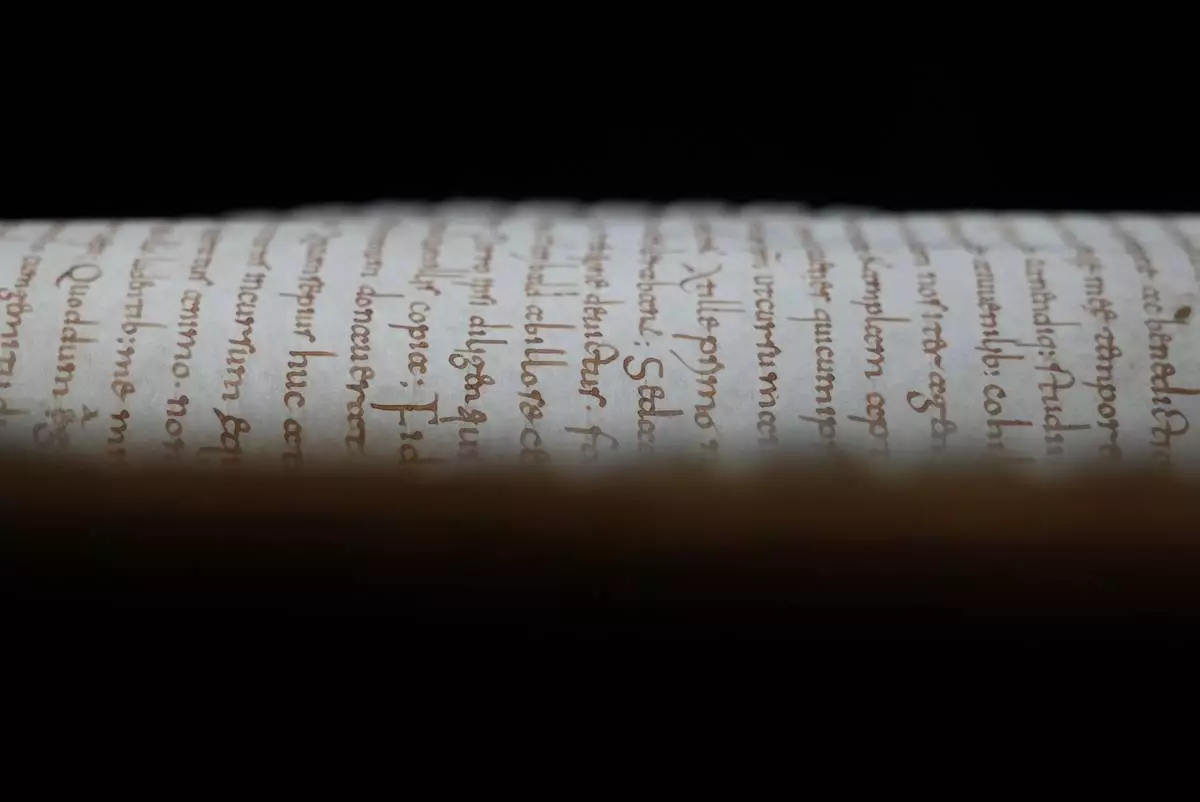
The 8th-century manuscript copy of the Venerable Bede's Ecclesiastical History of the English People, containing a rare, long-lost copy of Caedmon's Hymn — the first poem ever written down in Old English — is seen at Rome's National Library, Thursday, May 8, 2026. (AP Photo/Andrea Rosa)
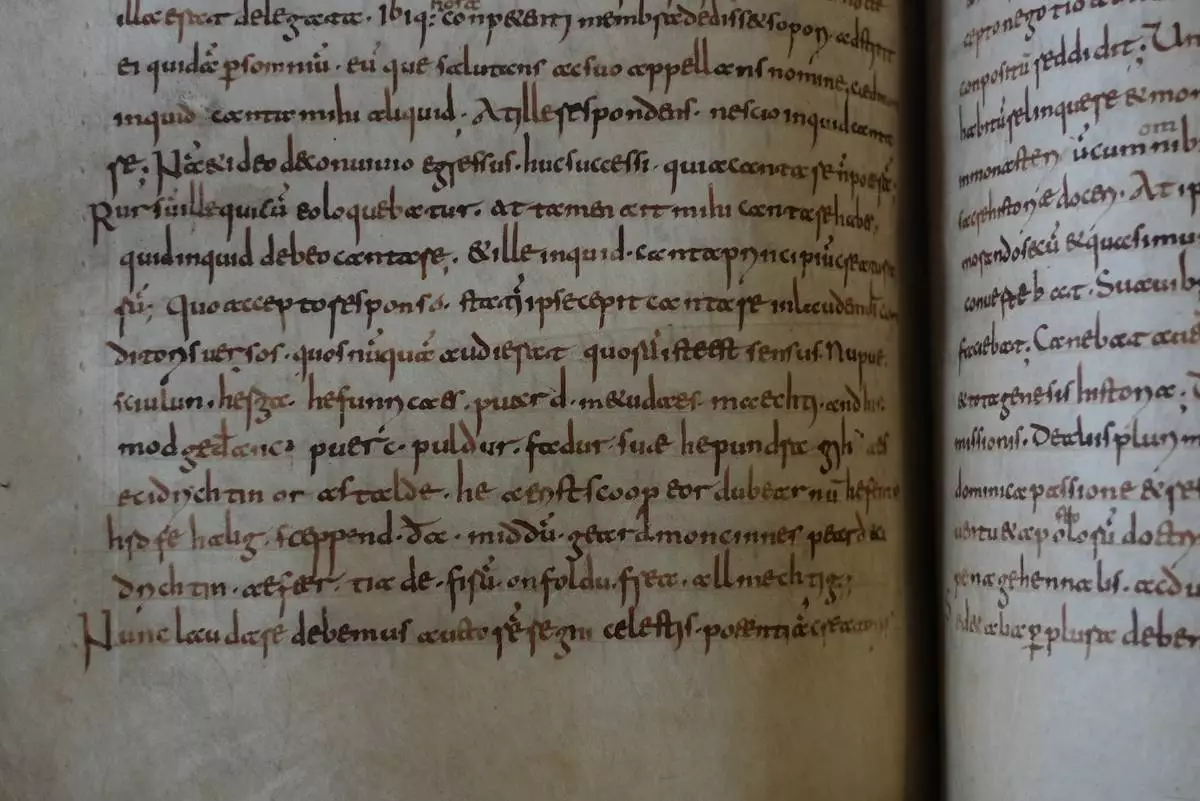
A rare, long-lost copy of Caedmon's Hymn — the first poem ever written down in Old English — is visible in the five lines above the final line of a page from an 8th-century manuscript copy of the Venerable Bede's Ecclesiastical History of the English People, at Rome's National Library, Thursday, May 8, 2026. (AP Photo/Andrea Rosa)
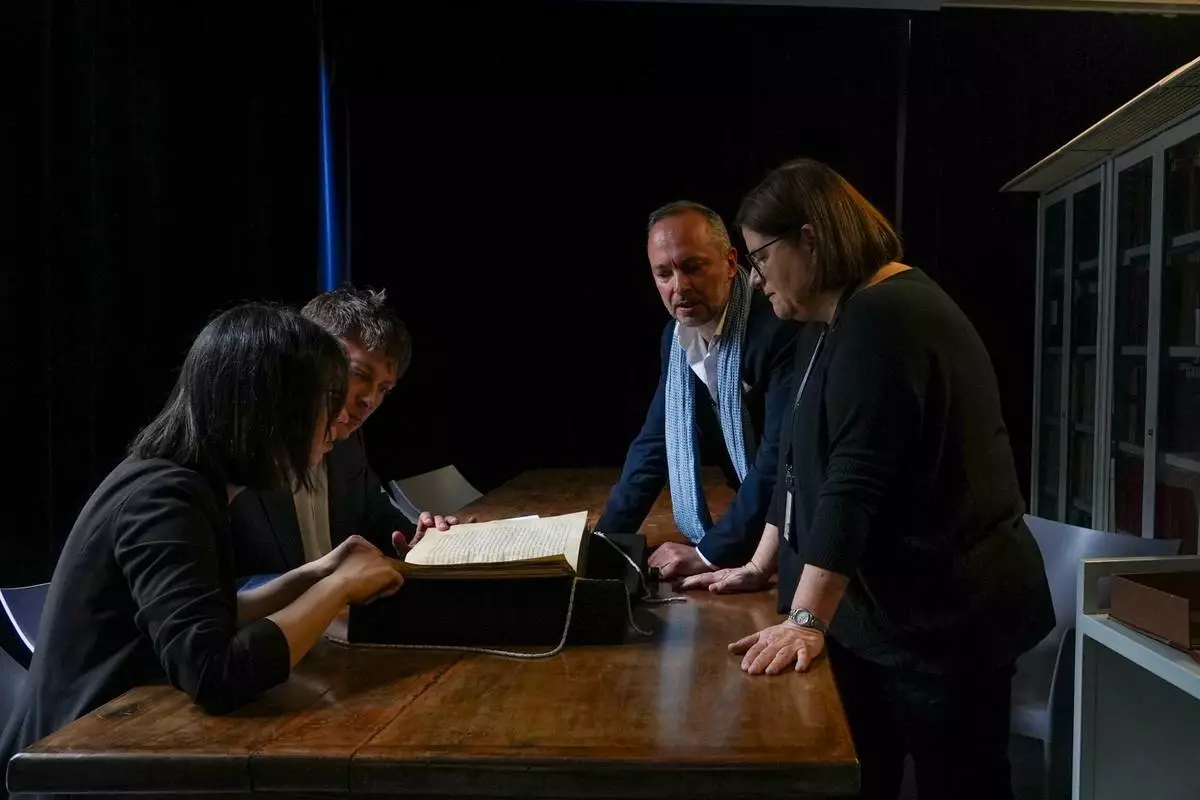
From left, Elisabetta Magnanti, Mark Faulkner of Dublin's Trinity College, Andrea Cappa and Valentina Longo of Rome's National Central Library examine a manuscript containing a rare, long-lost copy of Caedmon's Hymn — the first poem ever written down in Old English — at Rome's National Library, Thursday, May 8, 2026. (AP Photo/Andrea Rosa)
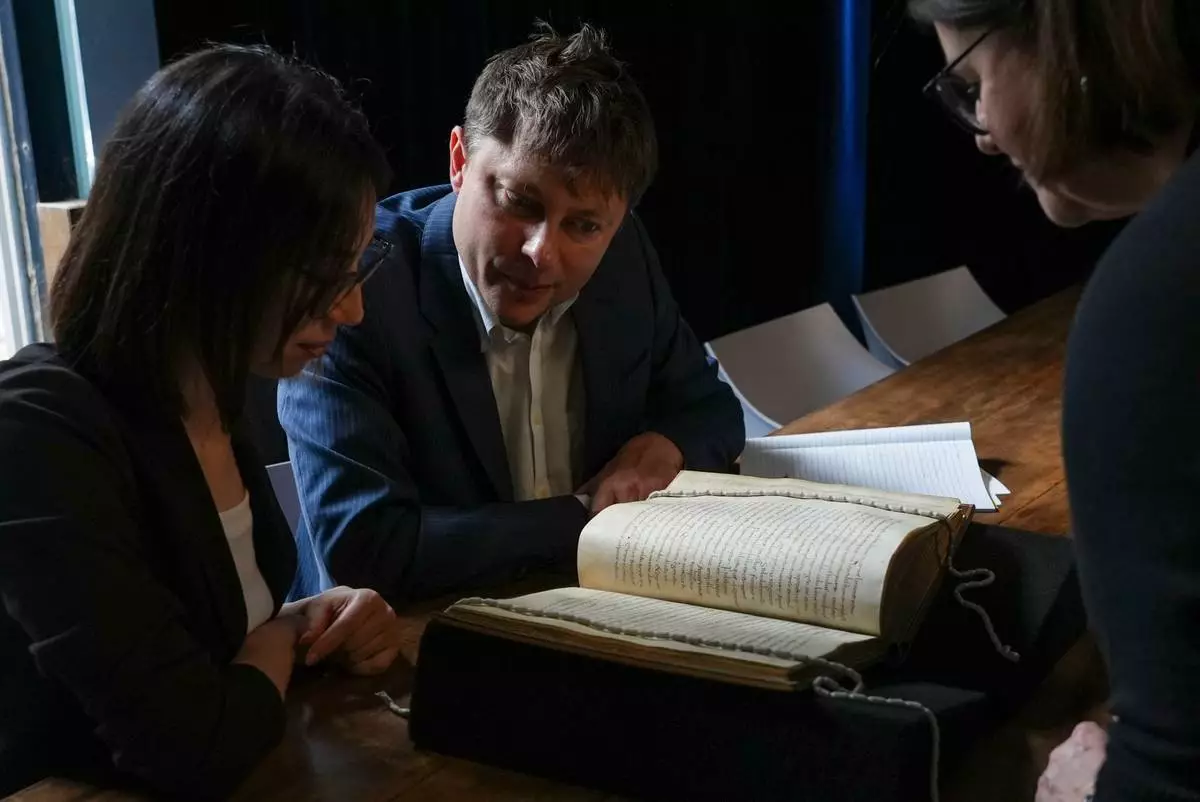
From left, Elisabetta Magnanti and Mark Faulkner from Dublin's Trinity College and Valentina Longo of Rome's National Central Library look at a manuscript containing a rare, long-lost copy of Caedmon's Hymn, the first poem ever to be written down in Old English, at Rome's National Library, Thursday, May 8, 2026. (AP Photo/Andrea Rosa)
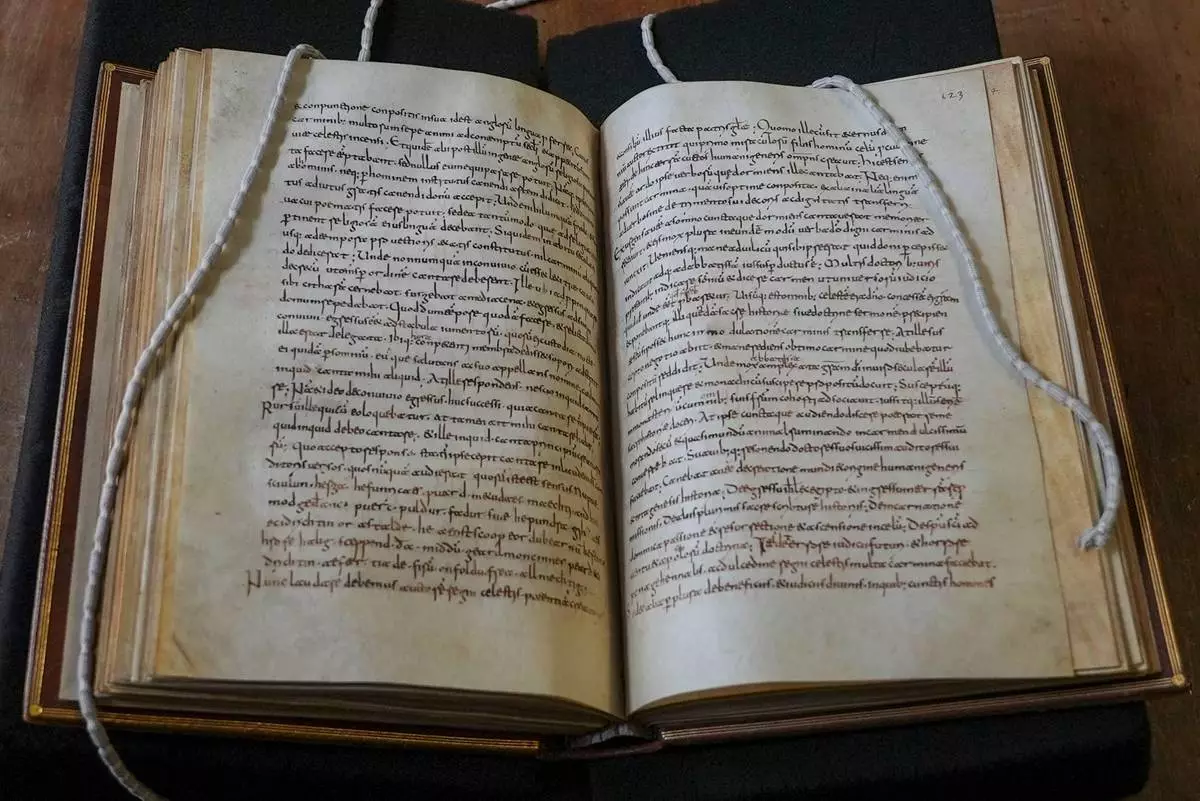
A rare, long-lost copy of Caedmon's Hymn — the first poem ever written down in Old English — is visible in the five lines above the final line of the left page from an 8th-century manuscript copy of the Venerable Bede's Ecclesiastical History of the English People, at Rome's National Library, Thursday, May 8, 2026. (AP Photo/Andrea Rosa)null