Skip to Content Facebook Feature Image

What to know about Trump’s nearly $1.8B fund to compensate allies claiming political targeting

News

What to know about Trump’s nearly $1.8B fund to compensate allies claiming political targeting
News

News

What to know about Trump’s nearly $1.8B fund to compensate allies claiming political targeting

2026-05-19 08:52 Last Updated At:13:12

WASHINGTON (AP) — President Donald Trump 's allies who believe they have been wrongly investigated and prosecuted could soon have access to a nearly $1.8 billion compensation fund, the Justice Department announced Monday in a move slammed by Democrats as unconstitutional and corrupt.

Acting Attorney General Todd Blanche said in a statement that the “Anti-Weaponization Fund" will represent “a lawful process for victims of lawfare and weaponization to be heard and seek redress.” Blanche's statement made no mention of how investigations and prosecutions of Trump’s political opponents under his watch have exposed the Justice Department to the same claims of politicized law enforcement that he has said he opposed.

The fund was announced as part of a deal to resolve Trump’s $10 billion lawsuit against the Internal Revenue Service over the leak of his tax returns.

The fund is in keeping with Trump's long-running claims that the Justice Department during the Biden administration was weaponized against him, even though then-President Joe Biden himself was scrutinized during that time. The fund would represent not only a highly unorthodox resolution but also a further demonstration of the Trump administration’s eagerness to reward allies who were investigated and in some cases charged and convicted.

Trump told reporters at the White House on Monday the fund is dedicated to “reimbursing people who were horribly treated.”

Democratic lawmakers opposed to the move argue that it will become a taxpayer-funded “slush fund” for Trump allies and supporters who claim political persecution. They also question whether the president should be able to direct money for the fund without explicit congressional approval.

Here's what to know about the fund:

The fund was announced after Trump, his sons Eric Trump and Donald Trump Jr., and the Trump Organization agreed to drop their lawsuit against the IRS and the Treasury Department. The lawsuit alleged that a leak of confidential tax records caused them reputational and financial harm and negatively affected their public standing, among other allegations.

According to the Justice Department announcement, the fund is meant to provide a formal process for people or entities who say they were unfairly targeted by the government for political, ideological or personal reasons.

“The use of government power to target individuals or entities for improper and unlawful political, personal, or ideological reasons should not be tolerated by any administration,” Justice Department official Trent McCotter said in the statement announcing the fund.

The money itself would come from the federal judgment fund, which pays out court judgments and compromise settlements of lawsuits against the government.

The fund will be able to review claims of alleged government political targeting, issue formal apologies and award monetary compensation to approved applicants, the Justice Department said.

The claims of a weaponized Justice Department during the Biden administration overlook the fact that Biden himself was investigated for the potential mishandling of classified information, and his son Hunter was charged with gun and tax crimes.

The Justice Department did not identify anyone by name who could theoretically benefit from the fund, but there were multiple investigations of Trump allies during the Biden administration where targets could look to obtain payouts.

Prosecutors, for instance, charged about 1,500 people in connection with the Jan. 6, 2021, riot at the U.S. Capitol. Trump on his first day in office of his second term either pardoned them, commuted their prison sentences or dismissed the cases.

It’s unclear whether those entitled to compensation would include Jan. 6 defendants who were convicted of attacking officers with makeshift weapons such as flagpoles, a hockey stick and crutch. More than 250 people were convicted of assault charges, with the attacks in many cases captured on surveillance or body camera footage.

Asked Monday if individuals who committed violence that day should receive compensation from the fund, Trump said, “It’ll all be dependent on a committee." He added: “I didn’t do this deal. It was told to me yesterday.”

Other prominent Trump supporters who were investigated and charged include Steve Bannon, who served a prison sentence for defying a congressional subpoena, and Peter Navarro, who was similarly convicted of contempt. Both have denied wrongdoing.

The Justice Department says the fund will receive $1.776 billion from the federal judgment fund, to operate through Dec. 15, 2028, and will be overseen by a five-member commission appointed by Blanche, with one member chosen in consultation with congressional leadership. According to the Justice Department, the president can remove any member.

It was unclear how the commission would determine who should be awarded compensation.

Democratic lawmakers and ethics watchdogs slammed the creation of the fund, saying it was corrupt, opaque and had the potential to become a “slush fund” for the president and his allies.

A group of nearly 100 members of Congress filed a brief teeing up a legal challenge to the case.

“This case is nothing but a racket designed to take $1.7 billion of taxpayer dollars out of the Treasury and pour it into a huge slush fund for Trump at DOJ to hand out to his private militia of insurrectionists, rioters, and white supremacists, including those who brutally beat police officers on January 6, 2021, and sycophant accomplices to his election stealing schemes,” Rep. Jamie Raskin, the top Democrat on the House Judiciary Committee, said in a statement.

Sen. Elizabeth Warren, D-Mass., called the fund "corruption on steroids.”

Last month, she and a group of other Democratic lawmakers introduced the Ban Presidential Plunder of Taxpayer Funds Act, which would ban the sitting president and vice president from collecting settlement payments from the U.S., among other things.

Associated Press writer Alanna Durkin Richer contributed to this report.
President Donald Trump listens during an event about prescription drug prices in the South Court Auditorium in the Eisenhower Executive Office Building on the White House campus, Monday, May 18, 2026, in Washington. (AP Photo/Julia Demaree Nikhinson)

President Donald Trump listens during an event about prescription drug prices in the South Court Auditorium in the Eisenhower Executive Office Building on the White House campus, Monday, May 18, 2026, in Washington. (AP Photo/Julia Demaree Nikhinson)

President Donald Trump speaks about prescription drug prices in the South Court Auditorium in the Eisenhower Executive Office Building on the White House campus, Monday, May 18, 2026, in Washington. (AP Photo/Julia Demaree Nikhinson)

President Donald Trump speaks about prescription drug prices in the South Court Auditorium in the Eisenhower Executive Office Building on the White House campus, Monday, May 18, 2026, in Washington. (AP Photo/Julia Demaree Nikhinson)

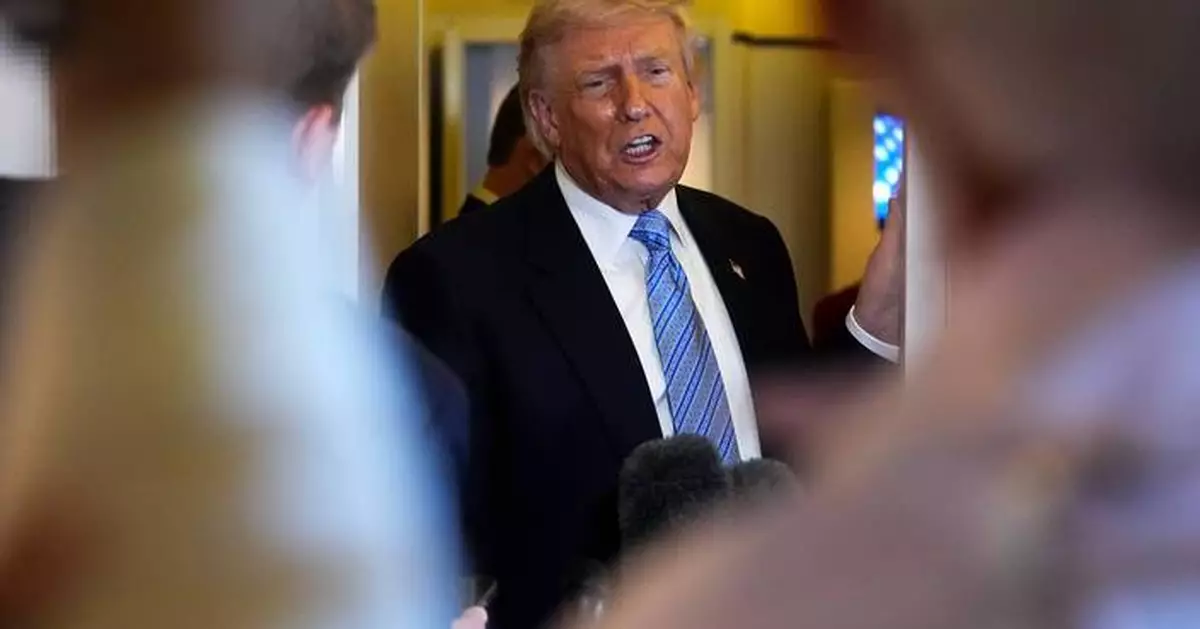
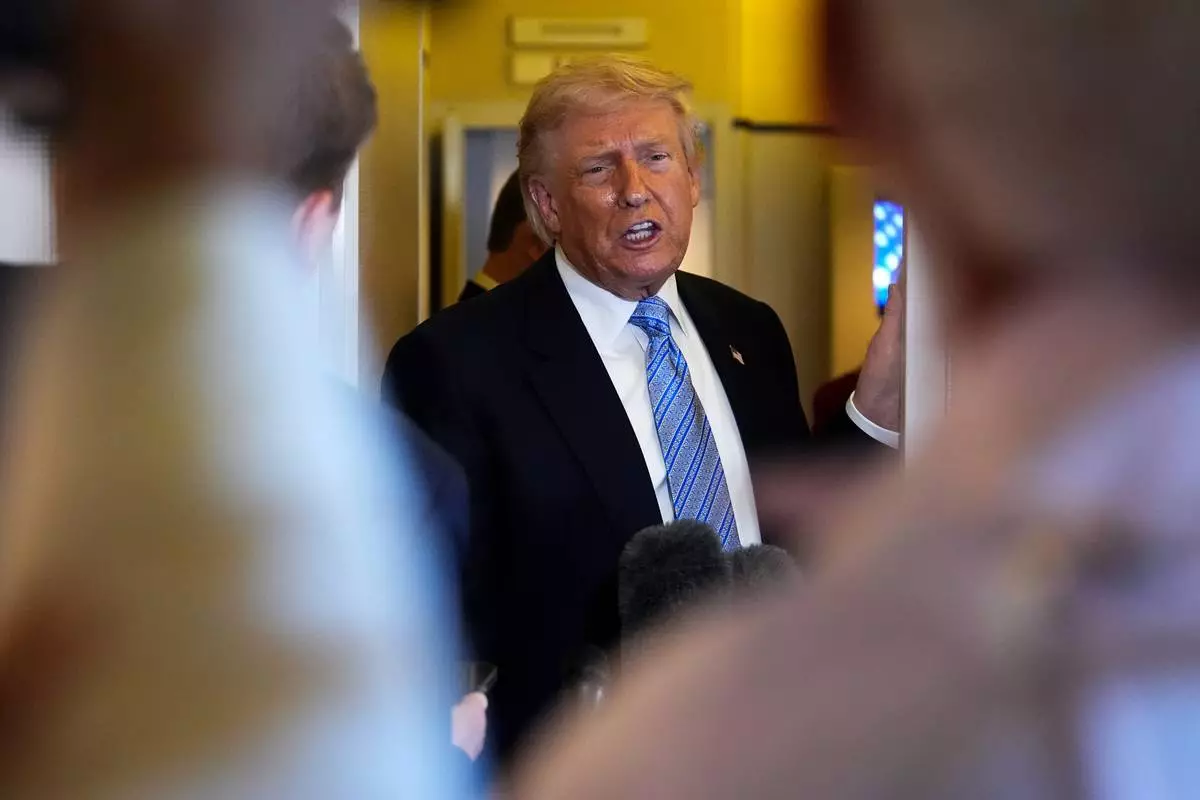
President Donald Trump speaks to reporters aboard Air Force One, Friday, May 15, 2026, as he returns from a trip to Beijing, China. (AP Photo/Mark Schiefelbein)

President Donald Trump speaks to reporters aboard Air Force One, Friday, May 15, 2026, as he returns from a trip to Beijing, China. (AP Photo/Mark Schiefelbein)
MADRID (AP) — More than a million people poured into a central Madrid plaza on Sunday for Pope Leo XIV ’s main Mass and a procession highlighting one of the most iconic expressions of Spanish popular piety: flower carpets.

They cheered and shouted “This is the youth of the pope!” as Leo arrived for the Mass, looping around the plaza and surrounding streets in his popemobile to a crowd packed several rows deep behind barricades.

Sunday’s Mass falls on the Catholic Corpus Domini feast day, which often features processions of faithful through towns and cities led by a priest carrying the Eucharist. In Spain as in other predominantly Catholic countries, the processions often feature elaborate floral carpets arranged along the route.

Leo, who arrived in Spain on Saturday at the start of his weeklong visit, has been keen to highlight the long tradition of Catholic devotion here to encourage especially young generations to find their faith.

At a vigil service Saturday night, an estimated 600,000 young Spaniards knelt for several minutes in silent prayer alongside Leo, suggesting that there is indeed interest among young people despite Spain’s heavily secularized society.

“Let me take the opportunity to tell all of you: Don't ever be afraid of thinking about a vocation to the priesthood or religious life, or other services in the church!” Leo told the crowd.

Irati Valda and Javier Hormazal, a young couple, held up a cardboard sign announcing they are going to get married on June 13 and were ushered up close to receive Leo's blessing during the vigil.

“To see so many young people together, it's incredible. Half a million people in silence, this is something you will only live once," Valda said.

For Sunday's Mass and procession, local organizers said 1.2 million people had turned out on a brilliant spring morning at the central Plaza Cibeles and surrounding streets, with more trying to get in.

The tradition of laying flower carpets — and destroying them when the procession tramples them — dates back two centuries and is popular also in Latin America, where elaborate sand designs are also made. The painstaking displays are considered an offering to the Eucharist.

Poland has already had its tradition of Corpus Domini flower carpets recognized by UNESCO, and Spain's Galicia region is trying to have its tradition listed along with other countries as part of the world’s intangible cultural heritage.

According to Spanish organizers, the 16 flower carpets decorating the half-kilometer (mile) procession route were prepared by a Spanish florists association from Galicia. Florists used more than 30,000 flowers, most the yellow and white colors of the Holy See flag, for the carpets that feature decorations such as the Holy See keys.

Wildly popular religious processions, pilgrimages and feasts continue to be held in most Spanish regions. The most recognizable are Holy Week processions during the final week of Lent where brotherhoods and robed penitents parade ornate statues of Christ and the Virgin Mary through cities, towns and villages alongside marching bands. Such processions draw the faithful as well as droves of non-believers and tourists.

Spanish towns and cities also regularly honor local patron saints with fiestas. Religious pilgrimages to local shrines mix piety with communal festivities and music. In Andalusia, the El Rocío pilgrimage fetches a million people that make a long, dusty journey over the Pentecost weekend on horseback and decorated covered wagons to venerate an icon of the Virgin Mary.

Leo arrived in Spain on Saturday and urged its people to put an end to polarization and work for unity. Later Sunday he is to meet privately with members of his Augustinian religious order and address cultural leaders.

AP visual journalist Helena Alves contributed.

Associated Press religion coverage receives support through the AP’s collaboration with The Conversation US, with funding from Lilly Endowment Inc. The AP is solely responsible for this content.

Pope Leo XIV arrives in the popemobile at Plaza de Lima in Madrid, Saturday, June 6, 2026, for a prayer vigil with young people on the first day of a seven-day apostolic journey to mainland Spain and the Canary Islands. (AP Photo/Bernat Armangue)

Pope Leo XIV arrives in the popemobile at Plaza de Lima in Madrid, Saturday, June 6, 2026, for a prayer vigil with young people on the first day of a seven-day apostolic journey to mainland Spain and the Canary Islands. (AP Photo/Bernat Armangue)

Pope Leo XIV is welcomed by Spain's King Felipe VI and Queen Letizia, as he arrives at the Royal Palace in Madrid, Saturday, June 6, 2026, on the first day of his seven-day apostolic journey to mainland Spain and the Canary Islands. (AP Photo/Alessandra Tarantino)

Pope Leo XIV is welcomed by Spain's King Felipe VI and Queen Letizia, as he arrives at the Royal Palace in Madrid, Saturday, June 6, 2026, on the first day of his seven-day apostolic journey to mainland Spain and the Canary Islands. (AP Photo/Alessandra Tarantino)

People wait for the arrival of Pope Leo XIV ahead of a Holy Mass and Corpus Christi procession at Plaza de Cibeles in Madrid, Spain, Sunday, June 7, 2026, on the second day of his seven-day apostolic visit to mainland Spain and the Canary Islands. (AP Photo/Andrea Comas)

People wait for the arrival of Pope Leo XIV ahead of a Holy Mass and Corpus Christi procession at Plaza de Cibeles in Madrid, Spain, Sunday, June 7, 2026, on the second day of his seven-day apostolic visit to mainland Spain and the Canary Islands. (AP Photo/Andrea Comas)

People wait for the arrival of Pope Leo XIV ahead of a Holy Mass and Corpus Christi procession at Plaza de Cibeles in Madrid, Spain, Sunday, June 7, 2026, on the second day of his seven-day apostolic visit to mainland Spain and the Canary Islands. (AP Photo/Andrea Comas)

People wait for the arrival of Pope Leo XIV ahead of a Holy Mass and Corpus Christi procession at Plaza de Cibeles in Madrid, Spain, Sunday, June 7, 2026, on the second day of his seven-day apostolic visit to mainland Spain and the Canary Islands. (AP Photo/Andrea Comas)

People wait for the arrival of Pope Leo XIV ahead of a Holy Mass and Corpus Christi procession at Plaza de Cibeles in Madrid, Spain, Sunday, June 7, 2026, on the second day of his seven-day apostolic visit to mainland Spain and the Canary Islands. (AP Photo/Manu Fernandez)

People wait for the arrival of Pope Leo XIV ahead of a Holy Mass and Corpus Christi procession at Plaza de Cibeles in Madrid, Spain, Sunday, June 7, 2026, on the second day of his seven-day apostolic visit to mainland Spain and the Canary Islands. (AP Photo/Manu Fernandez)

Recommended Articles