Skip to Content Facebook Feature Image

NTSB opens hearings on why UPS cargo plane engine fell off, causing deadly crash

News

NTSB opens hearings on why UPS cargo plane engine fell off, causing deadly crash
News

News

NTSB opens hearings on why UPS cargo plane engine fell off, causing deadly crash

2026-05-19 21:25 Last Updated At:21:30

Federal safety investigators opened two days of hearings Tuesday to examine why the engine flew off a UPS cargo plane last year, causing a crash that killed 15 people, and why Boeing didn’t address an underlying flaw sooner.

The engine separated from the MD-11's wing as it accelerated down the runway Louisville’s Muhammad Ali International Airport in November. The crash killed three pilots on the plane and 12 people on the ground. More were injured.

“Please know: Your loved ones are the reason we’re here. We want to find out what happened,” Jennifer Homendy, chair of the National Transportation Safety Board, said as she addressed families during her opening remarks.

The hearings, which involve NTSB staff, Boeing, UPS, labor unions and other parties, will stretch into Wednesday. The NTSB's final report likely won’t be ready until more than a year after the crash because it will look at every potential factor.

Here's what you should know:

The UPS plane, which was headed for Hawaii loaded with packages and fuel, had barely left the ground and cleared the airport fence when it crashed into several nearby Louisville businesses and created a massive fireball.

Dramatic photos the NTSB released after the crash showed the engine detaching and flying up and over the wing as flames erupted on the wing. The final images show the plane ablaze as it briefly gets airborne, leaving behind trails of smoke.

All MD-11s and DC-10s, a predecessor aircraft, were grounded after the crash. NTSB investigators said Tuesday that similar part flaws were found in three other UPS planes and a DC-10.

The Louisville disaster was reminiscent of a 1979 crash in Chicago involving a DC-10. The left engine also fell off in that crash, which killed 273 people and led to the worldwide grounding of 274 DC-10s.

The airliner returned to the skies because the NTSB determined that maintenance workers had damaged the plane that crashed while improperly using a forklift to reattach the engine. That meant the crash wasn’t caused by a fatal design flaw even though there had already been a number of accidents involving DC-10s.

But even at that point, the plane's manufacturer, McDonnell Douglas, raised concerns about the spherical bearing that helps hold the engines to the wings. McDonnell Douglas later merged with Boeing.

The NTSB said shortly after the Louisville crash that investigators had found cracks in some of the parts that held the engine to the wing. Those cracks hadn’t been caught in regular maintenance done on the plane, which raised questions about the adequacy of the maintenance schedule. The last time those key engine mount parts were examined closely was in October 2021, and the plane wasn’t due for another detailed inspection for roughly 7,000 more takeoffs and landings.

Boeing had documented in 2011 there were four previous failures on three different planes of a part that helps secure the MD-11’s engines to the wings, but at that point the plane manufacturer “determined it would not result in a safety of flight condition.”

The service bulletin that Boeing issued didn’t require plane owners to make repairs like an FAA airworthiness directive would, and the agency didn’t issue such a directive. At that point, Boeing just recommended replacing the bearings with a redesigned part that was less likely to fail.

Some MD-11s, a workhorse of the cargo fleet, are now back in the air after the FAA approved Boeing's plan to replace the spherical bearing on each aircraft and increase inspections.

FedEx resumed using the planes to deliver packages on May 10, but UPS has said it plans to retire its fleet of MD-11s. Western Global also uses MD-11s but hasn’t said what it plans to do.

Some experts speculated after the crash that the MD-11s might never fly again if the repair proved to be more expensive that it was worth in these older planes. But Boeing said it found a way to address the safety concerns simply by replacing the bearing and stepping up inspections.
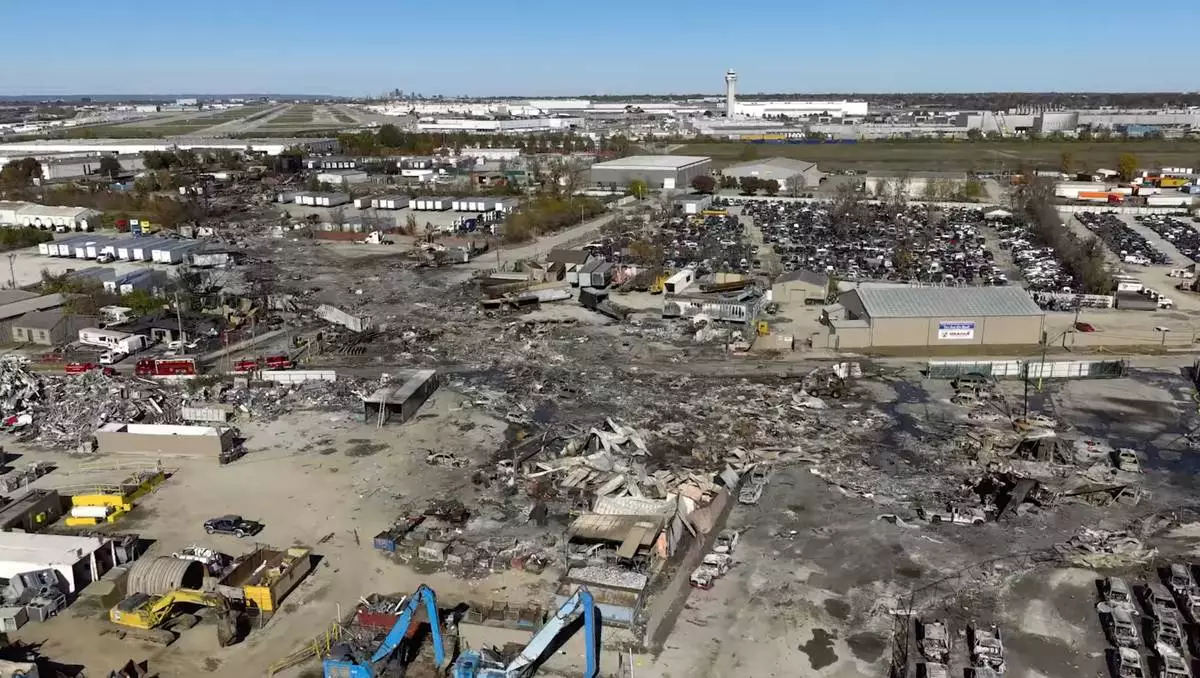
FILE - This photo provided by the National Transportation Safety Board shows UPS plane crash scene, Nov. 6, 2025 in Louisville, Ky. (NTSB via AP, File)

FILE - This photo provided by the National Transportation Safety Board shows UPS plane crash scene, Nov. 6, 2025 in Louisville, Ky. (NTSB via AP, File)

FILE - Plumes of smoke rise from the area of a UPS cargo plane crash at Louisville Muhammad Ali International Airport, Nov. 4, 2025, in Louisville, Ky. (AP Photo/Jon Cherry, File)

FILE - Plumes of smoke rise from the area of a UPS cargo plane crash at Louisville Muhammad Ali International Airport, Nov. 4, 2025, in Louisville, Ky. (AP Photo/Jon Cherry, File)

IRVINE, Calif.--(BUSINESS WIRE)--May 19, 2026--

TrustedTech, a Microsoft Managed Partner and leading provider of Microsoft cloud solutions and IT modernization services, today unveiled a striking paradox at the center of enterprise AI adoption: the most senior leaders in organizations are not only driving AI usage, but are also the most frequent users of unapproved tools, creating significant and largely unmonitored security risks.

This press release features multimedia. View the full release here: https://www.businesswire.com/news/home/20260519849160/en/

As organizations race to adopt AI technologies, the findings highlight a growing disconnect between policy and behavior at the highest levels of leadership. While companies continue to focus on controlling employee usage, TrustedTech’s data shows the real exposure is originating in the boardroom.

According to the report:

This combination of high usage, high awareness, and low adherence to policy underscores a critical issue: AI adoption is not being driven from the bottom up, it is being accelerated from the top down, often outside the boundaries of corporate governance.

“The conversation around AI risk has been focused in the wrong place,” said Julian Hamood, Founder of TrustedTech. “Organizations have been trying to control employee behavior, but what this data shows is that leadership teams are moving faster than the policies designed to guide them. When executives are using unapproved tools to move quickly, it creates a ripple effect across the entire organization.”

The findings suggest that senior leaders are not only aware of the risks associated with Shadow AI, but are actively participating in the very behaviors they seek to regulate. This dynamic creates a culture of mixed signals, where policies exist on paper but are not reflected in practice, leaving organizations exposed to data leakage, compliance gaps, and security vulnerabilities.

At the same time, the data reinforces that AI usage is no longer experimental, it is embedded in daily workflows. With nearly half of all professionals using unapproved tools and the vast majority acknowledging associated risks, organizations face an urgent need to rethink how they approach governance, visibility, and control.

“This isn’t about stopping AI adoption, it’s about bringing structure to something that’s already happening,” added Hamood. “Companies need visibility into how AI is being used across every level of the organization, especially at the leadership level, where the impact of decisions is the greatest.”

TrustedTech works with organizations to help them navigate this evolving landscape by providing the strategic guidance, governance frameworks, and technical expertise needed to adopt AI responsibly, ensuring that innovation does not come at the expense of security or compliance. For more information about TrustedTech and its Microsoft cloud licensing solutions and support, visit trustedtechteam.com

For the full whitepaper report, “Shadow AI in the workplace,” please visit:
https://www.trustedtechteam.com/pages/shadow-ai-whitepaper-download

ABOUT TrustedTech

TrustedTech is a leading Microsoft Cloud Solutions Provider (CSP) specializing in Microsoft Cloud support services, perpetual licensing, and comprehensive professional services for medium and enterprise-sized organizations. TrustedTech is a member of the Microsoft Partner Network to ensure the delivery of industry-leading customer experiences. Known for combining competitive pricing with licensing optimization, TrustedTech excels at helping IT teams navigate complex Microsoft 365 and Azure environments. Its teams across the U.S.and U.K are highly certified Microsoft architects and engineers are among the world’s top experts, resolving advanced technical challenges faster than typical industry SLAs. TrustedTech has achieved all available Microsoft Solutions Partner designations in the Microsoft Cloud Partner Program and continues to expand its capabilities to support customers through AI adoption, cloud modernization, and digital transformation initiatives.

Shadow AI in the Workplace - TrustedTech’s data shows the real exposure is originating in the boardroom.

Shadow AI in the Workplace - TrustedTech’s data shows the real exposure is originating in the boardroom.

Recommended Articles