The China-Europe jointly developed Solar wind Magnetosphere Ionosphere Link Explorer (SMILE) satellite is set to be the first to image the Earth's magnetic shield with soft X-ray imager (SXI), which is expected to usher in a new era in space weather forecasting and mark a deeper, more exemplary phase in China-Europe space science cooperation.
The satellite was launched into orbit on Tuesday by a Vega-C rocket at the Kourou launch center in French Guiana.
The SMILE mission is the first mission-level, all-round, in-depth collaborative space science exploration project between the Chinese Academy of Sciences (CAS) and the European Space Agency (ESA), aiming to reveal the mysteries of the interaction between the solar wind and the Earth's magnetosphere.
According to the plan, after approximately 42 days of orbital maneuvering following its entry into orbit, the satellite will reach its observation orbit. It will then undergo two months of in-orbit testing before entering a three-year routine scientific observation phase.
The Earth's magnetosphere acts as a "protective umbrella," shielding the planet from direct impacts of the solar wind. However, for a long time, scientists could only observe the magnetosphere locally through in-situ or point measurements, making it difficult to grasp the complete picture.
The core scientific objective of the SMILE mission is to achieve, for the first time, global imaging observations of solar wind-magnetosphere interactions, presenting the complete chain of how solar wind energy enters, propagates through, and dissipates within the Earth's space.
To realize this goal, the mission employs a groundbreaking design: it carries the world's first spaceborne SXI, which can transform the previously "invisible" magnetospheric boundary into images.
Additionally, the satellite carries an ultraviolet auroral imager (UVI), a light ion analyzer (LIA), and a magnetometer (MAG). This observation system enables simultaneous global-scale imaging to track magnetospheric evolution while measuring in situ solar wind physical parameters, providing unprecedented observational capabilities for studying space weather processes such as magnetic storms and substorms.
"The matter and energy of the solar wind may impact the Earth's space environment, which we also call space weather. Space weather has a serious impact on our space activities, communications and navigation. Our satellite was launched to understand how the matter and energy of the solar wind enter the Earth's space, thereby significantly improving our space weather forecasting capabilities and providing scientific support," said Wang Chi, an academician of CAS, and Chinese principal investigator of the SMILE satellite.
Originating from a cooperative initiative jointly launched by CAS and ESA in 2015, the SMILE project has established an equal, mutually beneficial and complementary mechanism for cooperation.
During in-orbit operations, Chinese and European scientists will jointly conduct data processing and analysis, with scientific data openly shared with research institutions worldwide.
"After the launch, once the data are transmitted, China and Europe will jointly receive and analyze them. In accordance with international practice, all of these data will be made available to scientists worldwide," Wang said.
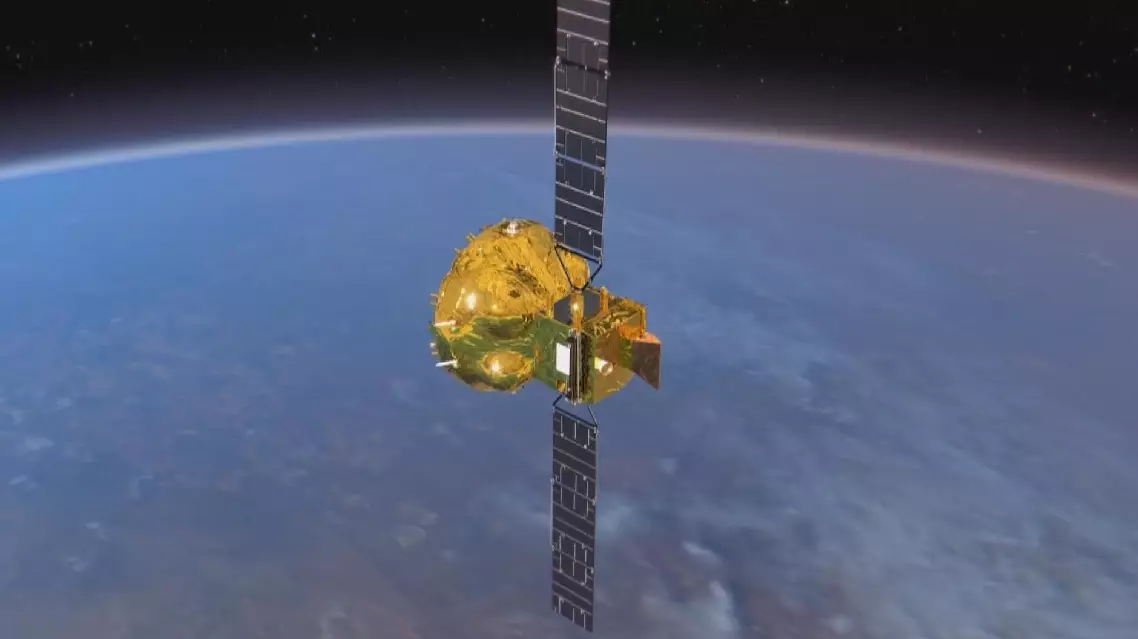
SMILE satellite to be first to image Earth's magnetic shield with X-ray vision: expert