TALLINN, Estonia (AP) — A NATO fighter jet shot down a Ukrainian drone over southern Estonia on Tuesday, authorities said.
It was the latest in a string of similar incidents in recent months, in which Ukrainian drones aimed at Russia have crossed or come down in NATO territory. Western officials previously blamed what they say is likely Russian electronic jamming of the drones.
Ukraine apologized for the “unintended incident,” without specifying what had happened.
Given the trajectory of the drone, “we decided that we need to take it down,” Estonian Defense Minister Hanno Pevkur said, adding that it was “most probably ... meant to hit some Russian targets.” The drone was downed by a Romanian F-16 deployed with NATO.
Estonian Foreign Minister Margus Tsahkna said in a statement that his country has not granted Ukraine permission to use its airspace for attacks on Russia.
Russia, meanwhile, repeated a threat it has made in the past that it would retaliate if Ukrainian drones are launched from Baltic countries or if those countries are complicit in their use against Russia.
A recent escalation of long-range strikes came after a May 9-11 ceasefire that U.S. President Donald Trump said he asked the warring countries to observe but which had little impact.
Fighting along the 1,250-kilometer (780-mile) front line in eastern and southern Ukraine, where Russia’s bigger army is engaged in a slow slog, is continuing. There is no sign a peace settlement is any closer despite U.S. diplomatic efforts.
Ukraine has steadily ramped up its drone raids against Russia, focusing on energy facilities and arms factories deep inside enemy territory as its domestic technology and scale of production improve. Russian drones aimed at Ukraine have also apparently strayed into neighboring NATO countries such as Poland and Romania.
On Sunday, authorities in Russia said that one of the largest Ukrainian drone strikes on the country killed at least four people, including three near Moscow, and wounded a dozen others.
Long-range drone attacks are a hallmark of the war, which began more than four years ago when Russia launched a full-scale invasion of neighboring Ukraine.
Experts from Ukraine and Estonia were working on measures to prevent such occurrences in the future, Ukrainian foreign ministry spokesman Heorhii Tykhyi said.
Ukraine apologizes “to Estonia and all of our Baltic friends for such unintended incidents,” Tykhyi said in an X post.
Estonia's defense minister said that Ukraine has been advised to be careful.
“Our messages have not changed,” Pevkur said. “We’ve said to the Ukrainians all the time that if you’re attacking Russian positions or Russian targets, then these trajectories have to be as far from the NATO territory as possible.”
The strikes have caused some tensions within the Baltic states, which are supporting Ukraine's war effort, and between them and Russia.
Russia’s Foreign Intelligence Service, known by its acronym SVR, claimed Tuesday, without providing evidence, that Ukraine is preparing to begin launching drone attacks against Russia from the territory of the Baltic countries and warned of retaliation.
It claimed Ukrainian military personnel had already deployed to Latvia and warned that the country’s membership in NATO wouldn’t protect it from “just retribution.”
“Modern surveillance systems allow precise determination of the coordinates of the drone launch site,” the SVR said.
Last week, Latvia's government collapsed. The prime minister resigned after the defense minister was forced to quit over the handling of multiple incidents involving stray drones suspected to be from Ukraine, and his party withdrew its support.
Latvian President Edgars Rinkēvičs posted on X that “Russia is lying about Latvia allowing any country to use Latvian airspace and territory to launch attacks against Russia or any other country.”
Ukrainian forces struck a Russian refinery and an oil pumping station over the past 48 hours, Ukraine’s General Staff said Tuesday.
Russian news agencies quoted the Russian Defense Ministry as saying that its air defenses intercepted 315 Ukrainian drones over Russian regions, the illegally annexed Crimea and the Azov Sea overnight.
Russia attacked Ukraine with 209 drones overnight, killing five civilians and wounding 24 others, Ukrainian officials said.
Geir Moulson in Berlin, Samya Kullab in Kyiv, Ukraine, and Barry Hatton in Lisbon, Portugal, contributed to this report.
Follow the AP’s coverage of the war in Ukraine at https://apnews.com/hub/russia-ukraine

Estonia's Defense Minister Hanno Pevkur speaks with the media as he arrives for a meeting of EU defense ministers at the European Council building in Brussels, Tuesday, May 12, 2026. (AP Photo/Virginia Mayo)
Federal safety investigators opened two days of hearings Tuesday to examine why the engine flew off a UPS cargo plane last year, causing a crash that killed 15 people, and why Boeing didn’t address an underlying flaw sooner.
The engine separated from the MD-11's wing as it accelerated down the runway Louisville’s Muhammad Ali International Airport in November. The crash killed three pilots on the plane and 12 people on the ground. More were injured.
“Please know: Your loved ones are the reason we’re here. We want to find out what happened,” Jennifer Homendy, chair of the National Transportation Safety Board, said as she addressed families during her opening remarks.
Separately, more details emerged as the NTSB released more than 2,000 pages of documents related to the disaster. The ill-fated plane was pressed into service after a fuel leak sidelined the original plane, investigators said, and the flight crew shared good-natured banter with the maintenance team during the second pre-flight inspection about “meeting again” so soon.
The hearings at the NTSB headquarters in Washington involve rounds of questions and answers among board members, investigators, and representatives of Boeing, UPS, the mechanics' union and other parties. The NTSB's final report likely won’t be ready until more than a year after the crash because it will look at every potential factor.
Here's what you should know:
The UPS plane, which was headed for Hawaii loaded with packages and fuel, had barely left the ground and cleared the airport fence when it crashed into several nearby Louisville businesses and created a massive fireball.
Dramatic photos the NTSB released after the crash showed the engine detaching and flying up and over the wing as flames erupted on the wing. The final images show the plane ablaze as it briefly gets airborne, leaving behind trails of smoke.
All MD-11s and DC-10s, a predecessor aircraft, were grounded after the crash. NTSB investigators said Tuesday that similar part flaws were found in three other UPS planes and a DC-10.
The Louisville disaster was reminiscent of a 1979 crash in Chicago involving a DC-10. The left engine also fell off in that crash, which killed 273 people and led to the worldwide grounding of 274 DC-10s.
The airliner returned to the skies because the NTSB determined that maintenance workers had damaged the plane that crashed while improperly using a forklift to reattach the engine. That meant the crash wasn’t caused by a fatal design flaw even though there had already been a number of accidents involving DC-10s.
But even at that point, the plane's manufacturer, McDonnell Douglas, raised concerns about the spherical bearing that helps hold the engines to the wings. McDonnell Douglas later merged with Boeing.
The NTSB said shortly after the Louisville crash that investigators had found cracks in some of the parts that held the engine to the wing. Those cracks hadn’t been caught in regular maintenance done on the plane, which raised questions about the adequacy of the maintenance schedule. The last time those key engine mount parts were examined closely was in October 2021, and the plane wasn’t due for another detailed inspection for roughly 7,000 more takeoffs and landings.
Boeing had documented in 2011 there were four previous failures on three different planes of a part that helps secure the MD-11’s engines to the wings, but at that point the plane manufacturer “determined it would not result in a safety of flight condition.”
The service bulletin that Boeing issued didn’t require plane owners to make repairs like an FAA airworthiness directive would, and the agency didn’t issue such a directive. At that point, Boeing just recommended replacing the bearings with a redesigned part that was less likely to fail.
Some MD-11s, a workhorse of the cargo fleet, are now back in the air after the FAA approved Boeing's plan to replace the spherical bearing on each aircraft and increase inspections.
FedEx resumed using the planes to deliver packages on May 10, but UPS has said it plans to retire its fleet of MD-11s. Western Global also uses MD-11s but hasn’t said what it plans to do.
Some experts speculated after the crash that the MD-11s might never fly again if the repair proved to be more expensive that it was worth in these older planes. But Boeing said it found a way to address the safety concerns simply by replacing the bearing and stepping up inspections.
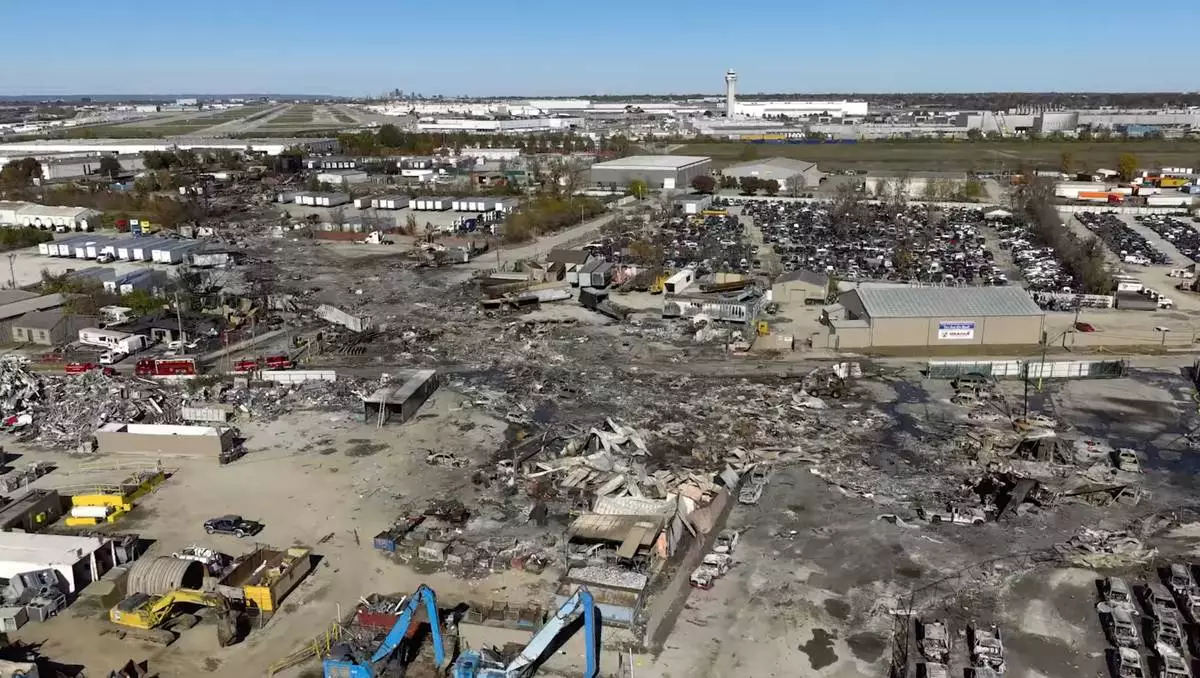
FILE - This photo provided by the National Transportation Safety Board shows UPS plane crash scene, Nov. 6, 2025 in Louisville, Ky. (NTSB via AP, File)
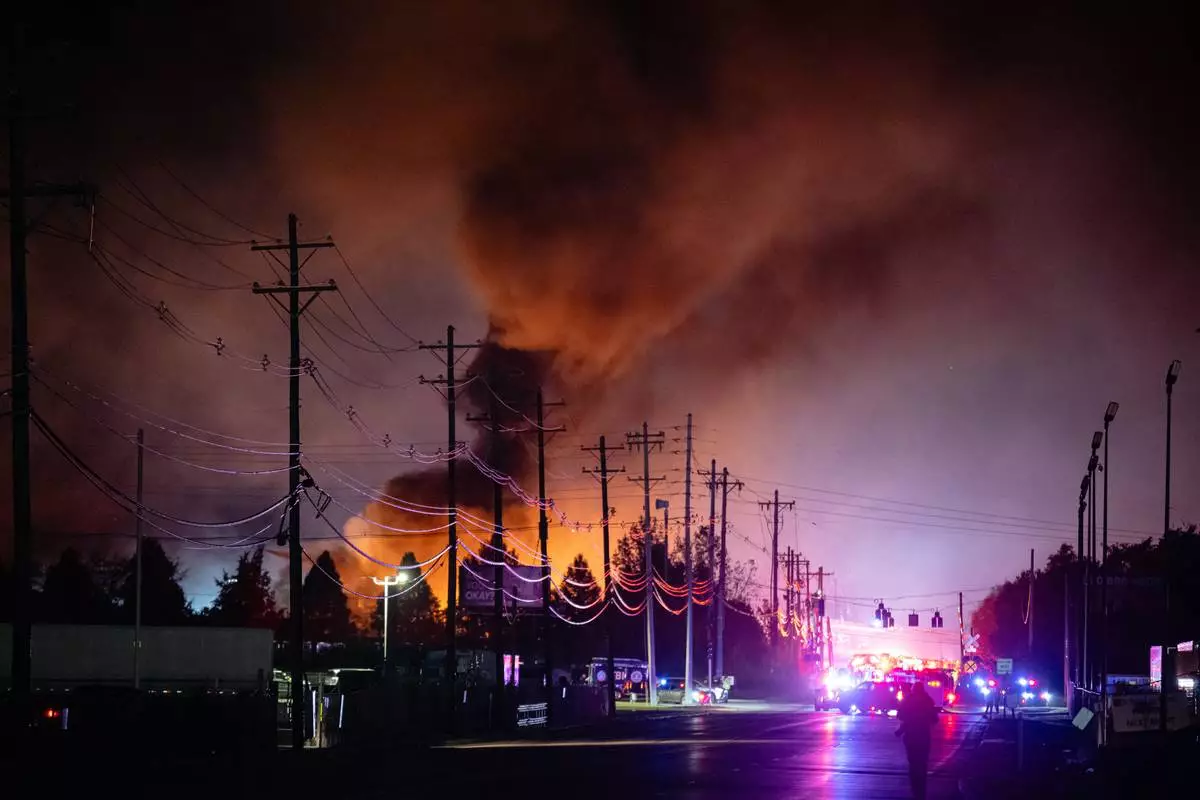
FILE - Plumes of smoke rise from the area of a UPS cargo plane crash at Louisville Muhammad Ali International Airport, Nov. 4, 2025, in Louisville, Ky. (AP Photo/Jon Cherry, File)