LONDON (AP) — British police said Tuesday they will ask prosecutors to consider charging 57 people and 20 organizations with criminal offenses over the Grenfell Tower blaze, almost a decade after the deadliest fire in Britain's modern history killed dozens.
The Metropolitan Police said files of evidence will be submitted to prosecutors by the end of September, with charging decisions by June 14, 2027 — the tenth anniversary of the London tragedy, which killed 72 people.
Bereaved families and survivors said justice delayed any further would be unacceptable. A damning public inquiry has found that the deaths were avoidable, and that a combination of dishonest companies, incompetent regulators and failures by government led the building to be covered in combustible external cladding.
"We have waited almost a decade for accountability," said Grenfell United, a group representing some bereaved families. “No family should have to wait over 10 years for justice for their loved ones, if it comes at all."
Police said the offenses being considered include corporate gross negligence manslaughter, fraud and health and safety breaches.
It said officers had gathered 165 million electronic files and looked at the role of 15,000 individuals and 700 organizations relevant to the investigation, making it the largest and most complex inquiry the force has ever carried out.
The fire at Grenfell Tower broke out in the early hours of June 14, 2017, in a fourth-floor apartment and raced up the 25-story public housing building like a lit fuse, fueled by flammable cladding panels on the exterior walls. It was the worst fire disaster in Britain since World War II, and the victims included retirees and 18 children.
The public inquiry in 2024 said companies that made the tower's cladding used cheap and unsafe materials and engaged in “systematic dishonesty,” and that the failures were exacerbated by complacent officials who did not adequately enforce safety standards.

FILE - A woman passes a construction wall with written messages near Grenfell Tower in London, Wednesday, Oct. 30, 2019. (AP Photo/Frank Augstein, file)
RANCHO PALOS VERDES, Calif. (AP) — It’s no stretch to say that in the battle of wills, visions and, yes, national titles being waged across the college-sports landscape, the Big Ten has taken the lead.
Leaders in the conference currently holding the football, men’s and women’s basketball titles opened their annual spring meeting Monday with nothing more than the future of their business on the agenda.
“It seems like we’re paddling beneath the surface and we don’t really know what direction we’re going in,” said coach Dusty May, whose Michigan men’s basketball team won the championship a mere six weeks ago. “There’s no easy solution to this. There’s no logical solution. There’s going to have to be some give and take.”
A few big-ticket items have, in fact, been resolved over the past month:
— The NCAA expanded March Madness from 68 to 76 teams and opened a new $300 million revenue stream to fund it through beer and wine sponsorships.
— The College Sports Commission won the first big arbitration case in a test of its authority to enforce rules governing name-image-likeness payments to athletes that are now the norm — and are putting college sports programs in financial jeopardy.
Even those issues, however, aren’t fully resolved — for example, will the arbitration decision involving Nebraska football players lead to a lawsuit? — and they only scratch the surface of what's yet to be hashed out.
Whatever conclusions the Big Ten comes to this week will only be one piece of the puzzle. The SEC gathers next week in meetings that will direct their own league’s business with a view of the wider picture in mind.
The size of the College Football Playoff seems to be the most digestible of the thus-far intractable standoffs, but still, there’s no resolution on the horizon.
In this, the Big Ten also seems to have taken a step forward. A year ago, the conference stood alone in advocating for a move from 12 to 24 teams, while the SEC’s more-limited suggestion, a move to 16 teams, felt like a more plausible option, and one commissioner Greg Sankey is still standing by.
But in the past few weeks, the Atlantic Coast and Big 12 conferences, along with the American Football Coaches Association, have all signaled their preference for 24 teams, which would provide more access.
“If you’re going to ask presidents and chancellors and boards to continue to invest in their football programs, it’s really important that they have hope,” ACC commissioner Jim Phillips said last week.
Expansion would also likely bring about the need to abolish conference title games, which are increasingly meaningless and would be more so in, say, a world where the first- through fourth-place teams in every conference end up in the playoffs.
Another unchanged element: The Big Ten and SEC have all the power in this conversation and they do not agree. The upcoming season’s playoff will be a 12-team affair and the (plausibly movable) deadline to change for 2027 is Dec. 1.
The start of the Big Ten meeting came while debate continued in Washington about legislation that could provide stability.
But late Monday night, the so-called SCORE Act got abruptly pulled off the schedule in the House rules committee in the latest delay for a bill that has languished in Congress for more than a year. Opponents, mostly Democrats, don’t want to give the NCAA the limited-liability protection it seeks, along with other elements they fear will undercut the rights of players.
The postponement came shortly after the Congressional Black Caucus added a new twist, pointing to the recent Supreme Court ruling that opened the door for Southern states to eliminate Black-majority voting districts as a reason to object.
“At the very moment those same communities face coordinated attacks on their democratic representation, too many leaders across college athletics have chosen silence,” the caucus said in a statement.
Meanwhile, negotiations continue between the two big-name policymakers on the issue in the Senate — Ted Cruz, R-Texas, and Maria Cantwell, D-Wash. If they come up with a bill that could garner the 60 votes needed to pass the upper chamber, it would likely be the closest thing anyone has seen to something that could actually become a law.
The NCAA is moving closer to changing eligibility rules as we know them by eliminating most redshirt seasons and giving most players five years to complete five seasons of eligibility.
In a world in which athletic departments are struggling to allocate a shifting amount of funds ($20.5 million in revenue sharing from the schools combined with untold millions from third parties), having a better gauge of how long players will be at their schools is seen as helpful.
“We probably all look out for our own self-interest too often,” said May, who won the title with a roster full of transfers. “But at Michigan, if we do take a transfer, that gives us a chance to almost assure them they’re going to get their degree while they’re still on scholarship.”
The NCAA would also like to stop getting sued over eligibility rules, though without action from Congress, this one would appear to open a whole new set of lawsuits.
Underpinning all this discussion is the future of NIL and the agency created to police it -- the CSC.
The “participation agreement” the commission sent out to Power 4 schools late last year hasn't been signed by all, which brings into question the commission's ability to function as a robust enforcement arm.
The CEO, Bryan Seeley, will be in town Tuesday to present to the conference athletic directors.
Last week, news of the arbitration win came as he was doing the same at the ACC. He called it a win, but hardly the final say on the matter, some of which revolves around schools unwilling or unable to sign away their ability to take legal action.
Get poll alerts and updates on the AP Top 25 throughout the season. Sign up here and here (AP News mobile app). AP college football: https://apnews.com/hub/ap-top-25-college-football-poll and https://apnews.com/hub/college-football
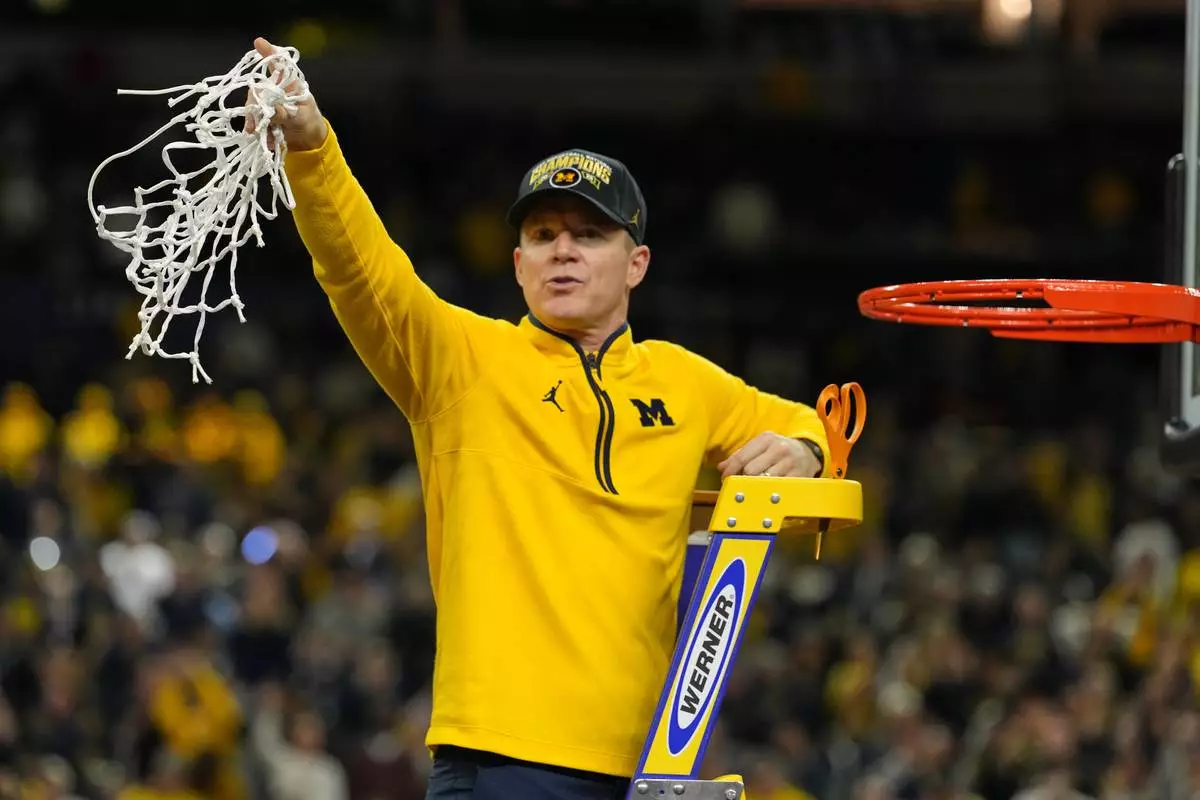
FILE - Michigan head coach Dusty May celebrates by cutting down the net after defeating UConn in the NCAA college basketball tournament national championship game at the Final Four, April 6, 2026, in Indianapolis. (AP Photo/Michael Conroy, File)
FILE - The Big Ten logo is seen on the field at Husky Stadium during an NCAA college football game, Oct. 25, 2025, in Seattle. (AP Photo/Lindsey Wasson, File)