Rising nearly 4,000 meters above sea level in southwest China's Xizang Autonomous Region, the Xigaze International Land Port has transformed into a bustling gateway, where the daily rhythm of engines and air brakes signals a booming trade route connecting China to South Asia.
Xigaze, once considered a remote destination at the end of the line, is now becoming a vital regional hub. Here, thousands of Chinese-made electric vehicles (EVs) and smart electronics are crossing the mountains into Nepal, taking one of the world's highest trade routes to market.
The journey has become significantly smoother for those navigating these heights. Duoji, a truck driver who has been on this route for twenty years, recalled when the job was far more arduous. Thanks to improved infrastructure and vehicles, the travel time from Lhasa to the Zhangmu Port has been cut in half.
"Cars are way better now compared to before, and the roads are great too. It used to take around four days to get from Lhasa to Zhangmu Port. Now it's much easier; it just takes about two days," he said.
The cargo traveling these roads has also evolved dramatically. Where once only small consumer goods crossed the border, today's shipments include sophisticated electronics and sleek electric vehicles manufactured in eastern China. In just ten days, these vehicles can travel from factories thousands of kilometers away to dealerships in Kathmandu, Nepal.
This remarkable speed and efficiency are centered at the Xigaze International Land Port, where business has been booming in recent years. In the first quarter of 2026 alone, Xigaze's export volume of new energy vehicles surged by over 25 percent year on year.
For Nepalese buyers, Chinese EVs offer an unbeatable combination of quality, affordability and accessibility.
"I like this Chinese brand. The cars are very easy to drive, and we can buy parts also, we can get easily, and near Nepal," said a Nepalese auto dealer who regularly visits the port.
A key factor behind this trade boom is the dramatic improvement in customs efficiency. At the port's advanced inspection area, a single customs scan now takes just two to three minutes from start to finish, with no need for unloading or repacking.
"By working closely with border ports like Gyirong and Zhangmu, we now handle customs and inspections just once, putting an end to the old hassle of repeated reloading," explained Duobjie, an officer with Xigaze Customs.
Inside the sprawling port complex, goods from across China are sorted and prepared for their journey south over the Himalayas. From small consumer products to auto parts and Tibetan specialty items, everything is streamlined for rapid delivery.
But this trade route runs in both directions. While Chinese EVs roll into Nepal, Nepalese herbs, handwoven clothing and traditional crafts are finding an eager market in China.
Tsering Nyima, a Nepalese trader, recognized this opportunity early. In 2019, he partnered with Pemba Dolma, a local Xigaze trader, to open a Nepali goods store right on the border.
"First, my duty is to bring something from Nepal. And then she sells here in China, and we together do business. Now it's good," said Nyima.
Dolma has leveraged digital tools to expand their business even further, taking advantage of favorable border policies.
"Locals enjoy an 8,000 yuan (about 1,177.38 U.S. dollars) daily duty-free quota, saving over 3,000 yuan in taxes monthly. Since few Nepalese do livestreaming, I help sell their goods this way with great success," she explained.
Xigaze's strategic location at the crossroads of overland routes into South Asia makes it uniquely positioned to capitalize on the region's growing consumer market. Five of Xizang's six overland trade ports are located here, connecting China to one of the world's fastest-growing economic regions.
In 2025, the region's total goods trade reached about 8.5 billion yuan, spanning 155 countries and regions.
Saturday marks the 75th anniversary of the peaceful liberation of Xizang. Over the past decades, Xizang has undergone a profound transformation across various fields.
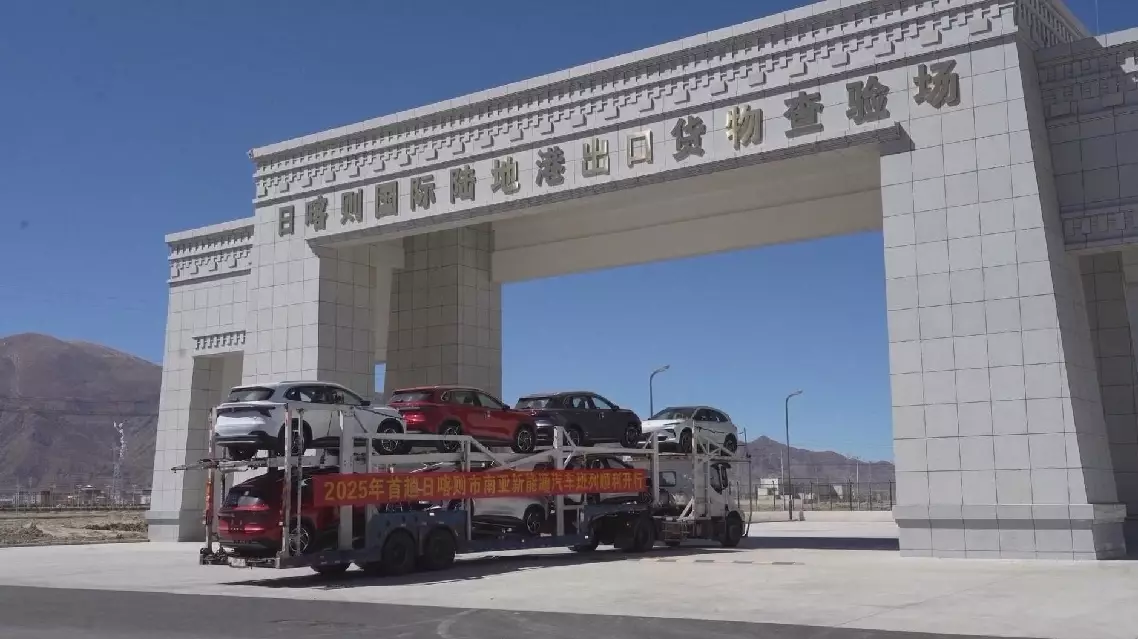
Xizang int'l land port emerges as vital hub for trade between China, South Asia