China's elderly care robot industry is projected to surpass 10 billion yuan (about 1.47 billion U.S. dollars) in 2026, with the market maturing and transitioning from technological verification phase to large-scale application, according to a report released on Tuesday by China's Ministry of Industry and Information Technology (MIIT).
According to the MIIT, the rapid expansion of the market is being driven primarily by an aging population and the mismatch between the supply and demand for elderly care services.
"As the aging process of the population continues to accelerate, the shortage of nursing staff becomes a long-term challenge and the demand for intelligent technologies and products among the elderly becomes increasingly urgent. Intelligent elderly care service robots have emerged as an innovative solution to traditional aging-related issues, and their future market potential is expected to be very broad," said Liu Wenqiang, vice president of the China Center for Information Industry Development.
After years of development, China's elderly care robot industry has built a full-fledged industrial chain ecosystem -- covering everything from research and development of core components and complete machine manufacturing to system integration and operational services.
Continuous breakthroughs have been made in key human-robot interaction technologies including multimodal perception, AI algorithms, and high-precision motion control. Domestically produced products have now reached internationally advanced levels in core functions such as fall detection, remote monitoring, and rehabilitation training.
The capabilities of these robots have expanded far beyond early basic tasks such as cleaning or meal delivery. Today, they offer a broad range of services -- including daily living assistance, health monitoring, emotional companionship, rehabilitation support, and helping to move or transfer seniors. That makes them suitable for the diverse needs of elderly individuals with different health conditions.
"Through recent years of follow-up research, continuous efforts are needed in areas such as technology, application scenarios, standards, and safety to rapidly improve the quality of robots. It is important to guide the integration and application of new technologies, like large AI models, new materials, and secure human-robot interaction, into elderly care service robots, while optimizing and upgrading them based on the specific pain points and needs of the elderly population," said Liu.
Forecasts indicate that professional nursing institutions will remain the largest market for elderly care robots, accounting for about 50 percent of demand. Community-based elderly care follows with roughly 30 percent.
While home-based care currently accounts for the smallest share, approximately 20 percent, it is seeing the most significant growth.
The elderly care robot sector is growing at an average annual rate of about 32 percent, while the market for companion robots is seeing even faster growth, at around 42 percent per year.
By 2025, China's population aged 60 and above had reached 323.38 million, with more than 130 million seniors living alone or as so-called "empty-nesters" whose children have moved out of the family home.
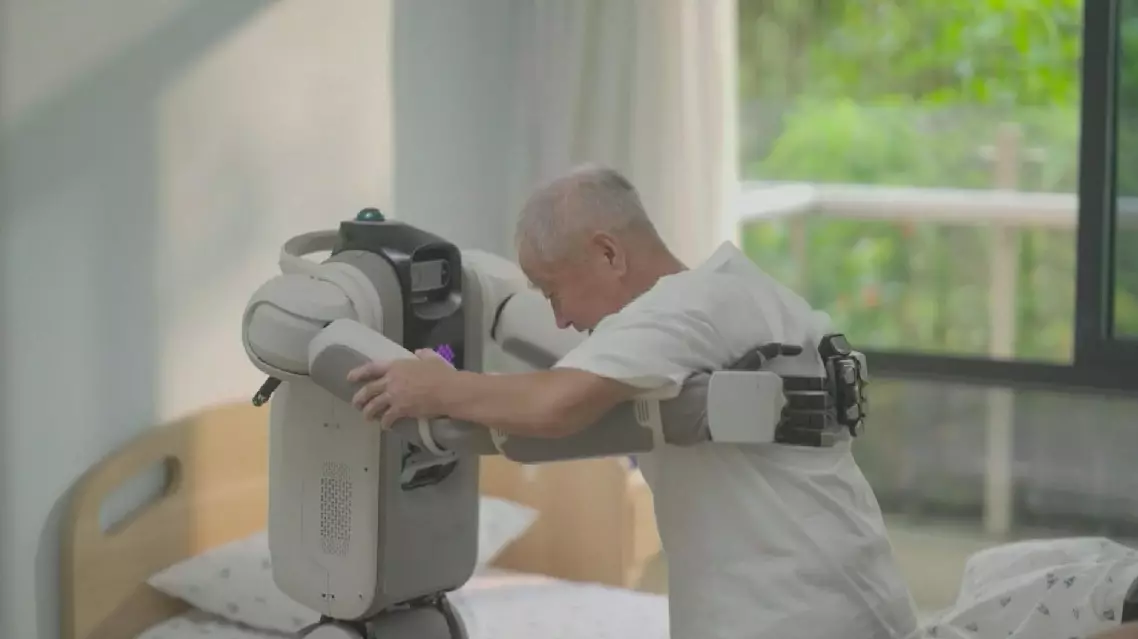
China's elderly care robot market growing rapidly: report